Korea Business Review · Section
ESG
Premium
ESG MARKET & CASES
ESG Dedicated Organizations: Time to Establish or Disband?
The questions are changing—the buzzword for 2026 is no longer whether there is a separate ESG department, but rather the simultaneous realization of two trends: on one hand, CSO and dedicated organizations being absorbed or reorganized into other functions, and on the other, 'internalization' across the entire company. Globally, it is a 'restructuring' rather than a 'retreat.' While some worry that CSO roles are being absorbed by CFO, risk, and legal departments, hiring demand and budgets remain robust, marking a shift from non-financial areas into the mainstream of management. The core issue is integration versus dilution. The moment ESG becomes 'everyone's job,' there is a risk that it degrades into 'no one's job' without authority and budgets, and side effects like greenhushing are reported. In Korea's reality, the establishment of ESG committees among the top 500 companies surpassed the halfway mark, rising from 53.7% in 2023 to around 57% recently (with significant industry deviations). The Financial Services Commission has presented a roadmap draft initiating mandatory disclosure starting in 2028 for assets of 30 trillion won or more beginning in February 2026, shifting the weight toward 'internalization and execution.' The essence lies in the structure of authority, data, and responsibility rather than the mere presence of a department. The real question should not be 'Do we have an ESG department?' but 'Is ESG actually changing our decision-making?'
이지영 기자 · 06/22/2026
Read more →
ESG Policy & Strategy
Why Climate Risk Must Be Brought to the Boardroom
강지혜 선임기자 · 06/16/2026

ESG MARKET & CASES
Casebook on ESG Controversies: How Rating Downgrades, Boycotts, and Lawsuits Occur
KBR 편집부 · 06/16/2026
ESG MARKET & CASES
ESG Management: The U.S. Retreats, Europe Simplifies, and South Korea Finally Reaches the Starting Line
강지혜 선임기자 · 06/15/2026

ESG Policy & Strategy
Are Korean Companies' ESG Management Strategies Properly Aligned with Global Standards?
KBR 편집부 · 06/11/2026
ESG MARKET & CASES
Examining ESG Among Global Enterprises: Strategies and Realities of Leading Companies
Amid the changing global ESG environment, global leading companies such as Apple, Microsoft, and Unilever, along with key domestic corporations including Samsung Electronics, Hyundai Motor Company, POSCO, and SK Hynix, are implementing ESG strategies tailored to their respective industry characteristics. Consumer goods and manufacturing ESG: The war on supply chains and plastics. Unilever: Transparency in goal adjustment and tangible performance. The rise of honest ESG communication: Cases of 'honest ESG' are increasing, where companies transparently disclose realistic adjustments and the reasons behind them—such as Microsoft admitting to emission increases and Unilever revising its plastic targets—rather than clinging to unachievable goals, thereby building trust instead.
강지혜 선임기자 · 06/10/2026
ESG MARKET & CASES
The Illusion That "K-ETS Makes Us Fine": The Blind Spot Revealed by CBAM Article 9
In the first full-scale year of the EU Carbon Border Adjustment Mechanism (CBAM), the common belief that "having K-ETS means we are fine" is only half true. The real level of protection is determined not by possessing a system, but by the actual carbon price paid and the quality of verified data. As the EU CBAM entered its full operational phase on January 1, 2026, the long-held assumption inside Korean industry that the K-ETS would largely offset burdens at the EU border has necessitated a reassessment. According to European Commission guidance, CBAM operated as a transitional phase focused purely on reporting obligations from October 1, 2023, to December 31, 2025, but transitioned to a cost system requiring importers to purchase and surrender certificates starting in 2026. The core issue is not whether South Korea operates an emissions trading system, but what carbon costs the EU actually recognizes under CBAM.
김민경 책임기자 · 06/09/2026

ESG Policy & Strategy
The Era of the "Second Financial Statement" Begins — Significance of Korea's Finalized ESG Disclosure Roadmap and Corporate Tasks
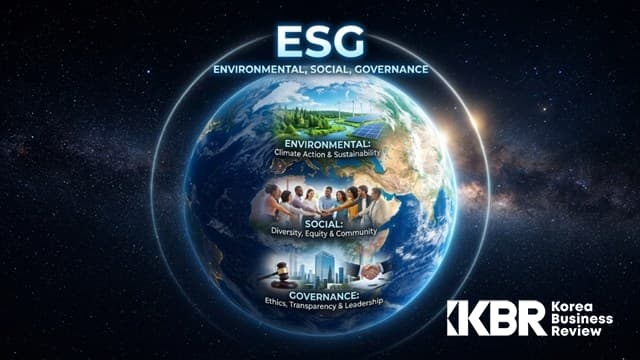
ESG is an international standard framework for corporate sustainability composed of three pillars: Environmental, Social, and Governance. In 2026, Korea officially transitioned this framework into a mandatory disclosure system through the finalization of KSSB standards and the announcement of the Financial Services Commission roadmap. [Image = Korea Business Review DB] 5 Years of Drifting, Finally Dropping Anchor
KBR 편집부 · 05/07/2026
ESG Policy & Strategy
ESG Management Set to Become a Condition for Survival by 2030
Korean exporters shipping six carbon-intensive items, including steel and aluminum, to Europe must prove the carbon emissions generated during production and bear the corresponding costs. The time has come for a fundamental shift in how Korean companies view ESG.
이우리 기자 · 04/28/2026

ESG MARKET & CASES
The Reshaping of ESG: 2026 Ushers in the 'Era of Trust'
A quiet revolution is underway. As of 2026, the global landscape surrounding ESG appears superficially fractured. Anti-ESG sentiment is surging at the U.S. federal level, and policy shifts by the Trump administration are casting uncertainty over the sustainable finance market.
류현진 기자 · 04/23/2026