Korea Business Review · Section
AI / TECH
Standard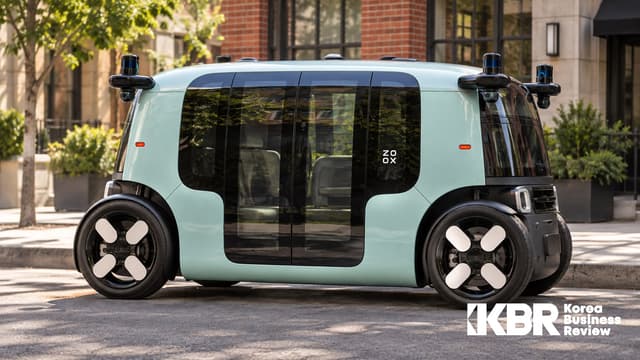
AI / Tech
Amazon's Zoox Opens the Door to Commercial Robotaxis: The Next Competition After Driverless Driving Is Profitability
Introducing paid services for steering-wheel-free dedicated vehicles and partnering with Uber, Zoox's moves show that the autonomous driving race is shifting from technology demonstrations to urban operations.
강지혜 Editor · 09/20/2026
Read more →
AI / Tech
How the EU Right to Repair is Reshaping Post-Sale Competition: Exporters Must Redesign Parts and Services From the Ground Up
이우리 Editor · 09/18/2026

AI / Tech
The Next Bottleneck for AI Data Centers is the Power Grid
류현진 Editor · 09/15/2026
AI / Tech
Why Did Google Contract with Nuclear Power Plants? The Power Grid Map of the AI Competition
박소유 책임기자 · 09/14/2026

AI / Tech
Waymo at 500,000 Weekly Rides, Tesla Cybercab... The Autonomous Driving War Has Truly Begun
박찬호 선임기자 · 09/10/2026
AI / Tech
Qualcomm and Amazon Partner on AI Chips Tied to Up to $60B: Will Nvidia's Monopoly Be Shaken?
Qualcomm and Amazon will jointly develop multi-generation custom semiconductors for AI inference and 1.6T-class optical interconnect solutions. The $60 billion figure is not a confirmed Amazon purchase order, but a maximum payout tied to the phased vesting of Qualcomm warrants. Despite AWS custom chip revenues exceeding an annual run rate of $25 billion, AWS is broadening its procurement portfolio by adding an external custom chip supplier. While Nvidia's position is unlikely to be shaken in the short term, the expansion of the inference market and the growth of hyperscaler custom chips are long-term variables. Opportunities may arise for South Korean memory, foundry, and optical interconnect companies, but Qualcomm's manufacturing and memory suppliers for Amazon-bound chips have not yet been disclosed.
이지영 기자 · 09/09/2026
AI / Tech
GPT-6 Astra Reignites 'AI Replacement' Fears: Why the U.S. is Nervous First and the Impact on South Korean Industry
Following OpenAI's release of GPT-6 Astra, concerns have resurfaced in the U.S. that AI agents could replace certain corporate software tasks, triggering a revaluation of software company valuations. With U.S. corporate AI adoption already at 17-20% and reaching 37% for enterprises with over 250 employees, the industrial foundation for agentic AI is taking shape. South Korea is a direct beneficiary of expanding existing AI infrastructure investments, as seen in August semiconductor exports surging 209% year-over-year to $46.65 billion. Conversely, if AI begins directly manipulating enterprise software, industries with a high proportion of repetitive knowledge work—such as SaaS, SI, consulting, accounting, and HR—face mounting pressures to restructure pricing and workforce models. The Korea Development Institute (KDI) estimates that generative AI could cumulatively increase South Korea's total factor productivity by 1.5% to 3.5% over the next decade, while simultaneously suggesting downside pressures on employment in medium- and high-skilled occupations.
류현진 선임기자 · 09/09/2026

AI / Tech
Why NVIDIA Bet $12.9 Billion on Hugging Face: The Reality of Open-Weight AI
NVIDIA agreed to acquire Hugging Face for $12.93 billion on September 3, with regulatory reviews and other procedures remaining before the actual transaction closes. Open-weight AI discloses model weights but not necessarily the training data and training code, distinguishing it from open-source AI. A core reason companies review open-weight models is not merely cost reduction, but data control and managing dependency on specific AI operators. Hugging Face serves as an open-model distribution infrastructure utilized by more than 3 million models and 18 million developers, for which NVIDIA proposed a corporate value of $12.93 billion. A key focal point following the acquisition is whether Hugging Face can maintain its existing neutrality and openness without leaning toward specific NVIDIA hardware.
KBR 편집부 · 09/05/2026

AI / Tech
Where Do Advanced Global Companies Stand on AI Transformation? The Widening Gap Between 'Deep Transformation' (34%) and 'Surface-Level Adoption' (37%)
According to a Deloitte survey conducted in August–September 2025 and released in January 2026, only 34% of global enterprises are in the deep transformation stage of fundamentally reimagining business models with AI, while 37% remain at surface-level adoption, revealing a stark performance gap. A McKinsey survey released in November 2025 shows that while 88% use AI, enterprise-wide value creation remains limited to a few, with only 39% reporting an impact on EBIT (mostly under 5 percentage points of improvement). JPMorgan Chase has accumulated nearly a decade of experience since 2017—from COiN (saving 360,000 hours annually) to the 2024 LLM Suite (deployed to over 230,000 employees)—now operating 450 use cases, with CEO Jamie Dimon citing up to $2 billion in annual business value. Siemens leads manufacturing AX with industrial AI agents and digital twins, establishing 2026 as a 'starting point' with its Erlangen plant as the initial blueprint, alongside a successful 8-hour autonomous logistics demonstration using humanoid robots in April. Common traits among high-performing companies include workflow redesign, proactive governance, and parallel growth goals, while key focal points for the second half of the year include the disparity in adoption speeds across industries (including healthcare's 'fast to explore, slow to deploy' pattern) and the standardization of ROI measurement frameworks.
이우리 선임기자 · 08/12/2026

AI / Tech
Where Does China's Manufacturing AI Automation Stand? The Gap Between Mass Robot Deployment and Early Humanoid Commercialization
According to the IFR, 54% of global new industrial robot installations (approximately 295,000 units) were concentrated in China in 2024, and production in the first half of 2025 increased by 35.6% year-on-year, sustaining the growth trend. Humanoids remain in the early commercialization stage; UBTech's contract with Airbus is a single-robot proof-of-concept, and its breakthrough past "1,000 units produced" actually translates to about 500 units delivered. UBTech itself stated that the work efficiency of the Walker S2 reaches at most half that of a human, and over 70% of Unitree's revenue comes from research and education rather than industrial applications. The IFR recalculated China's robot density from 470 down to 166, not because the number of robots decreased, but as a result of updated manufacturing employment statistics. KBR analyzes that South Korea must respond to China not through a robot "headcount" competition, but through the speed of ecosystem design encompassing data, standards, and supply chains.
강지혜 선임기자 · 08/10/2026