Korea Business Review · Section
K KNOWLEDGE
Free
K지식
Why Do Performance Evaluations Fail Even When Changed? 4 Conditions for Designing an Evaluation System Tailored to Our Organization
The core of performance evaluation lies not in choosing between relative and absolute grading, but in how clearly and fairly members accept goals and the evaluation process. A McKinsey survey showed that linking goals with business priorities, manager coaching, and performance-based compensation are closely correlated with evaluation effectiveness. When applying evaluation systems to Korean organizations, one must consider not only whether forced distribution is used, but also organization size, work performance cycles, evaluator competency, and collaboration structures. Rather than combining performance and competency into a single score, one can also consider using them from different perspectives: performance for compensation, and competency for development and placement. As a practical starting point prior to a complete system overhaul, establishing goal alignment, regular 1-on-1 check-ins, and the accumulation of evaluation evidence should be settled first.
KBR경영연구소 · 09/23/2026
Read more →
K지식
What Is an Inclusive Wage System? The Standards for Overtime Pay Included in Monthly Salaries and Additional Payments
강지혜 Editor · 09/21/2026

K지식
How Much More Must We Sell at a 10% Discount? Why Profits Can Shrink Even When Sales Increase
이우리 Editor · 09/16/2026

K지식
Why Working Capital Increases While Cash Remains Short
KBR경영연구소 · 09/15/2026

K지식
Can We Put Company Secrets into ChatGPT? The Absolute Boundaries of Information You Must Never Tell AI
강지혜 선임기자 · 09/12/2026
K지식
Employment Contracts, Annual Salary Contracts, and the Labor Standards Act: Which Prevails?
Employment and annual salary contracts are agreements between parties, but they cannot fall below the minimum standards set by the Labor Standards Act (Articles 3, 4, and 15 of the Labor Standards Act). The minimum wage for 2026 is set at 10,320 won per hour (2,156,880 won per month), and contract provisions falling short of this are automatically voided, with statutory standards applying instead (Ministry of Employment and Labor Notice No. 2025-47). The hierarchy of documents runs from the Constitution to the Labor Standards Act, collective agreements, rules of employment, and employment contracts, but if a lower-level document contains more favorable conditions, that part prevails (Principle of Priority for Favorable Conditions, contrary interpretation of Article 97 of the Labor Standards Act). An annual salary contract is a separate agreement specifying or modifying wage conditions, but provisions violating mandatory regulations, such as an annual salary scheme including severance pay, are generally void (Supreme Court Full Bench Decision 2007Da90760 delivered on May 20, 2010). The Supreme Court Full Bench decision in December 2024 abolished the 'fixity' requirement in calculating ordinary wages, opening the way so that ordinary wage status cannot be excluded solely by a tenure-condition phrase in a contract.
박찬호 선임기자 · 08/12/2026

K지식
Blistering Korean Peninsula: How Much Hotter Has South Korea Become Over the Past Decade?
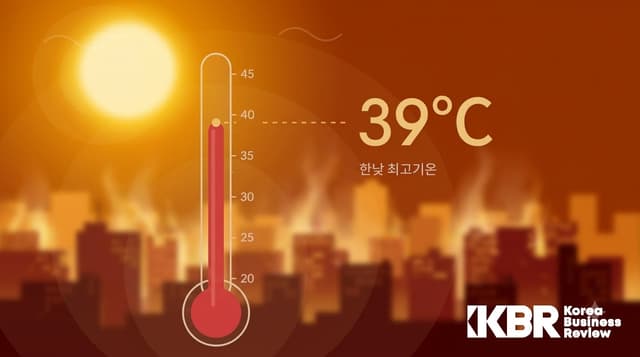
South Korea's annual average temperature has distinctly shifted upward over the past decade, rising from 13.4℃ in 2016 to 14.5℃ in 2024, the first time it entered the 14℃ range and the highest on record. Record highs were concentrated in recent years, with 2023 (13.7℃), 2024 (14.5℃), and 2025 (13.7℃) ranking 1st to 3rd historically. In the summer of 2025, the nationwide average temperature hit a record 25.7℃, and the average daily maximum temperature reached an all-time high of 30.7℃. Furthermore, Yangsan recorded 41.4℃ on July 31, 2026, and 41.6℃ on August 1, surpassing Hongcheon's 2018 record of 41.0℃ to set a new all-time high temperature. The normalization of extreme heat—marked by a restructured three-tier heatwave warning system featuring the new 'severe heatwave warning' and the earliest-ever first fatality on the opening day of heat-related illness monitoring—is expanding into a structural variable across institutional, health, and industrial sectors.
강지혜 선임기자 · 08/02/2026
K지식
Same AI, Different Results: Core Principles of Prompt Writing According to Experts
Criticism is mounting that even when using the same AI, the quality of results and work processing speed vary depending on how prompts are written. Experts highlight six core principles: providing context, assigning roles, specifying output formats, presenting examples, inducing step-by-step thinking, and iterative correction. However, generative AI is not free from hallucinations where it plausibly fabricates non-factual information, requiring separate verification for important figures and facts. While core principles apply commonly to most models, service-specific results may vary slightly due to differences in system settings and tool integration methods. Ultimately, even as tools evolve, the user's communication capability to clearly convey what is desired remains the core variable determining the quality of the output.
이우리 선임기자 · 06/30/2026

K지식
How Strategy and Tactics Differ: The Crucial Distinction Between Designing Victory and Executing It
Strategy is a high-level concept that determines where an organization will win in the long term, while tactics are the specific execution methods used to achieve that goal. Strategy addresses long-term, comprehensive direction, whereas tactics are short-term, field-oriented action plans that flexibly adjust to changing circumstances. In the perspectives of both Sun Tzu and Carl von Clausewitz, strategy is distinguished as achieving the overarching purpose of an entire war, while tactics are the execution methods for individual battles. In modern management, strategy is a matter of market positioning and choice, while tactics are execution tools such as campaigns, pricing, channels, and programs. Ultimately, tactics without strategy is busywork without a purpose, and strategy without tactics is a plan that is never executed, meaning the two concepts must always work together.
박찬호 선임기자 · 06/27/2026

K지식
What is AX? A Transformation That Changes Not Just Tools, But 'How We Work'
AI Transformation (AX) goes beyond simply adding AI to a few tasks, representing a shift in which organizations completely redesign their ways of working around AI. While DX (Digital Transformation) focused on 'automation' by moving analog to digital, AX enters an 'autonomy' stage where AI learns, predicts, and judges on digitized data, with both concepts existing on a continuum rather than as opposites. Approximately 65% of global companies already utilize AI in daily operations (McKinsey, 2024), and governments and domestic companies like Samsung and Daesang have declared '2026 the First Year of AX' to accelerate the transition. The core of AX lies in 'redesigning work' beyond mere 'efficiency,' requiring a balanced interlock of four key elements: data, infrastructure, people (AI literacy), and culture. Because it can begin in small work units without massive investments, it presents an opportunity particularly for small and medium-sized enterprises, shifting the core question from 'Will we adopt AI?' to 'How will we redesign our work?'
이태민 책임기자 · 06/23/2026