Korea Business Review

Korea Business Review · Section

ESG

Premium

Beyond Paper Checks: Hyundai Motor's Supply Chain ESG Moves to On-Site Verification at Mines and Smelters

ESG MARKET & CASES

Beyond Paper Checks: Hyundai Motor's Supply Chain ESG Moves to On-Site Verification at Mines and Smelters

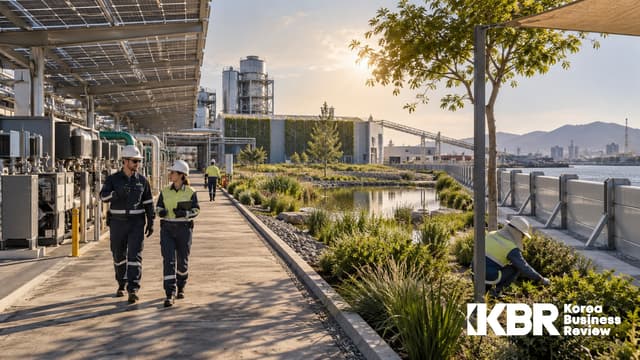
Hyundai Motor conducted ESG written assessments for 2,086 suppliers and on-site audits for 25 suppliers in 2025, while 25 suppliers with potential regulatory violations completed corrective action plans. Independent third-party RCS Global audited 3 mines and smelters in the Democratic Republic of Congo and Indonesia, identifying 58 non-conformities (47 major, 11 minor), with corrective actions currently underway. Legal experts generally view the EU Omnibus Directive, which took effect in March 2026, as clarifying risk-based due diligence rather than simply reducing audit volume. Through a mutual growth agreement signed with the Korea Fair Trade Commission in July, primary suppliers are paid within an average of 10 days post-closing instead of the statutory 60 days, while tier-2 and tier-3 suppliers are supported through training, incentives, and shared growth payments (benefiting an estimated 5,500+ companies). Despite achievements such as achieving RE100 across all operations in Europe, North America, and India, expanding the depth of in-depth audits and securing visibility into tier-2 and tier-3 suppliers remain future tasks.

류현진 선임기자 · 08/10/2026

Read more →
More Stories

ESG Policy & Strategy

Carbon Footprint Is No Longer 'Feel-Good Marketing' — It Becomes a 'Second Cost' in 2026

With the full implementation of the CBAM in January 2026 and the finalization of the KSSB in February, the carbon footprint has shifted from a 'measurement target' to an object of 'payment and reporting.' The EU CBAM imposes carbon costs on the import of six categories including steel and aluminum, with the certificate price for the first quarter announced at 75.36 euros per ton (April 2026). As the CSRD, Green Claims, and Digital Product Passport (DPP) intersect, regulatory focus is narrowing beyond company-wide levels to questioning the carbon of a 'single product' (PCF). South Korea will begin disclosures starting with KOSPI-listed companies with assets of 30 trillion won or more in 2028 (FY2027), while providing a three-year grace period until 2031 for Scope 3, which is the most challenging. Ultimately, companies equipped with verifiable carbon data infrastructure will reduce costs and gain bidding leverage, meaning the grace period is a 'preparation period,' not an 'exemption.'

이우리 선임기자 · 06/24/2026

Carbon Footprint Is No Longer 'Feel-Good Marketing' — It Becomes a 'Second Cost' in 2026

ESG MARKET & CASES

ESG Dedicated Organizations: Time to Establish or Disband?

The questions are changing—the buzzword for 2026 is no longer whether there is a separate ESG department, but rather the simultaneous realization of two trends: on one hand, CSO and dedicated organizations being absorbed or reorganized into other functions, and on the other, 'internalization' across the entire company. Globally, it is a 'restructuring' rather than a 'retreat.' While some worry that CSO roles are being absorbed by CFO, risk, and legal departments, hiring demand and budgets remain robust, marking a shift from non-financial areas into the mainstream of management. The core issue is integration versus dilution. The moment ESG becomes 'everyone's job,' there is a risk that it degrades into 'no one's job' without authority and budgets, and side effects like greenhushing are reported. In Korea's reality, the establishment of ESG committees among the top 500 companies surpassed the halfway mark, rising from 53.7% in 2023 to around 57% recently (with significant industry deviations). The Financial Services Commission has presented a roadmap draft initiating mandatory disclosure starting in 2028 for assets of 30 trillion won or more beginning in February 2026, shifting the weight toward 'internalization and execution.' The essence lies in the structure of authority, data, and responsibility rather than the mere presence of a department. The real question should not be 'Do we have an ESG department?' but 'Is ESG actually changing our decision-making?'

이지영 기자 · 06/22/2026

ESG Dedicated Organizations: Time to Establish or Disband?

ESG Policy & Strategy

Why Climate Risk Must Be Brought to the Boardroom

Climate risk is shifting from an operational duty for environmental teams to a top-tier agenda that must be directly overseen by the board of directors, now evaluated as a financial risk and opportunity rather than non-financial information. Succeeding the TCFD, the ISSB and South Korea's KSSB Disclosure Standard No. 2 place 'Governance' first among their four core elements, requiring disclosures on board and management oversight responsibilities, reporting frequency, and the linkage of climate targets to compensation—effectively making climate risk a mandatory boardroom agenda item. As South Korea's Financial Services Commission pushes for mandatory disclosures starting after 2026, building the internal capacity to handle repeated annual quantitative disclosures like scenario analyses is critical, a matter requiring board approval given its control over budgets and organization. In global governance discussions, the view that climate oversight failures could lead to breaches of directors' duty of care and legal risks is spreading (such as Delaware jurisprudence and ISS standards), though interpretations vary by jurisdiction and it should be noted that South Korea's legal system does not automatically adopt them. Recognizing that 'climate risk is investment risk' and that investors read board oversight systems as valuation metrics, companies need to calmly prepare through three measures: regularizing board agenda items, clarifying oversight responsibilities, and linking targets to compensation.

강지혜 선임기자 · 06/16/2026

Why Climate Risk Must Be Brought to the Boardroom

ESG MARKET & CASES

Casebook on ESG Controversies: How Rating Downgrades, Boycotts, and Lawsuits Occur

ESG controversies inflict tangible damage on corporations through three pathways: rating downgrades, consumer boycotts, and regulatory lawsuits. Rating agencies like MSCI evaluate firms on a seven-tier scale from AAA to CCC, with lower grades excluding companies from investment capital inflows. Namyang Dairy Products faced boycotts due to distributor coercion, owner risks, and the 'Bulgaris' controversy, paying the price of plunging sales and the end of nearly 60 years of family management. DWS's exaggerated ESG disclosures ($25 million settlement) and global greenwashing sanctions and class-action lawsuits demonstrate that false eco-friendly claims translate directly into costs and reputational damage. Because these three pathways are interconnected and chain into one another, ESG must be treated as practical management infrastructure rather than a formal committee.

KBR 편집부 · 06/16/2026

Casebook on ESG Controversies: How Rating Downgrades, Boycotts, and Lawsuits Occur

ESG MARKET & CASES

ESG Management: The U.S. Retreats, Europe Simplifies, and South Korea Finally Reaches the Starting Line

In 2026, global ESG entered a diverging phase where the U.S., EU, and South Korea are pursuing entirely different regulatory directions for the same concept. The U.S. has effectively withdrawn federal climate disclosure rules, fragmenting ESG around state-level regulations and investor demands. The EU has reduced the scope of CSRD and CSDDD and eased disclosure burdens while maintaining core principles such as double materiality and third-party assurance. South Korea has begun transitioning from voluntary disclosure to a statutory disclosure system through the finalization of KSSB standards and a phased mandatory roadmap starting in 2028. Korean companies must simultaneously manage EU supply chain requirements, KSSB compliance, and investor demand from the U.S. market, viewing ESG not merely as regulatory compliance but as infrastructure for global competitiveness.

강지혜 선임기자 · 06/15/2026

ESG Management: The U.S. Retreats, Europe Simplifies, and South Korea Finally Reaches the Starting Line