Korea Business Review · Section
RESEARCH NOTES
Premium
KBR Research Notes
Even When U.S. Industrial Production Stagnates, Manufacturing Declines: Why Facility Investments Cannot Be Decided by Average Indicators
The preliminary U.S. industrial production figures for August 2026 simultaneously show overall flatness and a decrease in manufacturing. It is necessary to distinguish the denominators of production levels, rates of change, and capacity utilization rates, and connect macroeconomic statistics to investment decisions for customer industries and bottleneck processes.
강지혜 Editor · 09/24/2026
Read more →
KBR Research Notes
Expanding High-Speed Rail Seats by 116,000 Weekly: How Much Will It Ease KTX Booking Struggles?
이태민 Editor · 09/18/2026
KBR Research Notes
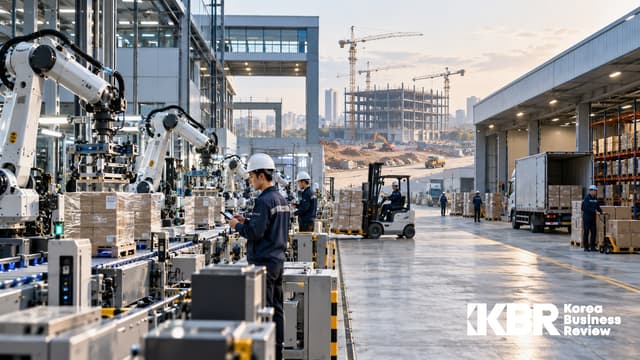
Facility Investment Rose 7.5% While Consumption Dropped 2.4%: The Temperature Gap in Recovery Shown by July Industrial Indicators
김민경 Editor · 09/18/2026

KBR Research Notes
U.S. Productivity Rose, But Labor Costs Also Increased: The Cost Structure Revealed by Q2 BLS Indicators
이태민 Editor · 09/17/2026

KBR Research Notes
Why Is Financing Still Difficult Even Though SME Loans Have Increased? Interest Rates, Collateral, and Investment Attraction Through OECD Financial Indicators
KBR경영연구소 · 09/16/2026
KBR Research Notes
Analyzing External Audit Corporations' Operating Profit Margin of 16.9%: The Gap Between Manufacturing and Non-Manufacturing
Against the backdrop of improved performance among external audit corporations in the second quarter of 2026, this article analyzes the profitability differences between manufacturing and non-manufacturing, as well as large enterprises and SMEs. It distinguishes the comparison periods for growth rates, profit margins, and debt ratios, connecting them to corporate order, cost, and cash plans.
이우리 Editor · 09/15/2026

KBR Research Notes
EVs Double, Tesla Hits 10,000 Units, While Hybrids Plateau: Automotive Market Shifts Require Distinguishing Between Cumulative Growth and Monthly Fluctuations
Changes in the domestic automotive market are revealed more through gaps between power sources and brands than through overall sales growth rates. Based on the Ministry of Trade, Industry and Energy's provisional data for January through July and August import car data, this article analyzes the expansion of electric vehicles (EVs), the sustained scale of hybrids, and Tesla's concentration on the Model Y. Cumulative growth and short-term fluctuations are distinguished using year-over-year comparisons by power source, registration comparisons by model, and a three-month trend graph by brand.
박소유 책임기자 · 09/14/2026

KBR Research Notes
Exports Hit $98.3 Billion with Semiconductors Accounting for 48%: Three Signals Hidden Behind Record Highs
South Korea's exports in August 2026 reached $98.25 billion, up 68.7% year-on-year. Semiconductor exports stood at $46.65 billion, representing 47.5% of the total, with chips accounting for approximately 78.9% of the total export increase. While non-semiconductor exports also rose by 20%, automobiles and ships declined, and petroleum products and petrochemicals saw export values increase driven by rising unit prices despite dropping volumes. Cumulative exports surpassed last year's annual total as of September 5, but reaching the $1.0 trillion annual mark remains in the realm of projections. Businesses should examine their own propagation pathways—ranging from prices, volumes, and customers to cash collection—rather than focusing solely on total export figures.
류현진 선임기자 · 09/14/2026

KBR Research Notes
The Era of 300,000 Foreign Students: Why Regional Universities Are Desperate to Attract Overseas Students
Foreign students in South Korea reached 307,464 in 2026, a 21.3% increase from the previous year, surpassing the government's target of 300,000 one year ahead of schedule. Students from Vietnam totaled 96,834, surpassing China for the first time, while 72.6% of all international students are enrolled in degree programs. With the proportion of non-metropolitan students expanding to 47.4%, the importance of foreign students in filling enrollment quotas and managing regional universities is growing. A complex combination of declining school-age populations, university enrollment shortfalls, limited tuition hike capacities, and government policies expanding international student numbers is driving this trend. The government is now shifting its policy direction from merely increasing the number of students toward enhancing educational quality, employment and settlement outcomes, and strengthening the management of underperforming universities.
이태민 책임기자 · 09/13/2026

KBR Research Notes
2.87 Million Foreign Residents, 1.11 Million Employed: Foreign Labor Fills the Gaps in South Korea's Manufacturing Sector
As of the end of June 2026, the number of foreign residents in South Korea increased to 2,874,278, bringing the milestone of 3 million within reach. Foreign employment reached a record high of 1,109,000 in May 2025, with an employment rate of 65.5%. Mining and manufacturing account for 44.9% of employed foreigners, who are heavily concentrated in major industrial cities such as Siheung, Ansan, Hwaseong, and Pyeongtaek. Although the government reduced the E-9 introduction quota for 2026 to 80,000, the influx of foreign nationals continues through existing resident populations, international students, and seasonal work programs. The rise of foreign workers should be interpreted not merely as an immigration phenomenon, but as an economic indicator reflecting a shrinking working-age population, manufacturing labor shortages, and shifting regional industrial structures.
이우리 선임기자 · 09/13/2026