Korea Business Review

ai-tech

Where Does China's Manufacturing AI Automation Stand? The Gap Between Mass Robot Deployment and Early Humanoid Commercialization

According to the IFR, 54% of global new industrial robot installations (approximately 295,000 units) were concentrated in China in 2024, and production in the first half of 2025 increased by 35.6% year-on-year, sustaining the growth trend. Humanoids remain in the early commercialization stage; UBTech's contract with Airbus is a single-robot proof-of-concept, and its breakthrough past "1,000 units produced" actually translates to about 500 units delivered. UBTech itself stated that the work efficiency of the Walker S2 reaches at most half that of a human, and over 70% of Unitree's revenue comes from research and education rather than industrial applications. The IFR recalculated China's robot density from 470 down to 166, not because the number of robots decreased, but as a result of updated manufacturing employment statistics. KBR analyzes that South Korea must respond to China not through a robot "headcount" competition, but through the speed of ecosystem design encompassing data, standards, and supply chains.
강지혜 선임기자Published 2026년 8월 10일Updated 2026년 8월 12일
Share
Where Does China's Manufacturing AI Automation Stand? The Gap Between Mass Robot Deployment and Early Humanoid Commercialization

According to the IFR, 54% of global new industrial robot installations (approximately 295,000 units) were concentrated in China in 2024, and production in the first half of 2025 increased by 35.6% year-on-year, sustaining the growth trend. Humanoids remain in the early commercialization stage; UBTech's contract with Airbus is a single-robot proof-of-concept, and its breakthrough past "1,000 units produced" actually translates to about 500 units delivered. UBTech itself stated that the work efficiency of the Walker S2 reaches at most half that of a human, and over 70% of Unitree's revenue comes from research and education rather than industrial applications. The IFR recalculated China's robot density from 470 down to 166, not because the number of robots decreased, but as a result of updated manufacturing employment statistics. KBR analyzes that South Korea must respond to China not through a robot "headcount" competition, but through the speed of ecosystem design encompassing data, standards, and supply chains.

Industrial Robots Have Already Expanded to the World's Largest Scale While Humanoids Remain in the Pilot Stage: Production Forecasts and Field Operations Must Be Viewed Separately


Artificial intelligence (AI) automation in China's manufacturing sector moves at different speeds depending on the domain. Industrial robots and smart factories have already been deployed on the world's largest scale, while humanoid robots are rapidly increasing pilot deployments and early commercialization cases in automotive, logistics, and electronics manufacturing sites. According to the International Federation of Robotics (IFR), approximately 295,000 industrial robots—accounting to 54% of newly installed industrial robots worldwide—entered Chinese factories in 2024, pushing China's operational inventory of industrial robots past the 2 million mark. Because the IFR's annual installation statistics are structured to be published every September based on the previous year's performance, 2024 is currently the most recent confirmed figure available. Annual statistics for 2025 will be released after September 2026. However, according to the National Bureau of Statistics of China, industrial robot production in the first half of 2025 increased by 35.6% year-on-year to approximately 370,000 units, indicating that the growth momentum continued into 2025. China's Ministry of Industry and Information Technology (MIIT) forecasted that domestic humanoid robot production will exceed 100,000 units in 2026. Nevertheless, "production," "shipments," and "field operations" are distinct concepts, and these differences must be discerned to grasp the actual coordinates of China's manufacturing AI. KBR outlines the current state of China's manufacturing AI across three fronts: the large-scale expansion of industrial robots, the early commercialization of humanoids, and the optical illusions created by policies and statistics.


Already Expanded Domains: Industrial Robots and Smart Factories

The starting point for China's manufacturing automation is the exhaustion of cheap labor. With the shrinking working-age population, rising labor costs, and the younger generation's aversion to manufacturing jobs, Chinese factories have accelerated robot adoption since the mid-2010s. "Made in China 2025," announced in 2015, designated robots as one of the top 10 fostering industries and pushed for the localization of core components such as reducers, servo motors, and controllers that previously relied on imports. As a result, the sales share of domestic brands in China's domestic robot market rose from 47% in 2023 to 57% in 2024, surpassing foreign brands for the first time.

Building upon this foundation, the recent shift has moved beyond mere "mechanization"—increasing the number of robots—toward "intelligentization," where the center of gravity shifts to AI analyzing and judging production, quality, equipment, and logistics data in real time. According to the MIIT, China established a multi-tiered smart factory rating system comprising roughly 35,000 basic-tier, 8,200 advanced-tier, 500 excellent-tier, and 15 top-tier leading smart factories by the end of 2025. Fifteen companies including Baowu Steel, XCMG, and Haier made the list for the leading tier, with XCMG announcing in December 2025 at the World Intelligent Manufacturing Conference (WIMC) that it had been officially certified by government ministries including the MIIT. According to compilations by Chinese industry research institution Tianxia Gongchang, these 15 companies deployed over 6,000 AI models, with AI scenario coverage exceeding 70%.


The Two Faces of Dark Factories: Xiaomi's Changping and Wuhan

A symbolic site of China's manufacturing AI is Xiaomi's "dark factory" (lights-out factory). The smartphone factory in Changping, Beijing, is a highly automated facility built with an investment of about 2.4 billion yuan (approximately 500 billion to 540 billion KRW) and boasts an annual production capacity of up to 10 million flagship smartphones. Starting with the US IT media outlet BGR, multiple media outlets reported this factory as an unmanned facility with virtually no resident workers on site, and the Chinese government certified it as a national smart manufacturing benchmark.

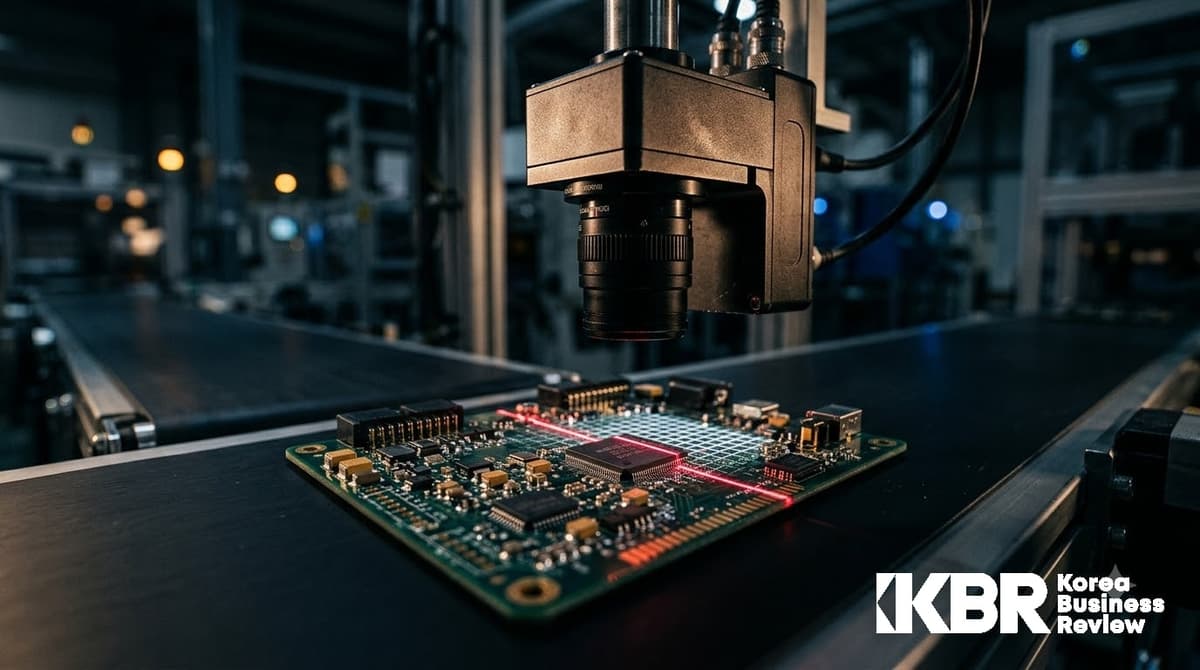
The home appliance factory in Wuhan, Hubei Province, which began operations in October 2025, represents a case where the dark factory model expands beyond smartphones to general household appliances. In a site tour first unveiled to foreign press corps in late December 2025, Xiaomi representatives stated that the automation rate of core production processes at the Wuhan plant (such as Surface Mount Technology or SMT lines) stands at around 97%, with remaining personnel deployed solely to respond to abnormal situations. Producing one air conditioner every 6.5 seconds, the facility relies on its self-developed AI manufacturing platform, "Xiaomi Surge," where 136 AI vision inspection devices catch defects down to the micrometer (㎛) level.


Humanoids, How Far Have They Come? Production and Deployment Are Different Stories

The hottest topic in China's manufacturing AI discourse for 2026 is the humanoid robot. However, accurately interpreting this domain requires distinguishing among production volume, order values, shipment volumes, and actual factory deployment counts. This is because the overall picture varies significantly depending on which of these criteria a company's announced figures represent.

On January 21, 2026, Shenzhen-headquartered UBTech announced via Reuters that it had signed a cooperation agreement with Airbus, the world's largest aircraft manufacturer. Under the agreement, Airbus purchased one unit of UBTech's latest industrial humanoid, the "Walker S2," for pilot application at an aircraft manufacturing site, which Airbus defined as an "initial concept-testing stage." This means it is a demonstration at the level of a single robot rather than a mass supply contract. UBTech announced that as of November 2025, the total value of Walker series orders exceeded 800 million yuan (approx. 150 billion KRW), and subsequent Reuters reports in January stated that the figure surpassed 1.4 billion yuan (approx. 200 million USD). It set a target to expand production capacity to over 10,000 units at maximum for 2026.

On December 26, 2025, UBTech announced that the 1,000th Walker S2 had rolled off the production line at its Liuzhou factory in Guangxi. This tally is based on "production," while the volume actually delivered to customers stands at over 500 units according to company announcements. Even the same number "1,000" takes on different meanings depending on whether the standard is production or delivery.

In terms of efficiency, UBTech itself has acknowledged its limitations. According to the German think tank Merics, UBTech stated in January 2026 that the work efficiency of the Walker S2 reaches at most half that of a human. The US news magazine TIME also reported that current humanoids exhibit productivity levels of 30% to 50% compared to humans in processes such as box handling and palletizing. Unitree stated that more than 70% of its cumulative sales in the third quarter of 2025 came from research and education demand, while the proportion applied to industrial sites stood at just 9%. This represents the revenue composition of Unitree alone and is distinct from the field application rate of China's humanoid industry as a whole.

Despite this gap, policy is directly targeting field deployment. In June 2026, the MIIT and the State-owned Assets Supervision and Administration Commission (SASAC) jointly issued a special action plan for the live training and deployment of humanoid robots and embodied AI. The goal is to uncover over 100 high-value application scenarios and build capacity for a "10,000-unit scale" deployment, shifting humanoids from "performance mode" to "work mode." It is an unusual step for central government ministries to issue a joint document targeting large-scale industrial deployment of humanoids, highlighting clear policy determination. According to multiple reports citing data compiled by market research firm Omdia, global humanoid shipments in 2025 reached approximately 13,000 units, with Chinese companies accounting for 85% to 90% of them. However, this is based on "shipments" and is a separate metric from actual field operating rates.


Policy Engines: "AI+" and the 15th Five-Year Plan

Behind this expansion lies meticulous policy design. In August 2025, the State Council issued opinions on deepening the implementation of "AI+", setting a target to raise the penetration rate of next-generation intelligent applications such as AI agents to over 70% by 2027. Aimed across the broader economy and society, the target is not confined to manufacturing. In January 2026, eight departments including the MIIT separately issued opinions on implementing the "AI+ Manufacturing Special Action," setting manufacturing-specific targets to build 1,000 industrial AI agents, 100 manufacturing datasets, and 500 representative application cases by 2027.

In March 2026, the National People's Congress (NPC) deliberated the draft of the 15th Five-Year Plan (2026–2030), which designates robotics and physical AI as core elements of the modern industrial system. Overseas policy analysis institutions, such as the UK's Bloomsbury Security Institute (BSI), report that a long-term national guide fund of approximately 1 trillion yuan is being promoted in line with this plan to support emerging technologies like AI and robotics. Rather than a single-year fixed budget, this is a long-term capital inducement plan. According to analysis by the Center for Strategic and International Studies (CSIS) compiling Reuters reports, the scale of support including subsidies, loans, and tax credits poured into the robotics industry by the Chinese government between late 2024 and early 2025 exceeded 20 billion USD. A standards preemptive strategy is also running in parallel. In early 2026, China released a comprehensive standards system for humanoids and embodied AI, which is interpreted as a strategic maneuver to establish domestic standards first and expand them into international standards, akin to the cases of 5G and high-speed rail.


The Trap of Numbers: Why Robot Density Dropped from "470" to "166"

Statistics surrounding China's manufacturing automation must be read by distinguishing between publication timing and base years. A prime example is robot density. The figure that China has 470 robots per 10,000 manufacturing workers—surpassing Germany and Japan—has been widely cited. However, data released by the IFR in April 2026 recalculated this figure to 166 by reflecting updated labor market data from the National Bureau of Statistics of China. This places China 22nd globally and 6th in Asia. While the density figure dropped because the denominator of manufacturing employment was adjusted upward, the actual volume of robot installations did not shrink. Rather, it can be read as indicating that the room for automation expansion in Chinese manufacturing remains substantial. Because a single country's ranking can vary greatly depending on which release period is cited, noting both the publishing institution and the timing enhances accuracy when referencing statistics.


Questions Posed to South Korea's Manufacturing Sector

From South Korea's perspective, the crux lies in speed and structure, not the headcount of robots. China is utilizing its world-class manufacturing base itself as an AI testing ground and data collection site, rapidly spinning a virtuous cycle of field deployment → data accumulation → performance improvement → price reduction. As the prices of industrial AI and robots fall during this process, South Korea's robotics and automation companies, as well as its core manufacturing industries across electronics, automobiles, and shipbuilding, could face cost competitiveness pressures. Domestic industrial research institutes diagnose that as China applies AI on a massive scale to traditional manufacturing and aims to preempt physical AI work standards, South Korea is in a golden time to expand its "irreplaceable manufacturing capabilities."

South Korea is also stepping up its response. A manufacturing AI transformation (AX) cooperative body involving the government and enterprises is operating, and Hyundai Motor Group announced at a conference in 2026 its goal to deploy the humanoid Atlas onto factory assembly lines starting in 2028. Heavy reliance on foreign core components and the lack of a system to accumulate data for on-site learning are pointed out as challenges. KBR's analysis shows that China's case demonstrates how ecosystem design encompassing data, standards, and supply chains—rather than the automation of individual factories—is the ultimate battleground.


Outlook and Checkpoints

Key points to watch from the second half of the year onward are threefold. First, whether the MIIT's projected annual humanoid production of 100,000 units is actually achieved, and how much the gap between "production" and "actual factory operation" narrows. Second, how intermediate performance toward the 2027 numerical targets of the "AI+ Manufacturing" special action is verified through official corporate disclosures. Third, whether the humanoid and embodied AI standards system led by China expands into international standardization discussions. Amid ongoing US export controls on advanced semiconductors, whether China can offset advanced chip constraints with massive industrial data and application ecosystems is another watchpoint. AI automation in Chinese manufacturing represents confirmed large-scale expansion in the industrial robot domain, while in the humanoid domain, it remains at the early commercialization stage where policy goals and corporate announcements still outpace on-site performance. Distinguishing between the two is the first step required for South Korean enterprises.

KBR Access

Global Radar 콘텐츠는 Standard 이상 열람할 수 있습니다

이 콘텐츠는 Standard 이상 회원에게 제공됩니다. Standard는 인사이트 4.0, 정책인사이트, Global Radar 등 일반 멤버십 콘텐츠를 이용할 수 있습니다.

이번 달 열람 현황: 0 / 0건 사용