Korea Business Review

ai-tech

Nvidia Unveils the World's First Open-Source Quantum AI Model 'Ising' — AI Becomes the Operating System for Quantum Computers

Nvidia Ising Decoding is a 3D CNN-based model that achieves error-correction speeds up to 2.5 times faster than existing standards. Weight of the Declaration: On April 14, 2026, marking World Quantum Day, Nvidia officially announced 'NVIDIA Ising', the world's first open-source quantum AI model suite.
이우리 기자Published 2026년 4월 20일Updated 2026년 8월 26일
Share
Nvidia Unveils the World's First Open-Source Quantum AI Model 'Ising' — AI Becomes the Operating System for Quantum Computers

Nvidia Ising Decoding is a 3D CNN-based model that achieves error-correction speeds up to 2.5 times faster than existing standards. Weight of the Declaration: On April 14, 2026, marking World Quantum Day, Nvidia officially announced 'NVIDIA Ising', the world's first open-source quantum AI model suite.

Nvidia Ising Decoding is a 3D CNN-based model that achieves error-correction speeds up to 2.5 times faster than existing standards.


Weight of the Declaration


On April 14, 2026, marking World Quantum Day, Nvidia officially announced 'NVIDIA Ising', the world's first open-source quantum AI model suite. This is not simply a software release.

This announcement is interpreted as a strategic declaration by Nvidia, having established a de facto monopoly in the AI semiconductor market, to target quantum computing as its next battlefield and preempt the standards and dominance of the entire ecosystem.

During the announcement, Nvidia CEO Jensen Huang stated, "AI is essential to making quantum computing practical," adding, "Because of Ising, AI will become the control layer of quantum machines, namely the operating system." Just as CUDA became the standard for the AI computing ecosystem, this is a declaration to complete the same framework in quantum computing as well.

Breaking Through the Core Challenges of Quantum Computing with AI


There are structural reasons why quantum computers have long remained a technology 'between theory and reality.' Qubits, the basic units of computation in quantum computers, respond extremely sensitively to external temperature and electromagnetic noise. Currently, qubits experience an error roughly once every 1,000 operations, and for quantum computers to become useful in actual enterprise environments, this error rate needs to be reduced to the one-in-a-trillion level. Bridging this gap has been the core challenge in the commercialization of quantum computing.

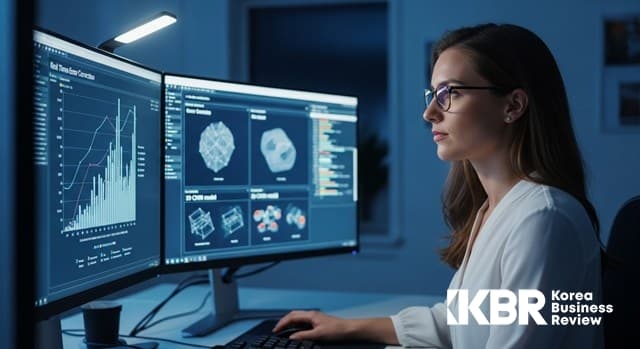
Nvidia has chosen the approach of solving this problem through AI software rather than hardware. Ising consists of two core models. 'Ising Calibration' is a vision-language model that interprets measurement data from quantum processors and automates calibration tasks, while 'Ising Decoding' is a 3D convolutional neural network-based model for real-time quantum error correction.

The model name 'Ising' originates from a statistical mechanics model named after the German physicist Ernst Ising. Just like this mathematical framework, which successfully described the behavior of complex magnetic systems with simple formulas, the name reflects Nvidia's philosophy to simplify complex quantum systems using AI.

Ising Calibration — Reducing Tasks That Took Days to Hours


Ising Calibration is a vision-language model (VLM) with 35 billion (35B) parameters, which supports agent automation of calibration tasks by learning multimodal qubit data. Whenever quantum processors are first started up or their states fluctuate, calibration tasks that researchers previously had to perform manually are handled autonomously by AI agents.

According to Nvidia, quantum processor calibration tasks that previously took days are reduced to a matter of hours following the introduction of this model.

To verify performance, Nvidia directly designed a new benchmark called QCalEval. QCalEval is the world's first VLM benchmark for quantum calibration, consisting of 243 samples across 87 scenario types in 22 experimental groups encompassing superconducting qubits and neutral atoms. In this benchmark, Ising Calibration scored 3.27% higher on average than Gemini 3.1 Pro, 9.68% higher than Claude Opus 4.6, and 14.5% higher than GPT 5.4.

The model architecture is a Mixture-of-Experts (MoE) vision-language model based on Qwen3.5-35B-A3B, adopting a sparsely activated structure where 8 out of a total of 256 expert modules are activated per token. It can be run on data center GPUs such as NVIDIA Grace Blackwell and NVIDIA Vera Rubin, as well as workstation-class equipment like NVIDIA DGX Spark.

Ising Decoding — Real-Time Error Correction Speeds


Ising Decoding is a model that detects and corrects errors occurring during quantum operations in real time. Available in two versions—speed-optimized and accuracy-optimized—they are compact 3D CNN models consisting of approximately 900,000 (0.9M) and 1.8 million (1.8M) parameters, respectively.

Nvidia stated that compared to pyMatching, which is widely used as the open-source industry standard, the speed-optimized model is 2.5 times faster with 1.11 times higher accuracy, while the accuracy-optimized model is 2.25 times faster with 1.53 times higher accuracy. In logical error rate (LER), a core metric in quantum error correction, it added that a 3x improvement over existing methods was verified under another benchmark condition.

Platforms, Not Hardware — Reenacting the CUDA Strategy


The true competitiveness of Ising lies not in the performance of individual models, but in its integration with Nvidia's existing platforms. Nvidia integrated the CUDA-Q platform and NVQLink hardware with Ising to present a hybrid computing standard where GPUs and QPUs (quantum processors) coexist. Regardless of which quantum hardware company dominates the market, the software stack operating on top of it is structured to become entrenched around Nvidia.

While IBM and Google focus on the quantum hardware competition, Nvidia is targeting the quantum market by preempting the software and platforms operating on top of them. This is the exact same strategy used to dominate the AI ecosystem.

The open-source release is also part of this strategy. Ising model weights, datasets, and benchmarks are made available via GitHub, Hugging Face, and build.nvidia.com, along with NIM microservices and cookbooks to enable research institutes and enterprises to fine-tune them for their own quantum hardware architectures. While lowering entry barriers, the structure is designed so that once enterprises adopt it, they cannot easily leave the Nvidia ecosystem.

Korea Is Already Inside This Ecosystem


The reason why this announcement is not a distant story for Korean companies is clear. Korea has already been incorporated as a core partner in building Nvidia's quantum-AI hybrid ecosystem.

The most concrete example is the tripartite cooperation among KISTI (Korea Institute of Science and Technology Information), IonQ, and Nvidia. On March 18, 2026, in San Jose, USA, KISTI signed a 'tripartite memorandum of understanding for quantum-high-performance computing (HPC) hybrid computing technology cooperation and ecosystem vitalization' with NVIDIA and IonQ. The core of the agreement is to directly link IonQ's next-generation trapped-ion quantum computer 'Tempo' (100 qubits) and Korea's national supercomputer No. 6 'Hangang' via NVIDIA NVQLink.

This cooperation was promoted as part of the 'building quantum computing service utilization systems' project supported by the Ministry of Science and ICT, and the Hangang supercomputer is scheduled to begin operations in the second half of 2026.

The main goals of the cooperation are to demonstrate quantum-HPC hybrid applications in core industrial areas such as logistics, chemistry, materials science, and large language model fine-tuning, and to expand Korea's national quantum ecosystem.

In academia, Yonsei University has also been officially listed as an early adopter institution of the Ising model. Given that Samsung and SK are already undergoing large-scale GPU cooperation with the Nvidia AI ecosystem, follow-up investments extending into the quantum ecosystem are highly likely.

Market Response and Critical Perspectives


Immediately following the Ising announcement, quantum computing-related stocks surged across the board. IonQ and D-Wave Quantum rose by more than 50% compared to the beginning of the week, while Rigetti Computing and Quantum Computing rose by over 30% each.

However, sober perspectives coexist. Robert Lee, an analyst at Bloomberg Intelligence, evaluated that "While these tools can contribute to accelerating development speed, considerable time is needed before large-scale quantum computing is actually utilized in industries." KB Securities pointed out that while viewing "the quantum computing industry as having entered the commercialization trajectory in 2026, with 2029 as the core turning point," one must keep in mind that most pure-play quantum computing companies are currently recording losses.

There are also technical objections regarding the benchmarking methodology. QCalEval, used for the performance comparison of Ising Calibration, was newly crafted by Nvidia because no pre-existing verification standards commonly accepted by the industry existed for it. A certain reservation is required until independent third-party verification accumulates.

Checkpoints: What Korean Companies Must Prepare For


The global quantum computing market is projected to grow to $11 billion by 2030. Nvidia is solidifying its position in this market not merely as a component supplier, but as a platform standard setter.

The task for Korean companies is to determine their position within this ecosystem right now.

While KISTI and Yonsei University's preemptive participation is a meaningful start, expanding the demonstration scope of quantum-AI hybrid computing into industrial fields such as semiconductors, materials, finance, and logistics must be followed by enterprise-led investment decisions.

In an industrial structure where the timing of technology adoption becomes a competitive advantage, Nvidia's strategic direction that 'quantum is next after AI' is already influencing Korea's technology roadmap.


KBR Access

Global Radar 콘텐츠는 Standard 이상 열람할 수 있습니다

이 콘텐츠는 Standard 이상 회원에게 제공됩니다. Standard는 인사이트 4.0, 정책인사이트, Global Radar 등 일반 멤버십 콘텐츠를 이용할 수 있습니다.

이번 달 열람 현황: 0 / 0건 사용