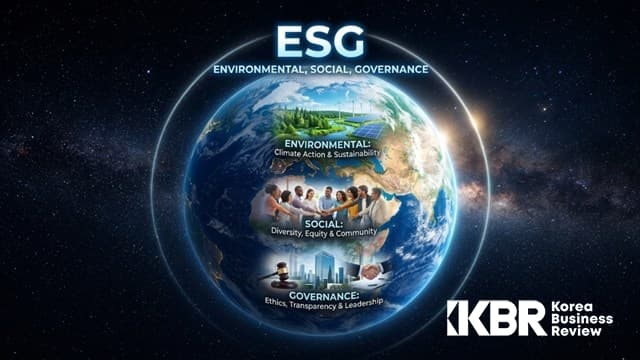
ESG is an international standard framework for corporate sustainability composed of three pillars: Environmental, Social, and Governance. In 2026, Korea officially transitioned this framework into a mandatory disclosure system through the finalization of KSSB standards and the announcement of the Financial Services Commission roadmap.[Image = Korea Business Review DB]
5 Years of Drifting, Finally Dropping Anchor
Back in January 2021, when the Financial Services Commission first announced "staged mandatory ESG disclosures starting from 2025," the market held both expectations and tension. However, the schedule was subsequently postponed twice, and phrases like "delayed beyond 2026" gradually came to be perceived by corporate ESG managers as an implicit signal that "it will be postponed again."
That momentum shifted dramatically in 2026.
On February 25, 2026, at the 4th Transition Meeting for Productive Finance, the Financial Services Commission announced the final roadmap containing specific implementation plans for the domestic sustainability disclosure system, which is scheduled to be finalized in April 2026 following an additional public comment period until March 2026. About five years after mandatory discussions were first mentioned, concrete execution plans have officially been placed on track.
Following public draft announcements in April 2024 and subsequent opinion collection processes, the first set of sustainability disclosure standards was prepared and finalized on February 26, 2026, by the Korea Sustainability Standards Board (KSSB). The successive finalization of KSSB standards and the announcement of the Financial Services Commission roadmap, coming just a day apart, was in itself an expression of policy commitment.
Core of the Roadmap: Starting from 30 Trillion Won Conglomerates in 2028, to Scope 3 in 2031
The framework of this roadmap is clear.
Beginning in 2028 (for the 2027 fiscal year), mandatory ESG disclosures will be introduced in phases, starting with KOSPI-listed companies with consolidated total assets of 30 trillion won or more (approximately 58 companies), with a plan to expand to those with consolidated total assets of 10 trillion won or more in 2029 (for the 2028 fiscal year).
In the case of governance (G) disclosures, a full expansion will already be implemented starting in 2026. From 2026, all KOSPI-listed companies will be required to publicly disclose corporate governance reports, establishing "G (Governance) disclosure" as a fundamental market rule. The obligation, previously applied to only 541 KOSPI-listed companies, will be expanded to all 842.
Regarding Scope 3 (supply chain emissions) disclosures, which sparked the most debate, a pragmatic compromise was reached. While Scope 3 emissions are included in the disclosure items for the system's effectiveness, a three-year grace period from the start of mandatory disclosure has been granted considering companies' preparation periods. Consequently, for the first mandatory disclosure companies in 2028, Scope 3 data reporting will apply starting in 2031 (FY2030).
Buffer mechanisms considering corporate burdens were also designed in the disclosure channels and legal liability structures. To alleviate corporate burdens in the early stages of system adoption, it will operate in the form of exchange disclosures, and once the system settles, it is scheduled to gradually transition to statutory disclosures such as securities reports. As companies' concerns over sanctions for disclosure violations grow upon transitioning to statutory disclosures, a safe harbor for disclosures utilizing predicted or estimated information will be permitted during the early stages of system operation.
KSSB Standards: Aligned with ISSB, Reflecting Domestic Industrial Structure
The newly finalized KSSB disclosure standards consist of three pillars. Standard No. 1 reflects the ISSB's IFRS S1 as "General Requirements for Disclosure of Sustainability-related Financial Information," Standard No. 2 is based on IFRS S2 as "Climate-related Disclosures," and Standard No. 101 serves as a selective additional disclosure standard, creating a structure that reflects domestic conditions under the premise of consistency with international standards.
While domestic ESG disclosure standards are based on ISSB-established standards, the characteristics of the domestic industrial structure with a high proportion of manufacturing are also jointly considered. Accordingly, disclosures on matters other than climate, internal carbon pricing per ton, and industry-specific indicators are expected to be permitted as optional disclosures.
The four core elements of disclosure—governance, strategy, risk management, and metrics and targets—adopt the framework of ISSB S1/S2 as they are, while featuring enhanced practical flexibility, such as permitting the use of GWP (Global Warming Potential) values reflecting domestic greenhouse gas measurement conditions.
KBR Insight
The finalization of KSSB standards has resolved the greatest uncertainty: the "absence of standards." However, gaps that must be bridged still remain between the finalized standards and the roadmap. The core point companies should focus on is not the "timing of mandating," but the fact that data collection systems and internal verification infrastructure must be built from now on for the first disclosure in 2028, because disclosure is not an output, but a reflection of management processes.
EU Omnibus: "Retreat" or "Adjustment"
While Korea is solidifying its disclosure foundation, the EU, the world's largest ESG regulatory axis, has entered into large-scale reorganization work.
The Council of the EU formally adopted the Omnibus I Simplification Package on February 24, 2026, and published it in the Official Journal on February 26, 2026, completing the legislative process. The effective date is March 18, 2026. Through this, the EU's Corporate Sustainability Reporting Directive (CSRD) and Corporate Sustainability Due Diligence Directive (CSDDD) were simultaneously and significantly overhauled.
The most noticeable change is the sharp decline in the number of companies subject to the CSRD. Under the revised CSRD, the criteria for companies subject to the CSRD have been significantly adjusted upward, and the number is expected to drop by about 80 to 90%, from roughly 50,000 down to around 3,000 to 5,000. This is because the criteria have been raised from companies with 250 or more employees and exceeding certain sales, to those exceeding 1,000 employees and net sales exceeding 450 million euros.
The same applies to the CSDDD. The revised CSDDD significantly adjusts the criteria upward, limiting the scope of application centered on large-scale enterprises. For companies established within the EU territory, it applies only to those that simultaneously meet the requirements of exceeding 5,000 employees and worldwide net sales exceeding 1.5 billion euros. In addition, EU member states must transpose the CSDDD into domestic law by July 26, 2028, and full application to companies begins on July 26, 2029.
Direct impacts on Korean companies have been somewhat mitigated. Many Korean companies whose sales within the EU fall short of 450 million euros or 1.5 billion euros have escaped or have a lower likelihood of falling under the direct mandatory targets of CSRD and CSDDD.
However, it is premature to lower guard. The global capital market's "barometer" remains high. Major institutional investors, credit rating agencies, and global supply chains already demand Scope 3 emissions, transition plans, and climate risk scenario analyses as de facto market standards. Even if EU legislation partially retreats, investors and multinational ordering parties can demand higher levels of ESG information through internal policies, in which case private discipline as a trade and investment condition, rather than legal obligation, will define reality.
ISSB Standards Pushed for Adoption by 30 Countries — Becoming the Global Standard
In contrast to the EU's simplification-oriented adjustments, ISSB standards are instead accelerating their spread worldwide.
This year marks the full-scale implementation of the first mandatory disclosures under the European Union's Corporate Sustainability Reporting Directive (CSRD), and with 30 countries seeking to adopt and align with the disclosure standards (IFRS S1·S2) established by the International Sustainability Standards Board (ISSB), evaluations suggest that climate and ESG information are de facto establishing themselves as a "second financial statement."
ISSB is also concurrently undertaking SASB standard revision work as part of its 2024–2026 work plan. After gathering global stakeholder feedback on the exposure draft until November 30, 2025, ISSB plans to finalize the revised standards during 2026, reflecting these inputs. This task integrates SASB's 77 industry-specific ESG disclosure standards with the IFRS S2 framework, signifying the international standardization of industry-specific disclosure indicators.
Korea cannot be an exception to this trend. With this roadmap finalization, Korea's transition to a mandatory disclosure system based on International Sustainability Standards Board (ISSB) standards has been made official, following major Asian nations such as Japan, Singapore, and Taiwan.
What Companies Must Do Now: Disclosure is a Process, Not a Result
The 58 KOSPI-listed companies with consolidated assets of 30 trillion won or more, who are the targets of the first mandatory disclosure in 2028, must virtually dive into preparation starting now. The reporting business year for 2028, the first year of disclosure, is 2027, and to collect and verify that data, internal system establishment must begin in the second half of 2026.
Preparation tasks highlighted by experts broadly fall into five categories.
First, familiarization with KSSB Standards No. 1 and No. 2 and performance of Materiality Assessment. Second, establishment of collection and verification systems for Scope 1 and 2 greenhouse gas emission data. Third, establishment of scenario analysis methodologies for climate-related risks and opportunities. Fourth, clarification of sustainability-related governance structures—the roles and responsibilities of the board of directors and management. Fifth, preparation of a foundation for supply chain data collection (preemptive preparation during the Scope 3 grace period).
Companies subject to mandatory disclosure must acquire the capability to reasonably and systematically explain climate-related risks and financial impacts in alignment with internationally accepted disclosure standards and terminology.
For companies preparing for 2028 and beyond, ESG disclosure is no longer an annual report from the public relations department. The era has officially arrived where Scope 1 and 2 emission data are incorporated into corporate valuation models, and climate transition plans become credit rating analysis items. Once Scope 1, 2, and 3 emission data and transition plans are standardized, carbon reduction becomes an area evaluated not by "image," but by "risk management capability."
Outlook: Direction is Clear, Speed May Be Adjusted
The global ESG disclosure trend can be summarized in one sentence—regulatory intensity is adjusted, but the direction does not change.
Although the EU Omnibus reduced CSRD-applicable companies by nearly 90%, disclosure obligations for the remaining large enterprises have become even stricter. While US SEC climate disclosure regulations face political uncertainty, institutional investors already treat climate risk analysis as a fundamental premise for investment decision-making. Korea has officially joined the global ranks by finalizing its roadmap after a five-year deferral.
Experts view that while the speed of sustainability disclosure trends over the next 3 to 5 years may be adjusted, the direction will be maintained. The method of each country adopting ISSB as its basic framework while adjusting only detailed requirements is expected to spread, and it is highly likely that Korea will also expand mandatory disclosure targets in phases within this structure.
KBR Insight
The year 2026 marks the true inaugural year in the history of Korean ESG disclosure. The finalization of KSSB standards and the announcement of the roadmap are not simply the publication of a regulatory schedule, but an official declaration of the domestic adoption of the international paradigm that "a company's non-financial information must also possess the same level of reliability and comparability as financial statements." The question companies must ask should not be "When is it mandatory?" but "What can we disclose in 2028?"