
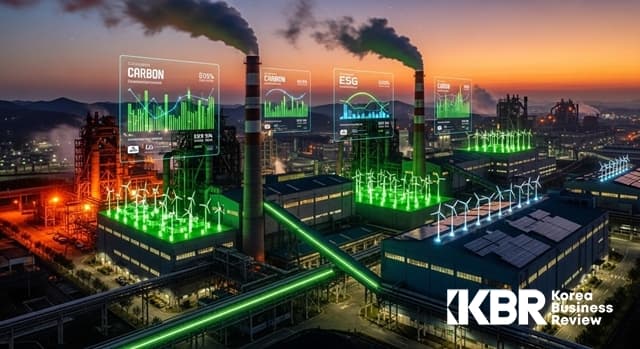
A composite image superimposing ESG indicators and renewable energy facilities over a carbon-emitting factory. Global carbon regulations taking full effect from 2026 make establishing data management systems in industrial sites an essential task for companies. [Image = AI-generated image]
Lately, calls from corporate legal teams to the ESG dedicated team at a large law firm in Yeouido, Seoul, have been non-stop.
The questions are mostly similar. "How far does our company need to go?" The responsible lawyer is said to answer like this: "You must do it right now. It might already be too late."
2026 is the year Korean companies realize that ESG (Environmental, Social, and Governance) is no longer a voluntary choice.
The wave of regulations triggered simultaneously at home and abroad has now emerged as a core variable dictating corporate survival and export competitiveness, moving beyond a simple management trend.
CBAM (Carbon Border Adjustment Mechanism), CSDDD (Corporate Sustainability Due Diligence Directive), finalized KSSB sustainability reporting standards, and the new government's policy stance to strengthen ESG — four massive waves are rushing in simultaneously.
① Domestic Disclosure Mandate Roadmap Finalized: No Longer Just a "Story for Large Conglomerates"
On February 25, the Financial Services Commission (FSC) announced the 'Draft Roadmap for the Sustainability Disclosure System'.
This marked the first official move in five years since the announcement of comprehensive improvements to the corporate disclosure system in January 2021, and it drew industry attention in that discussions on mandating sustainability disclosure, which had been stalled without a specific schedule, returned to the official policy track.
Following public consultations until March 31, the FSC plans to finalize and announce the sustainability disclosure system roadmap in April through the ESG Finance Promotion Task Force. In other words, as of April when this article is published, the finalization of the roadmap has entered the countdown phase.
The Financial Services Commission is pushing to mandate ESG information disclosures starting from 2026 for listed companies of a certain size, ultimately expanding the target to all companies listed on the KOSPI market. In 2026, the mandate to disclose corporate governance reports was expanded to all KOSPI-listed companies, which require reporting on 10 core items including shareholder rights, board composition and operation, and independence of the audit committee under a 'Comply or Explain' format.
The international standardization of disclosure standards is also a notable point. Regarding disclosure standards, domestic standards were prepared based on those established by the International Sustainability Standards Board (ISSB) considering international alignment, and were finalized on February 26, 2026, by the Korea Sustainability Standards Board (KSSB) at the Korea Accounting Institute.
What companies find most unfamiliar in practice is the concept of Scope 1, 2, and 3 emissions. Simply put, Scope 1 is carbon emitted directly from factories, Scope 2 is indirect carbon generated while purchasing and using electricity, and Scope 3 is carbon generated throughout the entire process from supply chain partners and logistics to the consumer usage stage.
Companies have entered an era where they must manage and disclose not only Scope 1 and 2, but also Scope 3, which includes emissions from partner companies. This creates a structure where carbon data from hundreds of partner companies must be collected one by one.
Inadequate ESG disclosures can lead to investment, reputation, and supply chain risks beyond mere fines. Omissions or lack of reliability in disclosures can spread to lowered ESG ratings, reduced investment accessibility, and possible exclusion from supply chains. This is why companies are facing the realistic fear of being squeezed out of the market, not simply because they are afraid of fines.
② CBAM (Carbon Border Tax): Actual Bills to Arrive Starting 2026
The Carbon Border Adjustment Mechanism (CBAM), introduced for the first time globally by the European Union (EU), is shifting from a transitional period (reporting obligations) to a definitive period (actual cost payment) starting in 2026.
Starting in 2026, the submission and verification of CBAM certificates will become mandatory, and the emission calculation method will also be unified with the EU method. Simply put, while it used to end with submitting a report stating "this is how much carbon came out of our factory," it now means companies must actually purchase and pay for certificates corresponding to that amount of carbon.
South Korea's exports to the EU amount to $68.1 billion, of which exports of items subject to CBAM stand at $5.1 billion, accounting for 7.5% of total exports to the EU. In particular, steel is expected to be the most impacted, accounting for 89.3% of target item exports to the EU, and aluminum is also within a significant impact zone.
As a country with high trade dependency and a carbon-intensive industrial structure, difficulties such as additional cost burdens for exporting companies are anticipated. In particular, heavy and chemical industries such as steel, cement, and aluminum are expected to face aggravated difficulties due to the inherent difficulty of decarbonization in their processes and direct exposure to international cost competition.
Even more concerning is the response capacity of small and medium-sized enterprises (SMEs). In a survey conducted by the Korea Federation of SMEs targeting 300 SMEs, 8 out of 10 SMEs failed to properly understand CBAM. A reality is unfolding where domestic SMEs that supply large EU corporations experience a mental breakdown upon suddenly receiving requests to submit carbon data.
With this CBAM amendment, through changes to exemption criteria for small importers (annual imported goods weight of 50 tons or less) and easing of certificate management requirements, approximately 90% of importers compared to the original plan are expected to be excluded from the scope of CBAM application. However, since this relief measure does not directly apply to Korean exporting companies, the individual company situation must be checked closely.
Future expansions of CBAM items must also be watched out for. Since the European Commission has signaled potential expansions targeting items with high carbon leakage potential such as organic chemicals and plastics, CBAM risks remain for companies exporting to the EU.
③ EU Supply Chain Due Diligence Directive (CSDDD): An Era of Being Responsible Even for My Partner Companies
If CBAM is a 'carbon tax', CSDDD is a 'human rights and environmental police' spanning the entire supply chain.
The Council of the EU formally adopted the 'Omnibus I Simplification Package' on February 24, 2026, and completed the legislative procedure by publishing it in the Official Journal on February 26, 2026. The effective date is March 18, 2026, which is 20 days after publication in the Official Journal.
The revised CSDDD drastically adjusted its application scope focusing on large corporations. For Korean companies, only those with net revenues within the EU exceeding 1.5 billion euros will fall under the direct application scope of CSDDD, so Korean companies falling under direct application are expected to be few. However, lowering one's guard here is forbidden.
Korean companies that do not meet the EU net revenue threshold may still fall under indirect influence, such as receiving requests to provide due diligence-related information from those companies, if they are incorporated into the supply chains of EU or global companies subject to CSDDD. This means that tier-2 and tier-3 suppliers providing parts to Samsung Electronics and Hyundai Motor cannot ultimately avoid the ripple effects of due diligence.
Companies subject to CSDDD must prevent environmental and human rights issues within their supply chains and transparently disclose the details of their due diligence on a regular basis. Specifically, they must establish a six-step process: internalizing due diligence into corporate policies and risk management systems, identifying, preventing, and monitoring negative impacts, communicating with stakeholders, and establishing remedial measures.
Guidelines regarding overall due diligence procedures are scheduled to be released on July 26, 2026, and penalties of up to 5% of global turnover can be imposed on non-compliant companies. This calculates to a maximum fine of 50 billion KRW for a company with annual sales of 1 trillion KRW.
④ The New Government's ESG Drive: Gaining Faster Momentum
External regulations are not the only issue. Changes in the domestic political landscape are also acting as a variable accelerating ESG mandates.
The Lee Jae-myung administration has declared plans to strengthen ESG management evaluations of public institutions during its term and actively promote various policies to lead the spread of ESG management in private companies.
To strengthen climate crisis response capabilities and foster new energy industries, it is pushing to establish a 'Climate and Energy Ministry' that integrates and jurisdictionally oversees climate affairs under the Ministry of Environment and energy affairs under the Ministry of Trade, Industry and Energy, and has also pledged to enact a 'Carbon Neutral Industry Act' to foster the carbon-neutral industry. Plans to create industrial complexes exclusively for RE100 (100% Renewable Energy) were also included.
As the ESG policy stance strengthens alongside the inauguration of the new government, rumors are circulating that the timing of disclosure mandates may be brought forward earlier than originally expected.
On March 31, the Ministry of Climate, Energy and Environment held an explanatory session by specialized institutions regarding greenhouse gas emission calculations to support our companies in implementing sustainability disclosures. The government has begun taking companies by the hand.
⑤ Greenwashing is Now a Criminal Risk
In the past, ESG allowed companies to turn a blind eye even if they pretended to be 'good'. Now, it is different.
The most common mistake is greenwashing, which involves recklessly tossing around unrealizable 'carbon neutral' goals. Starting in 2026, penalties for false disclosures are becoming severe enough to require paying a certain percentage of global sales as penalty surcharges. Relying solely on manual Excel work without introducing a system can drastically degrade disclosure reliability due to data errors.
On the other hand, looking at cases of failed companies, some adhered to traditional promotional report-writing methods only to be judged for data inconsistencies during independent external agency verification processes, which spread into suspicions of greenwashing in the market and led to stock price drops and credit rating downgrades.
Conversely, some companies succeeded in preemptive responses. Companies that introduced supply chain data platforms in advance to aggregate partner carbon emissions in real time and combined this with low-carbon technology support for high-emission processes not only enhanced disclosure credibility but also elicited positive evaluations from global investors as a 'sustainable supply chain'.