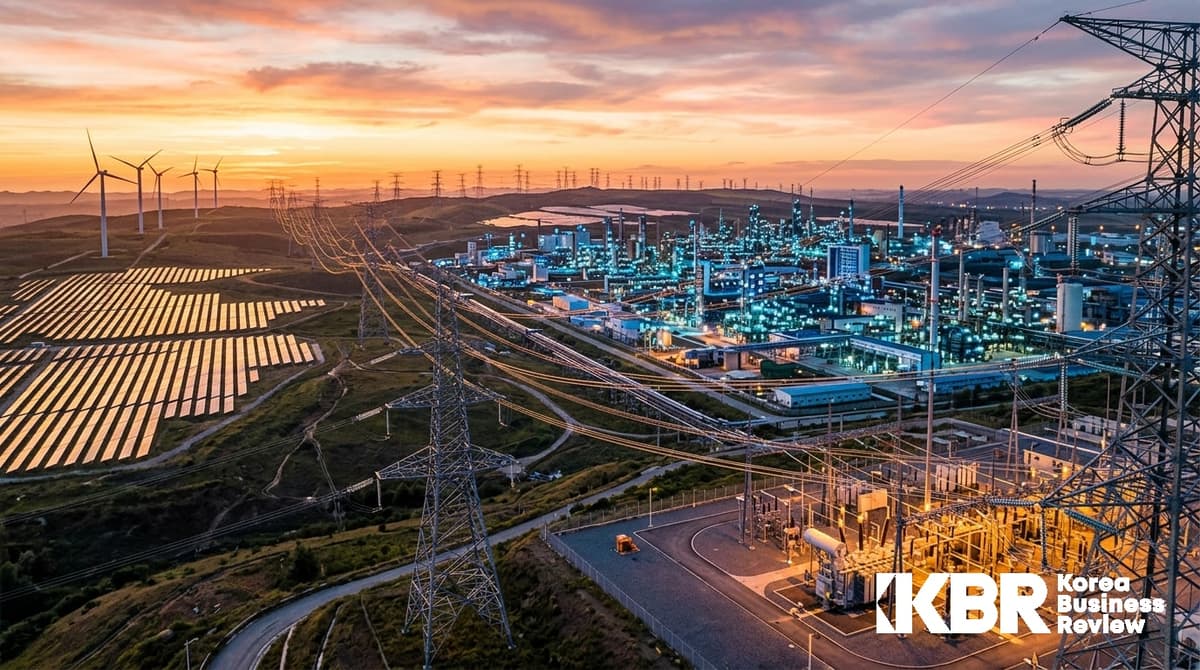
A 4,755 Trillion Won National All-Out War: Government Simultaneously Launches Three Mega-Projects in Semiconductors, Physical AI, and AI Data Centers
800 Trillion Won for Semiconductors and 550 Trillion Won for AI Data Centers Confirmed: A Balanced Development Gambits Expanding the Seoul Metropolitan Concentration Structure to Honam, Chungcheong, and Yeongnam, with Power and Water Infrastructure Determining Success or Failure
The government has formalized an ultra-large-scale industrial strategy to concentrate national capabilities and seize the initiative in the artificial intelligence (AI) transformation era. Related ministries, including the Ministry of Trade, Industry and Energy, held the 'Republic of Korea Great Leap Forward 3 Mega-Projects National Report' presided over by President Lee Jae-myung at the Blue House Yeongbin-gwan on June 29, 2026, announcing mid- to long-term investment and promotion plans for three major sectors: semiconductors, physical AI, and AI data centers. The slogan for the report was 'Beyond Recovery to a Great Leap Forward, Super-Gap Republic of Korea,' with the government setting goals to simultaneously achieve the leap to an irreplaceable semiconductor powerhouse, entry into the global top 3 in AI robots and global top 1 in physical AI, and the strengthening of the AI data center industrial ecosystem. Samsung Electronics Chairman Lee Jae-yong and SK Group Chairman Chey Tae-won personally attended the event to announce their respective group investment plans.
The weight of this announcement is evident in the scale of investment. Combining the mid- to long-term investment plans proposed by Samsung and SK with the government-corporate joint promotion tasks presented by the Ministry of Trade, Industry and Energy, the total investment scale reaches approximately 4,755 trillion won. This amount significantly exceeds South Korea's annual gross domestic product (GDP) and is unprecedented for a single policy package. The government defined semiconductors as the 'human brain,' physical AI as the 'body equipped with intelligence,' and AI data centers as the 'warehouse of thought,' stating that it will organically combine these three pillars to complete a Korean-style AI ecosystem where data collected in the field is gathered in data centers and fed back into industrial innovation. Rather than fostering individual industries separately, creating a virtuous cycle where the three fields mutually reinforce each other through data as a medium is the core design principle of this strategy.
The report was attended by a wide range of AI semiconductor and robotics companies including Samsung Electronics, SK, LG Electronics, Furiosa, Robotis, and HD Hyundai Robotics, as well as infrastructure-related institutions such as GS, KT, Korea Electric Power Corporation, and Korea Water Resources Corporation. The composition—bringing together companies that make semiconductors and physical AI alongside institutions that supply the power and water to operate them—demonstrates that this strategy is not merely for one or two specific industries, but a comprehensive national-level package encompassing production, infrastructure, and human resources. The announcement also encapsulates the government's determination to expand the high-tech industrial ecosystem beyond the capital region to simultaneously achieve balanced development and industrial competitiveness.
Semiconductors: Solidifying Memory Super-Gap via the '3S+1F' Strategy
The core pillar of the three mega-projects is semiconductors. To secure an unbridgeable super-gap in memory semiconductors and preempt the future semiconductor market in the AI era, the government presented the '3S+1F' strategy. The 3S stands for Speed, Stronghold, and Spearhead, coupled with a Full-support system to embody a vision where all members of the nation unite to back the initiative. Enterprises, universities, the central government, and local governments will divide their respective roles while cooperating under a single goal.
The speed strategy aims to complete production bases in the capital region early to double memory production capacity within five years. The government announced that it will accelerate the final fab completion dates for the Yongin National Industrial Complex and General Industrial Complex by 7 and 12 years, respectively. The stronghold strategy aims to expand production bases that have been concentrated in the capital area nationwide. In the southwestern region, a total of 800 trillion won will be invested to build four semiconductor fabs and a partner-and-talent ecosystem to foster a second production base; 81 trillion won will be invested in the Chungcheong region to build a packaging base; and supply chain stabilization bases for materials, components, and equipment (MCE) will be established in the southeastern and Daegyeong regions. The spearhead strategy involves investing over 30 trillion won over the next 15 years to preempt promising, small-scale yet high-potential semiconductor markets.
As indicated by the name of the strategy, the government placed the highest priority on 'speed.' Because the semiconductor industry has a structure where companies that first secure next-generation process technology and production capacity dominate the market, a delay of several years in fab completion could cede the initiative to competing nations during that window. The government's announcement that it will shorten completion dates by up to 12 years by advancing permit and infrastructure supply procedures reflects this industrial characteristic. Simultaneously, the stronghold strategy of decentralizing production bases to the southwestern, Chungcheong, southeastern, and Daegyeong regions acts as a safety valve to mitigate the impact of unexpected variables such as earthquakes, power outages, or regional shortages of power and water on overall production.
Corporate investments were also presented on a record scale. Samsung Electronics unveiled a domestic investment plan totaling 2,655 trillion won. While injecting massive capital into fostering semiconductor clusters including the Pyeongtaek campus and the Yongin National Industrial Complex, the plan expands investments in AI semiconductors, robotics, batteries, components, and materials into Honam, Chungcheong, and Yeongnam. To overcome the power and water limitations of a single capital-area base, Samsung Electronics and SK Hynix decided to build new global cutting-edge front-end process fabs in the southwestern region.
The background behind the government making the memory super-gap the starting point of its strategy lies in the characteristics of South Korea's export structure. Historically, South Korea's exports have been criticized for having high dependence on a small number of items, including semiconductors, making them vulnerable to global demand fluctuations and technological cycle shifts. Although memory demand is currently being robustly maintained due to expanding AI investments, the government's judgment is that it must preemptively boost production capacity and solidify its market position as chasing by latecomer nations and trade pressures from the US and China continue. The configuration connecting the southwestern fab, the Chungcheong packaging hub, and the southeastern/Daegyeong MCE hubs is interpreted as an effort to disperse production risks concentrated in a single region.
Physical AI: Transforming into a Robot Manufacturing Powerhouse via the '3M Strategy'
In the second pillar, physical AI, the government announced the '3M Strategy' to leap into the 'global top 3 in AI robots' under the recognition that "while South Korea has been a country that uses robots well, it must now transform into a country that makes robots well." The 3M stands for Mass Production, M.AX (Manufacturing AI Transformation), and Master (Securing Professional Capabilities).
First, by accelerating the AI transformation of manufacturing, the government will develop AI robots specialized for each industry and deploy more than 1,000 units to sites annually. To secure core component technology competitiveness, the plan builds data factories across 10 major industries to secure AI robot learning data, expands R&D investments into three vulnerable component areas—actuators, robot hands, and sensors—and nurtures 10,000 AI robot professionals. To build a mass production system, a robot foundry and component cluster will be created in Saemangeum, and the Daegyeong region will be supported in converting automotive and home appliance component companies into robot component companies. The vision is to transfer precision component manufacturing capabilities accumulated in the automotive and home appliance sectors to the robotics industry, simultaneously promoting business conversion for existing companies and fostering new industries.
Taking this a step further, the government presented a goal to foster physical AI as an irreplaceable national strategic industry, leaping to 'global number one.' To this end, it decided to build massive data production and accumulation infrastructure, develop world-class physical AI foundation models, and promote commercialization through large-scale demonstrations composed of domestic indigenous technologies.
Physical AI is the concept of combining artificial intelligence, which previously remained in the software domain, with the physical body of a robot and deploying it to manufacturing, logistics, and service sites. This is why the government emphasized that the global market landscape has yet to be finalized. While US big tech companies are ahead in generative AI competition centered on large language models, South Korea, as a manufacturing powerhouse, can have a comparative advantage in physical AI where field data and manufacturing capabilities are core. Experts evaluate this strategy as differentiating itself from existing robotics policies by being designed to elevate the entire supply chain together, spanning the localization of vulnerable components, securing learning data, and fostering professional talent, rather than simply increasing robot distribution.
AI Data Centers: 18.4 GW Infrastructure and Dedicated Pricing Plans
The third pillar is AI data centers, dubbed the 'heart of AI.' Seeing that global investments totaling $5.5 trillion are projected to flock to data centers by 2030, the government aims to channel this trend into domestic industrial growth and ecosystem competitiveness enhancement. Enormous computing power is required to train AI models and operate services, and data centers are the physical spaces where that computation takes place. With the explosive rise in generative AI demand, data centers have emerged as the fastest-growing infrastructure market worldwide.
Specifically, AI data centers with a total capacity of 18.4 gigawatts (GW) will be built. In the first phase, the government, SK, GS, and Naver will participate to build an 8.4 GW scale; subsequently, in the second phase, the government and SK will expand the existing 5 GW scale to 15 GW. The investment scale of the three companies participating in the first phase alone reaches 550 trillion won. To foster a domestic ecosystem for AI data center solution companies, the government plans to create a cluster, form alliances with demand companies, and promote joint demonstrations and exports. In addition, it envisions growing data centers into an export industry by supporting the acquisition of cloud technology capabilities and building an ecosystem centered around domestic neural processing units (NPUs).
Elevating AI data centers to a separate pillar stems from the recognition that data centers are more than simple computing facilities; they are hubs of forward and backward linkage industries that extensively generate demand for semiconductors, power, cooling, and network equipment. Increased data center investments simultaneously boost demand for memory semiconductors and NPUs going inside them, aligning with the first-pillar semiconductor strategy, while data collected in the field by physical AI is aggregated into data centers, completing a single circulation loop. However, because data centers are facilities that consume massive amounts of power, how to stably operate large-scale infrastructure amounting to 18.4 GW is considered the key variable determining the realism of this pillar.
The Keys to Success: Power, Water, and Urban Infrastructure
The core variables determining the feasibility of this mega-project are power and water. Because semiconductor fabs and AI data centers consume vast amounts of electricity and water, investment blueprints cannot help but remain on paper without supporting infrastructure supplies. Indeed, among experts, diagnoses suggest that while the blueprint of this announcement is sufficiently ambitious, resolving the difficult challenges of securing power and water will dictate success or failure. Conscious of this point, the government elevated infrastructure measures to a separate pillar alongside semiconductors, physical AI, and AI data centers.
Regarding power supply, the government plans to pursue the early achievement of 100 GW of renewable energy by 2030 and actively utilize nuclear power and small modular reactors (SMRs). Transmission networks will be expanded by increasing existing line capacities and expanding undergrounding in densely populated areas, enhancing power grid stability by reinforcing grid stabilization facilities. Notably, the government stated it will prepare an electricity rate system supporting cutting-edge industries, such as introducing dedicated pricing plans for AI data centers. For water, the Yongin industrial complex will respond through the early completion of an integrated water supply project and an increase in the reuse rate, while the southwestern region will utilize alternative water resources such as multi-purpose dams and power generation water. The government also decided to disclose information on substations with spare capacity in 345-kilovolt (kV) systems to help decentralize data center locations and support stable operations.
On the location and urban front, the government will supply custom-tailored locations for businesses, minimize location and urban planning regulations, and review the designation of public-supported rental-only industrial complexes enabling ultra-low-interest long-term leases. By creating corporate-style high-tech cities equipped with residential conditions and research/innovation foundations, the government unveiled goals to secure high-speed transportation infrastructure allowing travel to residential areas within 30 minutes and logistics hubs within 1 hour, and to shorten the period from industrial complex planning to factory operation from over 10 years to under 5 years. Improvements to connected transportation systems with surrounding areas, such as constructing industrial complex access roads and expanding public transit services, will also be pursued together. A characteristic of these infrastructure measures is broadening the scope of direct corporate participation in project execution and development processes, moving away from the conventional approach where the government developed sites and then attracted companies, and instead reflecting the demands of companies as consumers from the outset.
An Engine for Balanced Development and the First Testbed
Another pillar of this strategy is national balanced development. The vision is to expand the high-tech industrial ecosystem, which has been concentrated in the capital region, to Honam, Chungcheong, and Yeongnam to foster regional hubs. The government announced plans to designate regional hub universities in Gwangju and South Jeolla as semiconductor-specialized universities and joint research institutes to supply local professional talent, linking with the Saemangeum robot cluster to nurture 10,000 converged professionals over the next five years. It is reported that the government and corporations have also prepared incentives aimed at transplanting capital-area-level educational infrastructure to local areas and actively supporting infrastructure budgets to ease difficulties in securing talent accompanying local investments.
Building factories alone is not enough for high-tech industries to take root locally. Residential, educational, medical, and cultural conditions must be in place so that top talent can settle down with their families, and partner companies supplying components and materials must gather nearby to form an ecosystem. The government's announcement that it will simultaneously create corporate-style high-tech cities equipped with residential conditions and research/innovation foundations is in this context. Considering past experiences where local industrial complex policies struggled due to talent shortages and insufficient residential conditions despite focusing on attracting production facilities, designing this strategy by bundling industry, talent, and cities together is evaluated as an advanced approach.
However, industry and experts, while agreeing on the direction of the blueprint, point out challenges at the execution stage. Large fabs and data centers require power and water infrastructure to be supplied in a timely manner, and not just production facilities but a cooperating ecosystem and residential conditions to operate them must be established together. Because some detailed support contents have not yet been finalized, evaluations indicate that whether the government's announcement leads to actual investment execution and regional settlement depends on the concreteness of follow-up policies.
In particular, infrastructure measures such as the early achievement of 100 GW of renewable energy, expansion of transmission networks, and introduction of dedicated data center pricing plans harbor variables like inter-ministerial collaboration and local resident acceptance, forecasting turbulence during the implementation process. In addition, goals such as doubling memory production capacity within 5 years and shortening fab completion times by up to 12 years are ambitious, but actual investment speeds may be adjusted depending on global economic conditions, semiconductor industry cycles, and changes in the trade environment. Given the massive scale of investment, discussions surrounding the transparency of financial procurement and execution, as well as the equity of regional allocations, are expected to continue.
Nevertheless, this report is evaluated as a turning point signaling a shift in South Korea's industrial policy, given that the government and major groups simultaneously unveiled massive investment plans and tied semiconductors, robotics, and data centers under a single strategy. Its significance is considerable in that it integrated high-tech industrial policies previously pursued dispersedly by ministries and industries into a single national-level vision, connecting private investment, government support, and regional balanced development into a single package. Whether this investment relay, referred to as the largest scale since the founding of the nation, can lead to a 'great leap forward' for the South Korean economy will likely depend on the precision and execution capability of follow-up measures to be announced moving forward.