Korea Business Review

kbr-research-notes

One in Three Imported Cars is a Tesla: The 'EV Craze' Rocking the 2026 Auto Market

Domestic sales up 5.3% and eco-friendly vehicles account for 59% in Q1; Tesla takes the monthly top spot for four consecutive months, capturing 30% of import market share. Entering 2026 (Jan-May), South Korea's automobile market is showing a pattern of 'rapid internal realignment amid modest external growth.'
김민경 책임기자Published 2026년 6월 9일Updated 2026년 8월 12일
Share
One in Three Imported Cars is a Tesla: The 'EV Craze' Rocking the 2026 Auto Market

Domestic sales up 5.3% and eco-friendly vehicles account for 59% in Q1; Tesla takes the monthly top spot for four consecutive months, capturing 30% of import market share. Entering 2026 (Jan-May), South Korea's automobile market is showing a pattern of 'rapid internal realignment amid modest external growth.'


Domestic sales up 5.3% and eco-friendly vehicles account for 59% in Q1; Tesla takes the monthly top spot for four consecutive months, capturing 30% of import market share


Entering 2026 (January through May), South Korea's automobile market is exhibiting a pattern of "rapid internal realignment amid modest external growth." Because June final figures and first-half combined statistics have not yet been published, this article synthesizes official statistics from the first quarter with preliminary and aggregated data from April and May. 

While total sales increased slightly on a quarterly basis, a significant portion of that growth was concentrated in electric vehicles and imported brands—notably Tesla. Synthesizing official 2026 statistics from the Ministry of Trade, Industry and Energy (MOTIE), the Korea Automobile Mobility Association (KAMA), and the Korea Automobile Importers & Distributors Association (KAIDA), analysts suggest that describing the market as being 'replaced' rather than 'growing' is closer to reality. This is because a structural transition is underway in which domestic internal combustion engine vehicles are rapidly yielding their positions, with eco-friendly vehicles and imported EVs filling the void.


Q1 2026 Based on Official Statistics: Numbers Clearly Increased

The first fact confirmed is the rebound in domestic sales. According to the 'Automotive Industry Trends for the First Quarter of 2026' released by the Ministry of Trade, Industry and Energy, domestic sales in South Korea reached 165,000 units in March 2026, a 10.2% increase from the same month last year, while cumulative domestic sales for the first quarter rose 5.3% year-on-year to 409,000 units. 

In the same data, first-quarter production increased by 1.3% year-on-year to 1,026,000 units, extending the record of producing over 1 million units per quarter for four consecutive years, and first-quarter exports also increased by 3.5%. Superficially, it was a stable start with production, domestic sales, and exports all recording positive growth for the first time in a long while.

However, looking closely at the composition of growth, the center of gravity is heavily tilted to one side. According to MOTIE statistics, out of the 165,000 domestic sales in March, eco-friendly vehicles including EVs accounted for approximately 98,000 units, or about 59% of the total (on a monthly domestic basis). For comparison, looking at past figures from annual evaluation and outlook articles by the Korea Auto Industries Cooperative Association (KAICA), the cumulative domestic eco-friendly vehicle share from January to November 2024 was about 39.9% (based on '2024 Automotive Industry Evaluation and 2025 Outlook'), and about 48.6% for the cumulative period from January to November 2025 (based on '2025 Automotive Industry Evaluation and 2026 Outlook'). However, because these two figures come from different publications by the same organization, they may differ from statistics compiled by agencies using different methodologies. 

Although caution is required in direct comparisons due to differing compilation periods and denominators (monthly vs. cumulative), the underlying trend that the share of eco-friendly vehicles has risen steeply over the past two years is clear. In other words, the 'increase' in sales for 2026 is interpreted less as a result of the entire market growing evenly, and more as a result of a specific segment—eco-friendly vehicles—growing rapidly and pulling up the total.


Exports Also Rose, but Fortunes Diverged by Region

A similar asymmetry is observed on the export side. According to MOTIE data, export volume in March 2026 increased by 7.8% year-on-year, but by region in the first quarter, shipments increased centering on Europe, such as the EU (up approximately 14.2%), while dropping sharply in Asia (down approximately 38.9%) and the Middle East (down approximately 21.3%). 

The government believes that geopolitical instability in the Middle East influenced this decline. Furthermore, based on KAICA data, 2025 eco-friendly vehicle exports were concentrated in North America (approx. 46.1%) and Europe (approx. 36.2%), with the two regions accounting for over 80% of total eco-friendly vehicle export volume. However, amid the trend of U.S. electric vehicle tax credit reductions, the export structure itself is reportedly undergoing changes, such as an increasing proportion of hybrids and local production relative to direct EV exports.


Explosive Growth in Imported EVs Upends Fuel Landscape

This flow became even more pronounced past spring. According to statistics released by KAIDA on June 4, new registrations of imported passenger cars in May 2026 reached 29,860 units, a 5.9% increase from the same month last year, while cumulative registrations from January to May rose 32.3% year-on-year to 145,973 units. The imported car market thus continued double-digit external growth. However, considering that domestic car sales in May hovered around the 97,000-unit level over the same period (compiled based on KAMA and KAIDA data), it is evident that the driving force of growth is concentrated in imported cars, particularly imported EVs.

In fact, imported electric vehicles reportedly surged by over 170% year-on-year with cumulative sales of approximately 64,000 units from January to May 2026, according to media compilations. Looking at the month of May alone, electric vehicles accounted for 14,520 units (48.6%) and hybrids for 12,071 units (40.4%) of new imported car registrations, meaning the two categories combined reached approximately 89% of the total (KAIDA, May fuel-type registration basis). Diesel, which was once the core fuel for imported sedans and SUVs, failed to reach even 200 registrations in May, appearing to enter a stage of practical retirement from the market. 

Consequently, the fuel landscape of the imported car market has changed rapidly within just a few years. According to one set of statistics, bolstered by strong sales of the Model Y, electric vehicles even surpassed hybrids in April to rank second in domestic sales by fuel type.


Tesla Craze: ‘Monthly #1’ Becomes Routine

Tesla sits right at the center of all these changes. Based on KAIDA compilations, Tesla registered 10,866 units in May 2026, claiming the number one spot in monthly imported car sales for four consecutive months starting February, and its cumulative sales from January to May reached an estimated 45,020 units, up about 250.8% year-on-year. 

Tesla's cumulative market share in the imported car market over the same period reached approximately 30.8%, meaning one out of every three imported cars is a Tesla. Reportedly surpassing 10,000 monthly registrations for the first time among imported car brands in March, Tesla maintained '10,000 units per month' for three consecutive months through April (approx. 13,000 units) and May, sustaining an extraordinary level of influence for a single brand.

A particularly notable event occurred in April. According to data compiled by the Carisyou Data Institute, new registrations for the Tesla Model Y reached 8,762 units, ranking it first in domestic passenger car sales across both domestic and imported vehicles. 

Analysis and reports noted that this was the first time since relevant statistics were published that an imported model outperformed domestic cars to take first place in total monthly sales, and also the first time an electric vehicle captured the overall sales crown. In May as well, according to KAIDA, the Model Y Premium (7,195 units) and Model Y L (1,513 units) took first and second place side-by-side in imported car sales, and their combined volume (8,708 units) exceeded the total sales of the second-place brand BMW (6,555 units). A phenomenon occurred where a single car model surpassed an entire brand.

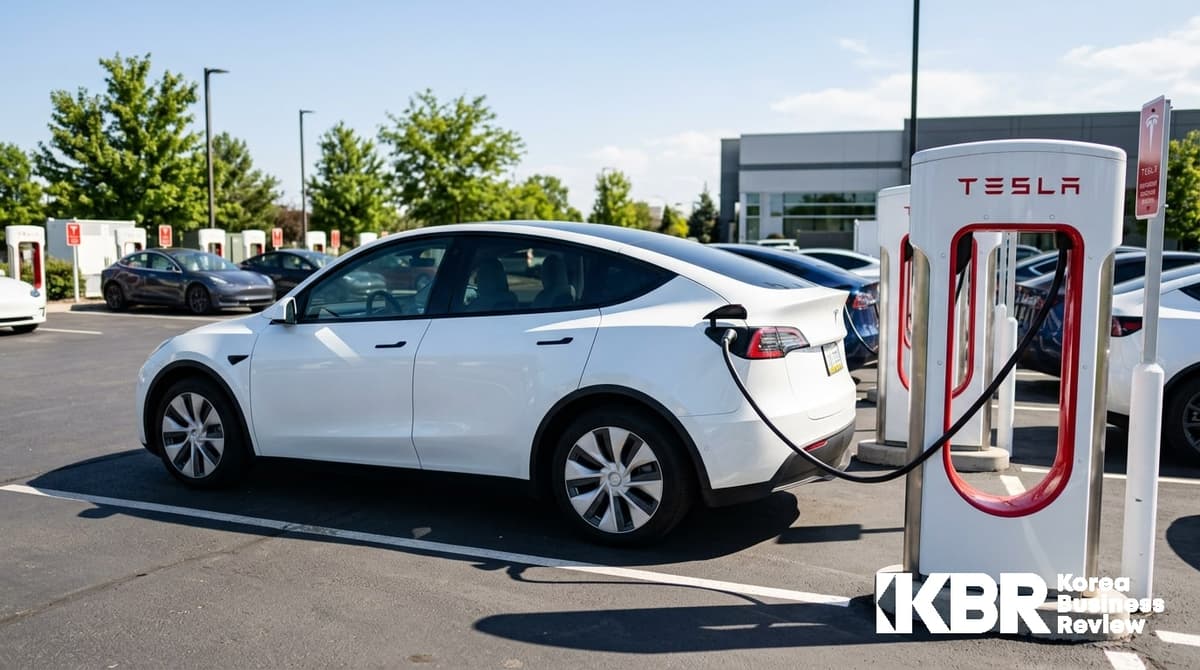
The industry generally points to three factors behind the Tesla craze. First is the price competitiveness of the LFP battery-equipped Model Y RWD produced at the Shanghai plant in China. According to a media compilation, this model alone sold approximately 28,000 units cumulatively from January to May, clearly widening the gap with domestic competing models. Second is accumulated price cuts. However, since price policies for the new Model Y L launched in April 2026 reportedly experienced fluctuations early on, exact price trends need to be verified through official announcements by Tesla Korea. Third is the expansion of charging infrastructure, with the industry viewing the expansion of the Supercharger network as a key factor that lowered the barrier to entry for actual buyers.


Ups and Downs of Domestic Cars: Those Riding the Transition vs. Those Pushed Aside

The scorecard for the domestic car camp is mixed. Clear growth is evident in pure electric vehicles. According to first-quarter media compilations, about 35,000 pure electric domestic SUVs were sold, marking a sharp increase compared to the same period last year, and new vehicle releases by Hyundai and Kia are evaluated to have largely resolved the previous 'chasm' (temporary demand stagnation). In the same compilation, the domestic-market EV5 launched in the second half of last year entered the top 10 in domestic SUV sales within its first quarter on the market, surpassing 3,000 monthly units in March.

Based on Korea Auto Industries Cooperative Association data, domestic electric vehicle sales from January to November 2025 increased by about 51.1% year-on-year, breaking away from a two-year downward trend, driven by the early execution of subsidies and the launch of major new vehicles such as the Ioniq 9, EV4, and EV5. This recovery momentum appeared even steeper entering 2026. Conversely, internal combustion engine SUVs, including hybrids, recorded double-digit declines over the same period, showing that the standing of internal combustion models is rapidly narrowing amid high fuel price conditions. Thus, even within domestic cars, fortunes diverged between models that jumped on the eco-friendly transition and those that did not.

Another pillar of support for domestic cars is hybrids (HEV). Based on Korea Auto Industries Cooperative Association data, domestic hybrid sales from January to November 2025 increased by about 16.5% year-on-year, backed by expanded lineups across all vehicle classes, sustaining one axis of the eco-friendly vehicle market. While pure electric vehicles experienced ups and downs due to charging, pricing, and safety issues, hybrids—which carry no separate charging burden—have propped up domestic brands' domestic market defense. The industry expects the growth of the eco-friendly vehicle market to continue in 2026 as robust preference for hybrids aligns with expanded electric vehicle subsidies.

A new variable has also emerged here. In KAIDA's country-of-origin new registration data for April, China reportedly ranked third behind the United States and Europe for the first time since relevant statistics began, pushing Japan—which had long maintained third place—down to fourth. Based on the same data, April registrations by country were recorded at roughly 16,000 units for Europe, 14,000 units for the U.S., 2,000 units for China, and 2,000 units for Japan. China's BYD has reportedly grown to a level where a single brand surpasses the total sales of all Japanese brands combined. Coupled with analysis that the box-office success of China-made Tesla Model Ys served as an occasion to dismantle 'prejudices against Chinese electric vehicles,' the full-scale entry of Chinese premium electric vehicles such as Zeekr is anticipated for the second half of the year. Analysts interpret this as a phase where domestic automakers simultaneously face the opportunity of a growing electric vehicle market and the threat of having to share that market with imported and Chinese brands.


Global Context: Tesla Reclaims Quarterly Throne

The Tesla craze unfolding in Korea is not unrelated global trends. According to multiple overseas reports, Tesla delivered 358,023 vehicles worldwide in the first quarter of 2026, an increase of about 6.5% year-on-year, recapturing the top spot in global quarterly BEV sales by overtaking BYD, which sold roughly 310,000 pure electric vehicles (BEVs) over the same period. 

Given that BYD outperformed Tesla on an annual basis in 2025, the quarterly reversal is symbolic. However, foreign media reported that a significant portion of this reversal stemmed from BYD's domestic slowdown in China (due to reduced subsidies and the introduction of a new purchase tax), which caused BYD's pure electric vehicle sales to drop by double digits (around 25% or so) compared to the same year-ago period. 

Therefore, analysts suggest it is more accurate to view this as a result created by the contrasting fortunes of the two frontrunners rather than Tesla's overwhelming growth. Furthermore, while Tesla is scaling back production of the Model S and Model X to shift manufacturing capacity toward next-generation businesses like robotaxis and humanoid robots, foreign media report that because the vast majority of sales remain driven by the Model 3 and Model Y, there will be no major impact on short-term sales.

In fact, while its domestic market faltered, BYD is turning its eyes overseas. According to foreign reports, BYD's overseas sales in the first quarter of 2026 reached approximately 320,000 units, recording a growth rate exceeding 50% year-on-year, and is accelerating its push into European and Southeast Asian markets by bypassing tariff barriers through the operation and construction of local plants in places like Hungary, Thailand, and Brazil. 

Conversely, reports indicated that Tesla produced more vehicles than it sold in the first quarter, resulting in accumulating inventories and declining European registrations, revealing shadows alongside growth. The competition between the two companies is unfolding as a war of attrition where price, technology, manufacturing capacity, and overseas expansion are intricately intertwined.

Looking at the market as a whole, the electrification trend itself remains robust. According to estimates by multiple major market research institutions, global EV sales from January to April 2026 are estimated to have increased by over 20% year-on-year, and the share of EVs in new vehicle sales over the same period also rose to around 20% or so. 

Some market research data cited structural background in that the average price of lithium-ion battery packs fell to about $89 per kWh in the first quarter of 2026, enabling price competition with internal combustion engines in certain vehicle classes. However, these global total volume, market share, and price figures vary widely depending on the compiling institution and should be taken as estimates. Meanwhile, following the elimination of the $7,500 federal EV tax credit in September 2025, the U.S. is evaluated to have created a challenging environment for the 2026 electric vehicle market.


Outlook and Risks: Upward Trend to Continue, but Unevenly

Supply-side variables are also noteworthy. According to forecasts by the Korea Auto Industries Cooperative Association, dedicated domestic EV production bases—such as Hyundai's new Ulsan plant and Kia's Gwangmyeong and Hwaseong EVO plants—are expected to begin full-scale operations in 2026, significantly expanding eco-friendly vehicle supply capacity. This implies that as supply increases, new vehicle launches and price competition could become even fiercer. In particular, as price-driven imported and Chinese EVs clash with increased supplies of domestic EVs over the same consumers, subsidy scale and new vehicle launch timing are projected to emerge all the more as variables dictating quarterly sales rankings.

The market's view on the entirety of 2026 is cautious. Forecast data affiliated with KAMA presents domestic market growth for 2026 at about 1.7%, noting that domestic cars will see a mere 0.5% increase while imported cars will post high growth of 6.9%. Projections were also presented that domestic market size itself will remain below 1.7 million units, the lowest level in the past decade. Household debt setting all-time highs exerts pressure on real purchasing power, while demographic and consumption structural changes—such as the retirement of baby boomers, an increase in single-person households, and weakening car ownership intentions among the 2030 generation—are pointed to as factors constraining new demand. Drawing parallels to 2024 when domestic sales fell 6.5% year-on-year to 1.63 million units following the suspension of individual consumption tax cuts, the direction of the 2026 market is projected to depend significantly on policy variables such as whether individual consumption tax cuts are extended.

In summary, the 2026 auto market is a year where 'growth' and 'realignment' are proceeding simultaneously. While the sales volume graph clearly points upward, what props up that rise is a narrow axis: electric vehicles, imported brands, and especially Tesla. As the contraction of domestic internal combustion vehicles, the rapid transition to eco-friendly vehicles, the landing of Chinese brands, and policy dependency variables intertwine, South Korea's automobile market this year is evaluated to be passing through the center of faster and more asymmetrical changes than ever before.

KBR Access

KBR Analysis 콘텐츠는 Premium 전용 콘텐츠입니다

이 콘텐츠는 Premium 회원에게 제공되는 프리미엄 콘텐츠입니다. Premium은 1개월 이용권 34,900원 또는 월 정기결제 29,900원이며, 결제 시 1개월 이용권(1회 결제·자동갱신 없음) 또는 월 정기결제(매월 자동결제)를 선택할 수 있습니다. ESG, KBR 아티클, KBR Analysis 등 핵심 프리미엄 콘텐츠를 열람할 수 있습니다.

이번 달 열람 현황: 0 / 0건 사용