Korea Business Review

deep-analysis

What Jensen Huang's 4-Night, 5-Day Trip Left Behind: Can South Korea Become a 'Core Hub' in NVIDIA's AI Supply Chain?

During his visit to South Korea, NVIDIA announced a long-term partnership with SK Group, including a multi-year HBM supply contract spanning over two years, and unveiled joint business plans with Naver and SK Telecom to build large-scale AI data centers, known as 'AI factories,' in the country. SK Group and NVIDIA established a long-term partnership lasting at least two years to pursue comprehensive cooperation, including the co-development of next-generation memory, memory supply for AI factories, and innovations in semiconductor design and manufacturing. Regarding whether South Korea can become a 'core hub,' the officially announced outcomes of this visit can be summarized as the long-term HBM supply contract, co-development of next-generation memory, joint AI factory business plans, and directions for expanded cooperation in robotics and physical AI.
박소유 책임기자Published 2026년 6월 9일Updated 2026년 8월 12일
Share
What Jensen Huang's 4-Night, 5-Day Trip Left Behind: Can South Korea Become a 'Core Hub' in NVIDIA's AI Supply Chain?

During his visit to South Korea, NVIDIA announced a long-term partnership with SK Group, including a multi-year HBM supply contract spanning over two years, and unveiled joint business plans with Naver and SK Telecom to build large-scale AI data centers, known as 'AI factories,' in the country. SK Group and NVIDIA established a long-term partnership lasting at least two years to pursue comprehensive cooperation, including the co-development of next-generation memory, memory supply for AI factories, and innovations in semiconductor design and manufacturing. Regarding whether South Korea can become a 'core hub,' the officially announced outcomes of this visit can be summarized as the long-term HBM supply contract, co-development of next-generation memory, joint AI factory business plans, and directions for expanded cooperation in robotics and physical AI.


From HBM long-term contracts and gigawatt-scale AI factories to physical AI… South Korea has expanded from a component supplier to an ecosystem partner, yet the gap between blueprints and reality remains a task for verification


NVIDIA founder and CEO Jensen Huang has concluded his 4-night, 5-day itinerary in South Korea. During his visit, he held consecutive meetings with South Korea's representative companies—including SK Group, Samsung Electronics, Hyundai Motor Group, LG Group, Naver, and SK Telecom—to discuss cooperation across the AI supply chain and overall infrastructure. Domestic industry circles evaluate that, as a return visit following last year, this schedule is interpreted as a continuation phase of existing cooperation rather than a one-off event.

Analysis suggests that the center of gravity for this visit has shifted compared to the past. While previous cooperation focused heavily on hardware procurement centered around High Bandwidth Memory (HBM), this time the scope has expanded to encompass data centers, robotics, and software. NVIDIA announced a long-term partnership with SK hynix during the visit, including a multi-year HBM supply contract lasting over two years, and unveiled joint business plans with Naver and SK Telecom to build large-scale AI data centers, known as 'AI factories,' in South Korea. We examine the specific agreements left by the visit by sector.


HBM: Market Share Being Reorganized on an Unshakable Foundation

The starting point of South Korea's status in the NVIDIA supply chain is HBM. SK hynix is currently the number one player in the HBM market by revenue, recording market shares of 62% and 57% in the total HBM market in the second and third quarters of 2025, respectively, according to market research firm Counterpoint Research. Another report estimates SK hynix's 2025 HBM market revenue share at 61%, Micron at 22%, and Samsung Electronics at 18%, and projects that SK hynix will maintain its top position with approximately a 50% share in 2026 as well.

During this visit, the relationship between the two companies became more concrete. NVIDIA and SK hynix agreed to co-develop next-generation memory required for NVIDIA's upcoming AI platforms, alongside a long-term HBM supply contract lasting over two years. The two companies explained that this cooperation goes beyond the existing AI server HBM supply relationship, extending into the co-development of memory for AI factories and the application of AI to semiconductor design and manufacturing processes.

Projections indicate that South Korean companies will likely maintain their edge in next-generation products. Firms such as Daishin Securities and Counterpoint Research estimate SK hynix's volume-based market share in the NVIDIA-bound HBM3E market for 2026 to be around 70%, with estimates hovering near 71%. For the next-generation HBM4 generation, a structure of SK hynix at 55%, Samsung Electronics at 28%, and Micron at 17% is forecasted. Looking solely at the market share figures, SK hynix's proportion shows a trend of slight adjustment compared to the past, but interpretations suggest this is part of a reorganization process as Samsung Electronics enters the NVIDIA supply chain.

Considering that the major suppliers of HBM to NVIDIA consist of SK hynix and Samsung Electronics, South Korean memory companies are evaluated to hold a very high proportion in the HBM supply chain for AI accelerators. This supply structure is cited as a factor reinforcing South Korea's standing in terms of supply chain stability.


AI Factories: From Component Supplier to 'Infrastructure Operator'

*

The notable change in this visit is that South Korean companies have moved beyond the position of supplying chips and memory to participating as entities that directly build and operate AI infrastructure. At the center of this is NVIDIA's 'AI factory' business model. AI factories are a business model where NVIDIA provides AI computing infrastructure on a data center scale, going beyond selling individual GPUs to an area the company is actively fostering. During this visit, NVIDIA announced cooperation plans regarding AI factories with SK Group, Naver, and SK Telecom.

SK Group and NVIDIA entered into a long-term partnership lasting at least two years to pursue comprehensive cooperation, including the co-development of next-generation memory, the supply of memory required to build AI factories, and innovations in semiconductor design and manufacturing. SK Telecom announced that it will pursue AI cloud infrastructure cooperation spanning from chips to data center operations based on NVIDIA's DSX platform, and plans to sequentially introduce next-generation platforms such as NVIDIA's Blackwell GPUs.

Naver also participates as a key partner. Naver disclosed in a regulatory filing that it has agreed to a joint business venture with NVIDIA aimed at building a gigawatt (GW)-scale ultra-large AI factory. The two companies revealed plans to begin operating 55MW-scale AI infrastructure in 2027, expand the scale step-by-step to 100MW in the same year and 200MW in 2028, and ultimately aim for GW-scale infrastructure construction over the long term. In this project, Naver is known to be responsible for securing, building, and operating the data center site, while NVIDIA participates in supplying AI accelerators such as GPUs and discovering global customers.


Physical AI and Robotics: Shifting Axis of Cooperation

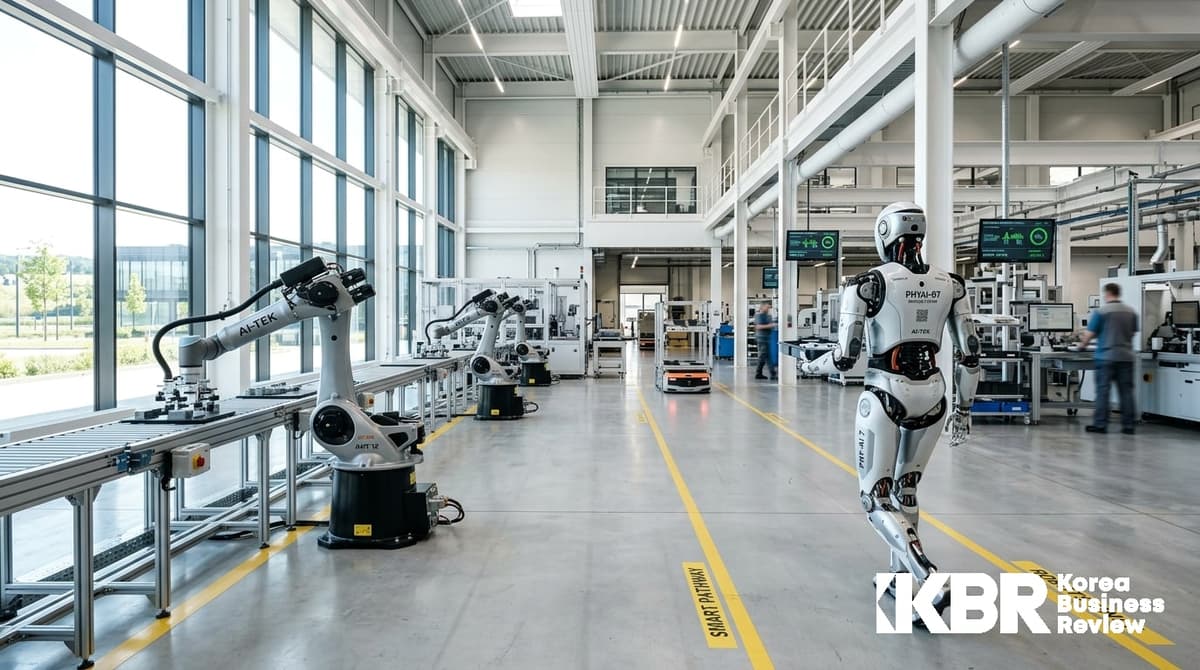
Another keyword emphasized by CEO Jensen Huang during this visit was 'physical AI.' Through statements made immediately before and during his visit, he mentioned robotics and humanoids as key future cooperation areas with South Korea. Analyses followed that the center of gravity of cooperation between NVIDIA and South Korean companies is expanding from memory to the physical world.

According to domestic reports, CEO Huang reportedly discussed cooperation directions related to autonomous manufacturing and robotics utilizing manufacturing data, digital twins, robots, and autonomous driving during meetings with LG Group, Hyundai Motor Group, and Doosan. Huang emphasized in various settings that securing data is the biggest challenge in implementing robotics and physical AI, and he reportedly remarked on South Korea's potential, possessing software, manufacturing, and AI capabilities combined.

In relation to this, domestic analyses suggest that the manufacturing site data and digitized production systems held by South Korean automakers, electronics, and robotics firms find points of contact with NVIDIA's physical AI strategy. This is the background behind why South Korea, holding both a manufacturing base and industrial data, is being discussed as a cooperation target in NVIDIA's physical AI strategy.


So, Can South Korea Become a 'Core Hub'?

The content officially announced during this visit can be summarized as the long-term HBM supply contract, co-development of next-generation memory, joint AI factory business plans, and directions for expanded robotics and physical AI cooperation. It is clear that the breadth of cooperation has widened as infrastructure cooperation in the form of AI factories and future cooperation directions in physical AI have been added to the existing foundation of HBM.

However, there are aspects that require careful assessment. Much of this cooperation takes the character of cooperative directions and blueprints rather than binding, definitive contracts. For some of the announced agreements, specific supply volumes, investment amounts, and contract periods were not disclosed. This means that time is needed before these flashy declarations are proven by actual operational performance and figures.

Ultimately, whether South Korea will become a 'core hub' in NVIDIA's AI supply chain, and further establish itself as one of the 'world's top 3 AI-leading nations' alongside the US and China, remains for now an area of evaluation and outlook based on CEO Jensen Huang's statements, industry remarks, and market forecasts. Whether promises such as the AI factory operation scheduled for 2027 and the co-development of next-generation memory lead to concrete outcomes will likely serve as the first testing ground determining the substance of South Korea's hub theory.

KBR Access

KBR News 월 열람 가능 횟수를 모두 사용했습니다

비회원은 KBR News 콘텐츠를 제한된 범위에서 열람할 수 있습니다. 계속 읽으려면 Free가입 또는 멤버십 안내를 확인해 주세요.

이번 달 열람 현황: 3 / 3건 사용