Korea Business Review

deep-analysis

Semiconductors Pull GDP Up by 1.7%, But Why Doesn't the Economy Feel It? — Dissecting the Illusion of South Korea's Economic Structure

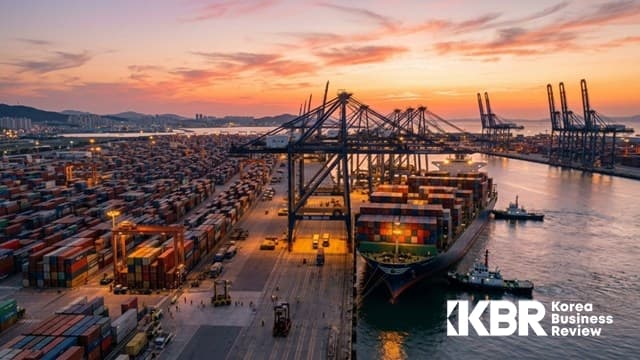
Amid a structural bias where a single item, semiconductors, accounts for 46% of total exports, the temperature gap between the vitality of logistics sites and the domestic economic sentiment is wider than ever. As of May 12, 2026, the numbers surrounding the South Korean economy are fractured.
이지영 기자Published 2026년 5월 12일Updated 2026년 8월 26일
Share
Semiconductors Pull GDP Up by 1.7%, But Why Doesn't the Economy Feel It? — Dissecting the Illusion of South Korea's Economic Structure

Amid a structural bias where a single item, semiconductors, accounts for 46% of total exports, the temperature gap between the vitality of logistics sites and the domestic economic sentiment is wider than ever. As of May 12, 2026, the numbers surrounding the South Korean economy are fractured.

Amid a structural bias where a single item, semiconductors, accounts for 46% of total exports, the temperature gap between the vitality of logistics sites and the domestic economic sentiment is wider than ever.

As of May 12, 2026, the numbers surrounding the South Korean economy are fractured.

According to the preliminary import and export data for May 1–10 released by the Korea Customs Service on this day, exports during this period reached $18.4 billion, surging 43.7% compared to the same period last year and breaking the all-time record for May 1–10. Semiconductors are undoubtedly at the center of this trend.

Semiconductor exports surpassed $8.5 billion, skyrocketing 149.8% year-on-year to record the highest-ever performance for the same period in May. Semiconductors' share of total exports jumped 19.7 percentage points from a year ago to 46.3%.

Looking at the figures alone, South Korea's economy appears to be enjoying an unprecedented boom. However, on the same day, the head of a small printing shop in Euljiro, Seoul, said, "Orders have decreased compared to last year," while the owner of a snack bar in Mapo-gu, Seoul, complained about rising ingredient costs. This gap between numbers and reality is the structural dilemma facing the South Korean economy in 2026.

GDP Surprise Driven by the Semiconductor Supercycle


According to the preliminary real gross domestic product (GDP) figures for the first quarter of 2026 released by the Bank of Korea, the economic growth rate for the first quarter stood at 1.7% quarter-on-quarter, the highest level in 5 years and 6 months since the third quarter of 2020. It was a so-called "earnings surprise," nearly doubling market expectations (0.9%).

The core driver leading this growth was exports. First-quarter exports surged 5.1% quarter-on-quarter, centered on IT items such as semiconductors, recording the highest growth rate since the third quarter of 2020.

Tracing month by month, the sprint of semiconductor exports becomes even more evident. In March, semiconductor exports spiked 151% to $32.8 billion, surpassing $30,000,000,000 for the first time in history. Semiconductor exports for the first ten days of April also hit a record high, making it certain to break the $20 billion monthly mark for the fifth consecutive month. In the previous month (April), semiconductor exports achieved a record high of $31.9 billion, surging 173.5% year-on-year, continuing a 13-month streak of breaking all-time records for corresponding months.

The background of this performance lies in the AI infrastructure investment boom. Driven by the rapid growth of the AI market, demand for high-value-added server semiconductors, such as high-bandwidth memory (HBM), has exploded, and the business conditions of global IT front-end industries are showing a clear recovery.

As this unusual situation unfolds where a single semiconductor sector accounts for nearly half of South Korea's export structure, overseas investment banks have also begun quickly upwardly revising their forecasts for South Korea. The average economic growth forecast for South Korea this year presented by eight major IBs stood at 2.4% as of the end of April, rising 0.3 percentage points in a month from 2.1% at the end of March. JPMorgan, which saw the largest upward adjustment, raised its forecast by a whopping 0.8 percentage points from 2.2% to 3.0%.

"Grim Without Semiconductors" — The Flip Side of Illusionary Growth


However, there is an uncomfortable flip side to this growth story.

The gap between the leading composite index and the coincident composite index widened to 3.4 points, the largest gap in 16 years and 3 months. While the background lifting the leading index lies in the surging KOSPI tied to semiconductor strength, the cyclical component of the coincident composite index, which shows current economic conditions, stood at merely 100.1 in March. This means that the perceived temperatures of the future economy and the current economy have diverged to the greatest extent in 16 years.

The bias in the export structure is also at a serious level. Major research institutions such as PwC and KDI pointed out that South Korea's item concentration among the world's top 10 exporting countries is at a very high level (based on the Herfindahl-Hirschman Index). They warned that given the high risk of shocks from global demand fluctuations, technology cycle changes, and government policies due to high reliance on a few items like semiconductors, portfolio diversification is necessary to secure a stable export base. Indeed, in the April 1–10 exports by item, semiconductors (152.5%), petroleum products (38.6%), and ships (26.6%) increased, while passenger cars (-6.7%) and auto parts (-7.3%) decreased, clearly showing a polarization of business conditions within the manufacturing sector.

Domestic demand reveals an even harsher reality. While semiconductor exports poured out historic highs, the private consumption growth rate lingered at 0.5% quarter-on-quarter in the first quarter.

The trickle-down effect, where the export boom of large conglomerates delivers warmth down to small and medium-sized suppliers, self-employed individuals, and service industry workers, is practically blocked structurally. As KDI pointed out when forecasting facility investment, sectors excluding semiconductors remain sluggish, and construction investment is solidifying a trend where the sluggishness of local real estate markets persists despite order improvements.

Two Arrows — Inflation and Rate Hike Signals


Aside from growth, the second variable straining the South Korean economy in May 2026 is inflation. The consumer price inflation rate in April was 2.6% (year-on-year), up 0.4 percentage points from the previous month (2.2%). This is 0.6 percentage points higher than the Bank of Korea's inflation target of 2.0%, the result of combined oil price increases and exchange rate factors.

As inflationary pressures intensify, signs of change are also being detected in monetary policy stances. The Deputy Governor of the Bank of Korea stated, "There is a possibility that rate hike signals may emerge at the May Monetary Policy Board meeting," citing an environment placing more burden on inflation than growth and a longer-than-expected semiconductor supercycle as grounds for hinting at a rate hike in the second half of the year.

Newly appointed Bank of Korea Governor Rhee Hyun-song also emphasized in his inaugural address that policymakers must respond cautiously and flexibly because Middle East conflicts are causing supply shocks, complicating inflation and growth paths.

The current base rate is 2.50% per annum. The market is watching closely to see which direction the first rate decision under Governor Rhee Hyun-song's leadership will flow at the Monetary Policy Board meeting scheduled for May 28. According to forecasts by multiple institutions such as Daishin Securities and Hanwha Investment & Securities, the base rate is likely to reach 2.75% by the end of the year through a single rate hike in the second half, but uncertainties stemming from Middle East geopolitical variables remain fluid regarding scenarios of two or more hikes.

If the rate hike signal materializes, the classes taking the most direct hit are households and small business owners carrying variable-rate loans. Given the domestic reality where the proportion of variable-rate loans in total household debt hovers around 60%, an analysis by Hanwha Investment & Securities estimates that a 0.25 percentage point base rate hike will drive up the annual interest burden of households holding variable-rate loans by an average of about 500,000 won or more.

The Hormuz Variable — Geopolitical Risks Threatening the Export Boom


Adding another layer of uncertainty to all these analyses is the geopolitical risk in the Middle East. The South Korean-flagged container ship HMM Namu was attacked externally in the Strait of Hormuz on May 4, and a hole 5 meters wide and 7 meters deep was confirmed at the bottom of the hull, revealing physical evidence supporting that it was an intentional attack rather than a simple accident.

This is not a simple maritime security incident. The Strait of Hormuz has remained blockaded for over two months since March, and South Korea's energy structure is uniquely vulnerable to this crisis, with approximately 66% of total crude oil imports concentrated in this strait.

According to major institutions like the International Energy Agency (IEA), this strait is a strategic choke point through which about the upper 20% range of global seaborne crude oil trade passes. The prolonged blockade can spread throughout industries via a cascading ripple path where rising crude oil import costs lead to deteriorated refiner margins, rising petrochemical production costs, and increased aviation and transportation costs.

Industry insiders worry that if such uncertainties persist, corporate earnings could decline starting from the second quarter, because rising maritime freight rates and logistics delays are eating away at export price competitiveness, and additional cost burdens such as war risk insurance premium hikes have occurred due to the attack on the HMM Namu. In short, the logistics foundation that made the export boom possible is being shaken.

Exit Strategy for a Semiconductor-Dependent Economy: It Is Now Execution, Not Words


Experts use the expression "conditional rebound" to describe the current situation. The Hyundai Research Institute analyzes that maintaining growth is possible if supply chain diversification, technology investment, and export market expansion are pursued simultaneously, concluding that the direction of the South Korean economy depends on the speed of internal response rather than the magnitude of external shocks.

In the mid-to-long term, diversification of the export structure is urgent. After the U.S.-China trade conflict materialized in 2018, the central axis of South Korea's exports shifted from China to the United States. China's share of total exports fell from 26.8% in 2018 to 19.5% in 2024, while the U.S. share rose from 12.0% to 18.7%. However, with the Trump administration's tariff policies also placing limits on the expansion of South Korea's exports to the U.S., resolving reliance on specific countries and diversifying export items have become survival tasks, not choices.

Seeds of change are also sprouting in the bio-health sector. According to a Bank of Korea issue note, the global bio-health market is projected to grow at an annual average of 5.0% over the next 5 years due to increased medical demand from aging populations and the accelerated convergence of biotechnology and AI, a figure significantly outpacing the growth rate of automobiles (2.7%), a core domestic industry.

Following semiconductors, whether bio CMO (contract manufacturing of pharmaceuticals) led by Samsung Biologics and Celltrion, AI-based new drug development platforms, and medical device exports can enter a phase of full-scale scaling as second and third export engines is expected to be the core of structural transition discussions in the second half of the year.

May 2026: The Crossroads Where the South Korean Economy Stands


At this very moment, the South Korean economy stands at two crossroads simultaneously.

One is the fork in the road of whether to awaken from the illusion of growth created by a single engine called semiconductors and practically pursue the recovery of a balance between domestic demand and exports. The other is the issue of whether to protect the fiscal soundness of households and small and medium-sized enterprises amid the triple upward pressure of inflation, interest rates, and energy costs.

What signals the Bank of Korea's Monetary Policy Board scheduled for May 28 will send, and which direction U.S. monetary policy will pivot after the expiration of Fed Chair Powell's term and the inauguration of new Chair Kevin Warsh on May 15, will become core variables determining future domestic financial markets, exchange rates, and the funding environments of South Korean companies.

The GDP figures pulled up by semiconductors are certainly a welcome signal. However, unless we face the triple erosion of domestic demand cooling, inflation rebounds, and geopolitical risks quietly proceeding beneath those figures, the South Korean economy in the second half of 2026 may face an even harsher reality following "surprise growth."


KBR Access

KBR News 월 열람 가능 횟수를 모두 사용했습니다

비회원은 KBR News 콘텐츠를 제한된 범위에서 열람할 수 있습니다. 계속 읽으려면 Free가입 또는 멤버십 안내를 확인해 주세요.

이번 달 열람 현황: 3 / 3건 사용