RESEARCH NOTES
Where Does South Korea's Humanoid Robot Technology Stand?
In the first half of 2026, South Korea's humanoid robot industry moved beyond exhibition demos into actual industrial site validation stages. Hyundai Motor Group showcased its fully electric Atlas at CES 2026 and presented a mass production roadmap aiming for phased deployment in U.S. plants starting in 2028. Multiple media outlets reported that Rainbow Robotics' mobile dual-arm robot RB-Y1, for which Samsung Electronics is the largest shareholder, has been deployed to Coupang logistics centers for pilot testing. Meanwhile, the government aims to invest over 1 trillion won through the K-Humanoid Alliance by 2030, targeting the development of a robot AI foundation model by 2028 and mass production of over 1,000 units annually by 2029. Strategies among major conglomerates also clearly diverge, with LG Electronics targeting a separate front in home-use humanoids. However, while hardware competitiveness is approaching global levels, AI software (physical AI) remains in a chasing phase behind the U.S. and China, leaving South Korea with the challenge of combining verified hardware with smarter brains and turning field tests into actual revenue.
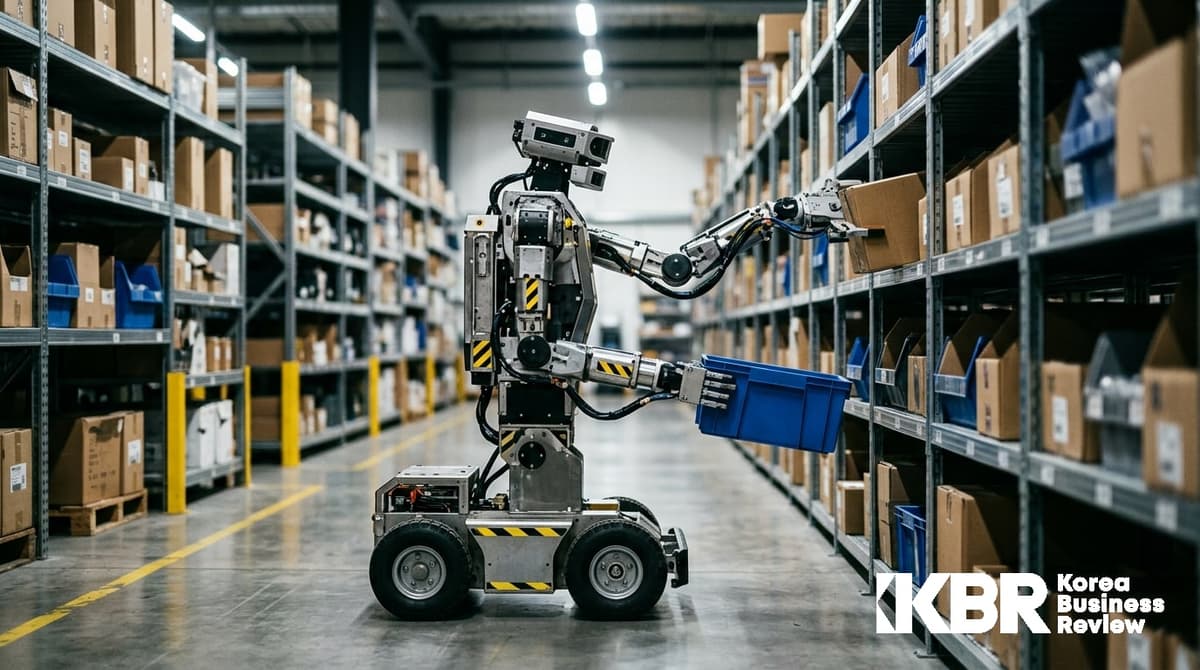
In the first half of 2026, South Korea's humanoid robot industry moved beyond exhibition demos into actual industrial site validation stages. Hyundai Motor Group showcased its fully electric Atlas at CES 2026 and presented a mass production roadmap aiming for phased deployment in U.S. plants starting in 2028. Multiple media outlets reported that Rainbow Robotics' mobile dual-arm robot RB-Y1, for which Samsung Electronics is the largest shareholder, has been deployed to Coupang logistics centers for pilot testing. Meanwhile, the government aims to invest over 1 trillion won through the K-Humanoid Alliance by 2030, targeting the development of a robot AI foundation model by 2028 and mass production of over 1,000 units annually by 2029. Strategies among major conglomerates also clearly diverge, with LG Electronics targeting a separate front in home-use humanoids. However, while hardware competitiveness is approaching global levels, AI software (physical AI) remains in a chasing phase behind the U.S. and China, leaving South Korea with the challenge of combining verified hardware with smarter brains and turning field tests into actual revenue.
<p c…
KBR Access
KBR Analysis content is available to Premium members only
This content is available exclusively to Premium members. Premium comes as a 1-month pass (₩34,900, one-time payment, no auto-renewal) or a monthly subscription (₩29,900/month) — both available via Toss Payments. Premium unlocks core content including ESG, KBR Articles, and KBR Analysis.
FREE ACCOUNT · NO CARD REQUIRED
Create a free KBR account
Creating a KBR account is free and takes about a minute — no card required. You'll come straight back to this page once you're done.
KBR NEWSLETTER
Sign up for free and get the KBR Newsletter!
Sign up and opt in to the newsletter to receive KBR's curated business and economic insights by email.
LATEST IN TOPIC
Latest in this topic
 Even When U.S. Industrial Production Stagnates, Manufacturing Declines: Why Facility Investments Cannot Be Decided by Average Indicators
 Expanding High-Speed Rail Seats by 116,000 Weekly: How Much Will It Ease KTX Booking Struggles?
 Facility Investment Rose 7.5% While Consumption Dropped 2.4%: The Temperature Gap in Recovery Shown by July Industrial Indicators
RELATED CONTENT
Related Content