Korea Business Review

kbr-research-notes

Cash Disappearing from Wallets... Only 1 in 6 Payments Uses Cash: How Far Has the 'Cashless Society' Come?

According to a Bank of Korea survey, the proportion of cash payments among domestic adults stood at 15.9% by transaction count, plunging by about 61.5% over 11 years from 41.3% in 2013, leaving only 38.5% of that previous level. The year 2023 marked the first time (at 50.5%) that methods where physical cards are not presented surpassed physical cards in domestic merchant card transactions, with the gap widening further to 52.4% in 2024 and 54.3% in 2025. Simple payment services grew to an average of KRW 1.1053 trillion per day. According to parliamentary data, commercial bank ATMs decreased by approximately 7,700 units from the end of 2020 through mid-2025, with the reduction rate generally higher in regional areas than in Seoul. However, 88% of people still had experience using cash in face-to-face transactions within the past month, making the guarantee of cash accessibility a new policy challenge. On July 15, 2026, the Financial Services Commission officially designated Project Hangang Phase 2 as an innovative financial service, expanding participating banks to 9 and the deposit token holding limit per wallet to KRW 10 million, while the exact start date for live transactions has not yet been officially finalized.
김민경 책임기자Published 2026년 8월 9일Updated 2026년 8월 12일
Share
Cash Disappearing from Wallets... Only 1 in 6 Payments Uses Cash: How Far Has the 'Cashless Society' Come?

According to a Bank of Korea survey, the proportion of cash payments among domestic adults stood at 15.9% by transaction count, plunging by about 61.5% over 11 years from 41.3% in 2013, leaving only 38.5% of that previous level. The year 2023 marked the first time (at 50.5%) that methods where physical cards are not presented surpassed physical cards in domestic merchant card transactions, with the gap widening further to 52.4% in 2024 and 54.3% in 2025. Simple payment services grew to an average of KRW 1.1053 trillion per day. According to parliamentary data, commercial bank ATMs decreased by approximately 7,700 units from the end of 2020 through mid-2025, with the reduction rate generally higher in regional areas than in Seoul. However, 88% of people still had experience using cash in face-to-face transactions within the past month, making the guarantee of cash accessibility a new policy challenge. On July 15, 2026, the Financial Services Commission officially designated Project Hangang Phase 2 as an innovative financial service, expanding participating banks to 9 and the deposit token holding limit per wallet to KRW 10 million, while the exact start date for live transactions has not yet been officially finalized.

Cash Payment Proportion Falls 61.5% from 41.3% to 15.9%, 54.3% of Domestic Merchant Card Payments Use 'Card-Not-Present' Methods... Commercial Bank ATMs Decrease by 7,700 Units in Four and a Half Years Since Late 2020


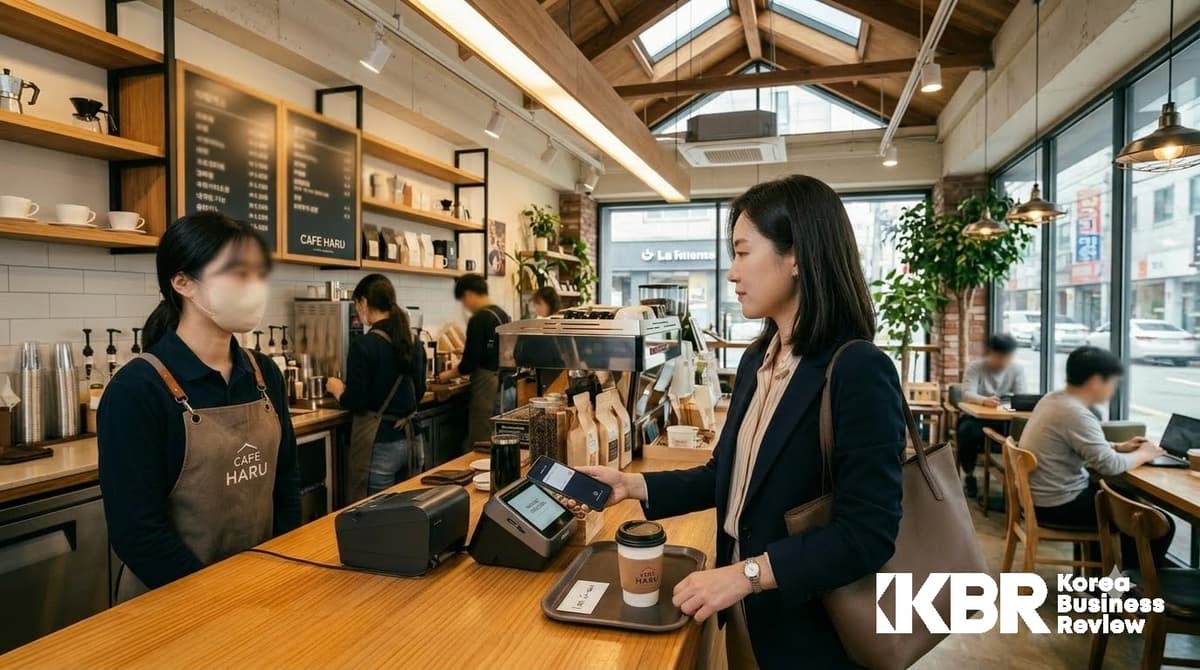
How long has it been since you last opened your wallet? At convenience stores, payments are made by tapping a card or smartphone against a terminal, and online shopping ends with a six-digit simple payment password. Meal expenses split with friends are settled via bank transfers or simple remittances. The need to touch physical banknotes and coins itself has sharply diminished. This tangible feeling is clearly confirmed by statistics. Based on Bank of Korea surveys, the proportion of cash among payments made by domestic adults has dropped to 15.9% by transaction count. This is less than 1 in 6 payments. Considering that the cash proportion was 41.3% in the same survey in 2013, it has decreased by 61.5% compared to 2013 over an 11-year period, leaving only 38.5% of the level at that time. 

Based on official statistics from institutions like the Bank of Korea and the Financial Supervisory Service, this report examines how much the use of physical currency has actually decreased, what payment methods are filling that void, and what challenges the 'cashless society' leaves behind.


1 in 6 Payments... The Retreat of Cash Confirmed by Official Statistics

The most authoritative evidence is the '2024 Survey on Payment Methods and Mobile Financial Services Usage Behavior' released by the Bank of Korea on March 25, 2025. In this survey of 3,551 adults aged 19 and older nationwide, the proportion of cash usage among payment methods was tallied at 15.9% by transaction count. It ranked third after credit cards (46.2%) and check cards (16.4%), with mobile cards (12.9%) closely trailing cash. Looking at the trend in the proportion of cash usage, the downward trend reveals that it is not a temporary phenomenon but a structural flow. The cash proportion, which stood at 41.3% in 2013, passed through 26.4% in 2019 and 21.6% in 2021 before falling to the mid-10% range in the 2024 survey. Looking at it on an amount basis, the direction is the same. 

According to the Bank of Korea's 'Survey on Cash Usage Behavior by Economic Agent', the proportion of cash in total household expenditures fell from 38.8% in 2015 to 21.6% in 2021, while the proportion of credit and check cards expanded significantly from 37.4% to 58.3% over the same period. Cash is also falling behind in consumer satisfaction evaluations. In the 2024 survey, payment method satisfaction combining convenience, safety, acceptability, and cost was led by credit cards at 75.5 points, check cards at 72.9 points, cash at 64.4 points, and prepaid balances at 54.5 points in order, with cash clearly lagging behind card types.


Simple Payments Exceeding KRW 1 Trillion Daily, 'Card-Not-Present' Payments Also Exceeding Half... The Protagonists Who Filled the Void of Cash

The space vacated by cash is being rapidly filled by digital payments based on cards, simple payments, and bank transfers. According to the 'Status of Electronic Payment Services Use in 2025' released by the Bank of Korea on March 20, 2026, the usage scale of simple payment services represented by Kakao Pay, Naver Pay, Toss, and others in 2025 averaged 35.57 million transactions and KRW 1.1053 trillion per day, increasing by 14.9% and 14.6% year-on-year, respectively. Simply annualized (daily average x 365 days), this amounts to roughly KRW 403 trillion. However, this is a reference figure obtained by mechanically annualizing transaction amounts in the simple payment service category, and it does not equal the total scale of domestic non-cash payments, making direct comparisons with other payment method statistics such as payment cards and bank transfers difficult. 

Electronic Payment Gateway (PG) services handling online shopping payments also saw their daily average usage amount increase by 9.2% year-on-year to KRW 1.5542 trillion, with the number of transactions growing by 11.8% to 33.64 million. The usage amount of prepaid electronic payment instruments, which are used to pay and remit with pre-charged funds, also expanded by 11.0% to a daily average of KRW 1.3051 trillion. Changes in the landscape within the simple payment market are also noteworthy. In 2025, the proportion of simple payment amounts held by electronic financial businesses such as Kakao Pay and Naver Pay rose by 4.4 percentage points year-on-year to 54.9% from 50.5% the previous year, whereas mobile device manufacturers like Samsung Pay saw their share decline to 23.7% and financial institutions like banks saw theirs drop to 21.5%. This means that fintech platforms centered on electronic financial businesses are expanding their share in the simple payment market. Cash is also being pushed out of financial transactions between individuals. Simple remittances and bank transfers now take over the roles previously played by cash in congratulatory and condolence money or Dutch pay settlements. The usage amount of simple remittance services based on prepaid electronic payment instruments grew by 7.3% year-on-year to a daily average of KRW 978.5 billion in 2025, and the number of transactions increased by 2.9% to 7.42 million. The popularization of mobile finance also underpins this trend. 

In the 2024 survey, 81.3% of adults answered that they had experience using mobile financial services within the past month, a figure 15.9 percentage points higher than in 2021 (65.4%). For those in their 20s to 40s, the experience rate exceeded 95%, and for those aged 60 and above, it nearly doubled to 53.8% compared to 2021 (28.9%). This trend is confirmed in even greater detail in the '2025 Domestic Payment Trends' released by the Bank of Korea on March 30, 2026. According to this announcement, the total daily average usage scale of payment cards, including credit and check cards, rose 4.7% year-on-year to KRW 3.6 trillion from KRW 3.4 trillion the previous year. Narrowing the scope to the daily usage amount of personal and corporate credit and check cards at domestic merchants among these, it rose 3.6% from the previous year to KRW 3.1 trillion. Among this domestic merchant usage amount, mobile, PC, biometric, and other payments where physical cards are not presented reached KRW 1.7 trillion (up 7.3%), surpassing physical card payments of KRW 1.4 trillion (down 0.4%). Both of these amounts and the 54.3% proportion are rounded figures from Bank of Korea announcement data, and minor discrepancies may occur if recalculated through simple division. As a result, the proportion of card-not-present payment methods in domestic merchant card payments continued its upward trajectory, climbing from 52.4% in 2024 to 54.3% in 2025. It should be noted that this 54.3% is not the proportion of smartphone payments alone, but the proportion of all payments where physical cards are not presented, including mobile devices, PCs, and biometrics. The year when payments using mobile devices and other card-not-present methods first surpassed physical card payments is 2023, not 2025. 

According to media reports citing Bank of Korea announcements, this proportion steadily increased from 38.6% in 2019 to 44.1% in 2020, 47.1% in 2021, and 48.4% in 2022, before recording 50.5% in 2023 to outpace physical cards (49.5%) for the first time ever, and subsequently widening the gap to 52.4% in 2024 and 54.3% in 2025. While the figures for 2024 and 2025 were directly verified from the original Bank of Korea announcement text, the annual series for 2019–2022 relied on media re-citations. Over the same period, the daily average usage scale of internet banking and mobile banking at domestic banks also increased by 10.9% and 3.4% to 28.29 million transactions and KRW 90.1 trillion, respectively, clearly showing a trend where not only card payments but also account-based financial transactions are being reorganized around mobile platforms.


Commercial Bank ATMs Decrease by 7,700 Units Since Late 2020... The Reduction of Cash Infrastructure

The decline in cash usage is leading to a contraction of the physical infrastructure that handles cash. The ATM statistics covered here are not total domestic ATMs, but are based on commercial bank-operated ATMs subject to Financial Supervisory Service compilation. Based on commercial bank ATMs analyzed by a National Assembly member's office using FSS data, approximately 7,700 units have decreased from the end of 2020 through mid-2025. However, total installation counts appear differently depending on the compilation targets and baseline dates of each member's office. 

Specifically, in data released by Representative Lee Yang-soo's office, ATMs across 16 banks decreased by 7,727 units from 37,537 at the end of 2020 to 29,810 in June 2025. Having decreased every year to 35,307 in 2021, 33,165 in 2022, 31,538 in 2023, and 30,384 in 2024, the 30,000-unit threshold ultimately collapsed. In data separately received by Representative Choo Kyung-ho's office, it decreased by 22.9% (7,720 units) from 33,707 in 2020 to 25,987 in July 2025. 

Although the total volumes in the two data sets differ, the reduction figures virtually coincide around 7,700 units, identically supporting the direction that "commercial bank ATMs have decreased by about 7,700 units over four and a half years." Among the top 5 commercial banks, KB Kookmin Bank experienced the largest reduction at 1,583 units (27.4%), falling from 5,785 ATMs at the end of 2020 to 4,202 in July 2025, followed by Woori (24.8%), NH Nonghyup (23.6%), Shinhan (23.6%), and Hana (6.3%) banks in that order. This is the result of bank branch consolidation intersecting with the expansion of non-face-to-face transactions. Voices within the banking sector point out that maintenance is difficult as users have significantly dwindled relative to the annual operating cost burden per ATM. 

A similar trend is observed in the convenience store industry. Based on industry tabulations, the number of convenience store-operated ATM stores across the big four convenience store chains (GS25, CU, Seven-Eleven, Emart24) stood at 31,871 locations at the end of June 2025, down 142 locations from the end of 2024 (32,013 locations). However, reports indicate that withdrawal demand for convenience store ATMs is actually increasing, centered around regions where bank ATMs have decreased, showing an aspect where the 'contraction of total volume' and 'channel migration' of cash infrastructure are proceeding simultaneously. Amidst this process, concerns are being raised about the deterioration of cash accessibility for financial vulnerable groups. Pointing out that cash infrastructure possesses characteristics of a public good to a certain extent when considering disaster or communication failure situations and the elderly who are unaccustomed to digital finance, this concern is valid. 

According to data from Representative Choo Kyung-ho's office, ATM reduction rates by region appeared in the order of Ulsan (28.4%), Gyeongbuk (27.3%), Gyeongnam (27.1%), Busan (26.7%), Daegu (25.4%), Chungbuk (24.2%), and Seoul (23.9%), with reduction rates in non-metropolitan areas generally appearing higher. This raises concerns that the contraction of cash infrastructure could intertwine with regional financial disparity issues. In response, the four major banks—KB Kookmin, Shinhan, Hana, and Woori—along with the Korea Federation of Banks launched a project to install joint ATMs in traditional markets to supplement accessibility for financially vulnerable groups, but as of September 2025 reports, the number of nationwide installations stood at only four locations.


Cash Still Does Not Disappear... 88% Still Have Experience in Face-to-Face Transactions

The decline in the cash proportion does not mean the extinction of cash. In the same 2024 Bank of Korea survey, responses stating they had experience using cash in face-to-face transactions within the past month reached 88.0%. Although its proportion in payment transactions has dropped, it means that the vast majority of citizens still use cash somewhere in their daily lives. Temperature differences across age groups are also distinct. 

When asked about preferred payment methods, respondents in their 20s and 30s picked mobile cards and those in their 40s and 50s picked credit cards, whereas among those aged 60 and older, the response favoring cash was relatively high at 30.2%. Experiences of having cash payments refused are also increasing. Based on Bank of Korea surveys, the proportion of responses indicating they had experienced cash payment refusal rose from 0.5% in 2018 to 6.9% in 2021. 

With the spread of 'cashless stores' such as Starbucks, controversies over the infringement of consumers' right to choose payment methods have also continued. Interestingly, even while cash is being pushed out of payments, the demand for currency itself has not completely vanished. Beyond its function as a payment method, cash also functions as a store of value, meaning holding demand that is not captured in payment statistics exists separately. 

The Bank of Korea consistently emphasizes the necessity of physical currency even in situations where cash usage is decreasing. The intent is to maintain the functions of cash, which prevents financial alienation among vulnerable groups and serves as a last-resort payment method during emergencies such as computer failures or disasters. Accordingly, the policy direction presented by the Bank of Korea is to ensure there are no inconveniences in cash usage while simultaneously expanding education for digital financial vulnerable groups to create an environment where they can freely use non-cash payment methods as well.


The Shadow of the Non-Cash Era... 'Safety' is What Consumers Value Most

New anxieties have entered the space vacated by cash. In the 2024 Bank of Korea survey, the item respondents answered they value most among the characteristics of payment methods was safety (47.9%) rather than convenience. 

This is interpreted as the result of increased possibilities for personal and payment information leaks as the use of non-cash payment methods grows, along with mounting concerns over payment service-related security accidents such as voice phishing and smishing. Actual damage experiences are also at a level that cannot be ignored. In the same survey, responses indicating they had experienced payment method security-related accidents within the past year were tallied at 4.9%, with accident types led by loss (2.5%), voice phishing (1.9%), and smishing (0.5%) in order. When asked about tasks to minimize security accidents and losses, 31.5% of respondents selected 'strengthening consumer protection such as compensation when accidents occur' as their top choice. While cash accumulates relatively little electronic payment information during the payment process, digital payments entail new risks of information leaks and fraud damages in exchange for convenience. This is the background behind the pointed view that the advancement of financial security systems must keep pace with the speed of transition to a cashless society. 

Meanwhile, the digitalization of payment is progressing beyond national borders as well. Respondents who had experience paying overseas within the past year answered that they used payment methods in the order of physical cards (16.4%), local currency cash (4.1%), and mobile payments (2.2%), showing that cards maintain an overwhelming advantage over cash even abroad. 

When paying overseas with physical cards, the credit card usage rate reached 89.2%, and respondents with experience paying with mobile devices abroad answered that they used them most in Japan (42.8%) and Southeast Asia (24.9%). The overseas travel scenery of exchanging bundles of local currency at exchange booths is essentially becoming a thing of the past.


The Next Phase is the 'Digital Won'... CBDC Experiments and Stablecoin Debates

The next phase of the cashless society is the digitalization of currency itself. The Bank of Korea has been conducting 'Project Hangang', a demonstration project where the central bank issues blockchain-based wholesale central bank digital currency (CBDC), and commercial banks issue deposit tokens based on it for general citizens to utilize in actual payments. 

In the Phase 1 live transaction test conducted from April to June 2025, 81,000 participants based on electronic wallets participated and traded 114,880 transactions using deposit tokens, with the number of transactions per participant standing at a mere 1.4, pointing to a lack of use cases and insufficient convenience as challenges. To supplement these limitations, the Financial Services Commission newly designated five innovative financial services at its regular meeting on July 15, 2026, including the 'implementation of Phase 2 of the deposit token-based payment settlement test within the Bank of Korea digital currency (CBDC) system (Project Hangang).' With this, the cumulative designation count of innovative financial services reached 1,111. Participating banks expanded to 9 with Gyeongnam Bank and iMBank newly joining the existing 7 (KB Kookmin, Shinhan, Hana, Woori, NH Nonghyup, IBK Industrial Bank of Korea, and Busan), and the scale of deposit token user wallets expanded fivefold from a maximum of 100,000 in Phase 1 to 500,000. The holding limit per wallet was also significantly raised from KRW 1 million (cumulative KRW 5 million) to KRW 10 million (cumulative KRW 100 million). Use cases expanded from general merchants to small business owners and large enterprises, while peer-to-peer remittances, biometric authentication, non-face-to-face electronic wallet opening for business operators, and cash receipt issuance functions were newly added, alongside the introduction of a function that automatically converts to deposit tokens if account deposit balances are insufficient. 

As of August 8, 2026, participating banks are proceeding with final pilot tests and merchant linkage developments ahead of live transactions with the general public. IBK Industrial Bank of Korea signed a business agreement with the Bank of Korea and GS Retail to proceed with system linkage development enabling deposit token payments at GS25 convenience stores, and electronic payment (PG) company KG Inicis also participated in Phase 2 to build a payment network enabling merchants to receive deposit tokens without separate system development. 

The specific timing for the commencement of live transactions has not been officially finalized as of August 8, 2026, and some quarters in the financial sector project it could begin around September at the earliest. In Phase 2, a pilot project to disburse government subsidies and vouchers as deposit tokens is also being promoted concurrently, with the project slated for demonstration first being the Ministry of Climate, Energy and Environment's electric vehicle charging facility subsidy disbursements, having completed document verification for applicant business operators as of the end of June 2026. Discussions on introducing a won-stablecoin are also overlapping here, but this is still at the legislative and policy discussion stage and has not been finalized or commercialized. Bank of Korea Governor Rhee Chang-yong, who took office on April 21, 2026, is a figure who has researched wholesale CBDC and deposit token combination structures since his days at the Bank for International Settlements (BIS). Based on this, observations are emerging in the financial sector that this policy direction will be maintained for the time being.

In summary, the retreat of physical cash is a structural flow already confirmed by official statistics. The proportion of cash by payment transaction count has fallen by about 61.5% from 41.3% in 2013 to 15.9%, more than half (54.3%) of domestic merchant card payments as of 2025 are made through card-not-present methods, and simple payments have grown to a scale exceeding KRW 1 trillion daily. 

Conversely, commercial bank ATMs have decreased by approximately 7,700 units over four and a half years since the end of 2020. However, 88% of face-to-face transactions still experience cash, and cash remains an irreplaceable means for the elderly and vulnerable groups. Amidst the blitz of the 'cashless society', how to maintain the safety net of cash accessibility is expected to become a core challenge moving forward.

KBR Access

KBR Analysis 콘텐츠는 Premium 전용 콘텐츠입니다

이 콘텐츠는 Premium 회원에게 제공되는 프리미엄 콘텐츠입니다. Premium은 1개월 이용권 34,900원 또는 월 정기결제 29,900원이며, 결제 시 1개월 이용권(1회 결제·자동갱신 없음) 또는 월 정기결제(매월 자동결제)를 선택할 수 있습니다. ESG, KBR 아티클, KBR Analysis 등 핵심 프리미엄 콘텐츠를 열람할 수 있습니다.

이번 달 열람 현황: 0 / 0건 사용