The Big Picture of Capital Flows
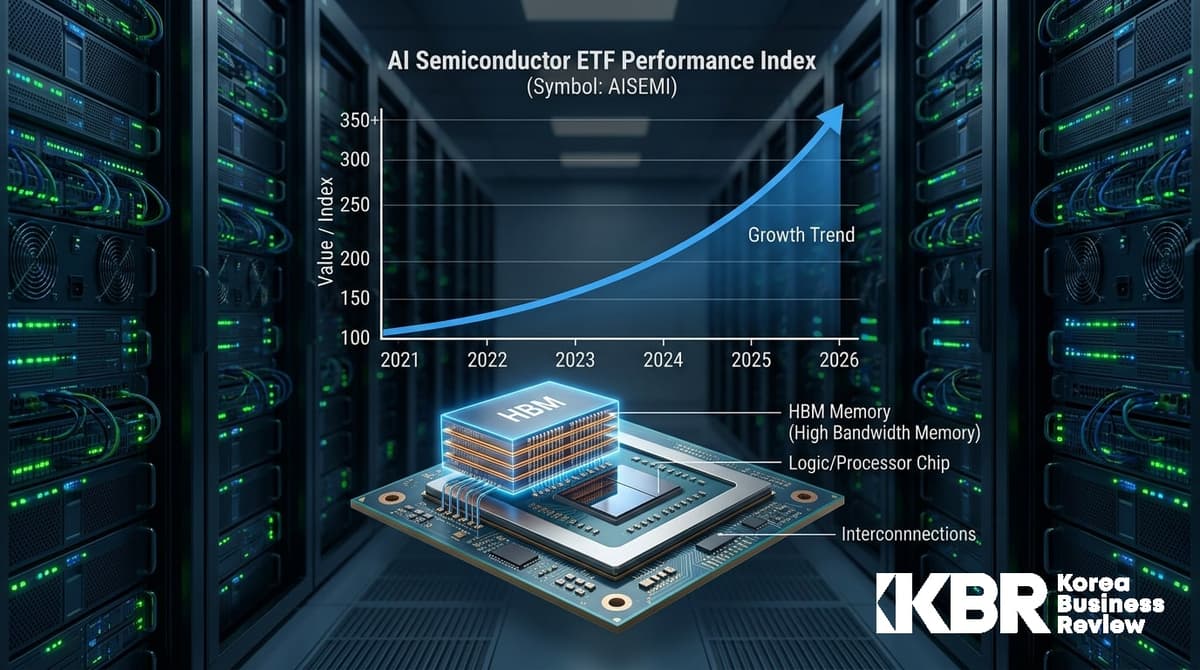
In the domestic ETF market in the first half of this year, retail investor funds are rapidly flocking to AI and semiconductor themes. In particular, the market's focus is gaining traction around the 'AI memory beneficiary' structure centered on Samsung Electronics and SK Hynix, rather than the semiconductor industry as a whole.
Looking at the actual pace of capital inflows, compressed ETFs featuring TOP2 or TOP2-plus formats are showing much stronger absorption capacity than products broadly containing the entire semiconductor value chain. This suggests that retail investors are responding more strongly to intuitive investment stories centered on large-cap memory stocks rather than complex corporate analyses by process.
Actual Capital Flowing into Representative ETFs
The most symbolic case is the SOL AI Semiconductor TOP2 Plus. As of early June 2026, this ETF surpassed 5 trillion won in net assets, and cumulative net purchases by retail investors were tallied at 2.6579 trillion won.
Looking solely at the end of May, the net assets of the same ETF exceeded 3.5 trillion won, and cumulative retail net purchases since listing reached 1.9729 trillion won. This starkly illustrates the intensity of retail capital concentration, given that it grew into a multi-trillion-won ETF just over two months after its listing.
The KODEX AI Semiconductor TOP2 Plus showed a similar trend. This product recorded net assets of 4.1914 trillion won as of early June, with 394.0 billion won in retail net purchases flowing in within 13 trading days after its renewal.
The ACE AI Semiconductor TOP3+ also received strong capital inflows. As of the end of April, year-to-date retail net purchases were tallied at 105.5 billion won, total capital inflows at 274.8 billion won, and net assets at 731.7 billion won.
Structure of Domestic AI Semiconductor ETFs
Currently, domestic AI semiconductor ETFs can generally be divided into three categories. The first is compressed TOP2 or TOP3 types with increased weightings in Samsung Electronics and SK Hynix, the second is process-specialized types focusing on specific value chains such as parts/materials/equipment (Sabu-jang), back-end processes, and core processes, and the third is comprehensive types that more broadly contain the overall semiconductor industry.
However, the category that received the most market selection this year was the compressed products. This is why evaluations are emerging that although they are named ETFs, they are functionally serving as a vehicle for indirect concentrated investment in South Korea's large-cap memory stocks.
Investment Rationale Created by HBM and AI Data Center Demand
Behind the influx of retail investors into these ETFs lies a clear investment rationale: the expansion of demand for HBM and AI data centers. There is a strong perception in the market that expanded AI infrastructure investment boosts GPU demand, which in turn leads to increased demand for HBM and server memory.
Amid this trend, Samsung Electronics and SK Hynix are perceived as the stocks expected to receive the most direct benefits in the domestic stock market. Ultimately, when the ETF names include 'AI Semiconductor' and 'TOP2 Plus' and top holdings are concentrated in these large-cap stocks, it becomes easy for retail investors to accept the investment rationale without complex technical analysis.
How Retail Investors Process the Information
Rather than analyzing all the detailed technologies of semiconductor processes or the competitive landscape of equipment and material companies, retail investors tend to quickly understand the character of a product through its ETF name and top holdings. In this context, names like 'AI Semiconductor TOP2 Plus' deliver a very intuitive message to investors.
In other words, the current capital inflow is closer to a 'bundled investment in AI memory beneficiaries' rather than an 'investment in the entire AI semiconductor value chain.' The phenomenon where related product names repeatedly appear among the top retail net-purchase ETFs this year aligns with this interpretation.
Advantages and Limitations of ETF Structures
The advantages of these products are clear. They allow investors to include Samsung Electronics, SK Hynix, and some related value-chain companies all at once, reducing the burden of picking individual stocks directly.
However, ETFs with excessive weight concentrations in the two major memory stocks are far from being broad diversification products in the traditional sense. This is because the overall yield and volatility of the ETF can be significantly shaken depending on the performance of specific large-cap stocks, memory market conditions, export regulations, and valuation changes.
What is Actually Happening
What is happening in the domestic ETF market right now is not simply an expansion of theme investments. While funds are entering under the names of AI and semiconductors, in reality, the concentration phenomenon in large-cap memory stocks centered around Samsung Electronics and SK Hynix is being further reinforced through ETFs.
Therefore, to accurately describe the current trend, a single line stating 'money is flocking to AI semiconductor ETFs' is insufficient. A more accurate expression is closer to 'retail investor funds are concentrating on AI semiconductor ETFs centered around the top two Korean memory stocks.'