DEEP ANALYSIS
Not Just Due to Regulations: 4 Reasons Why Uber and Grab Do Not Work in South Korea
The absence of Uber and Grab cannot be explained by a single line stating they were blocked by regulations. While private car ride-sharing services like UberX are illegal under the Passenger Transport Service Act, Uber remains in a transformed state as a 'taxi-hailing app' rather than fully withdrawing, and Grab never entered South Korea in the first place. The 'Tada incident' was a critical turning point; even though the court ruled it legal, the passage of the anti-Tada law in the National Assembly in 2020 and its dismissal by the Constitutional Court solidified the reality that mobility services operating outside the traditional framework of taxis struggle to survive in South Korea. Uber's sluggish performance was also a strategic miscalculation. Its 'occupy first, negotiate later' approach clashed with the organized taxi industry and dense public transportation, whereas Kakao secured over 90% of the market with 'Kakao T,' which embraced existing taxis (recording approximately 13.58 million MAU as of February 2026). Uber's counterattack in 2026 also failed to narrow the gap; users who briefly increased through the Uber One subscription and Naver partnership dwindled back to about 650,000 as the 'Naver effect' faded, leading Uber to pivot toward niche strategies such as foreign and tourist demand and 'Uber rental.' Autonomous driving has emerged as a variable that will shake all balances anew. With robotaxis becoming commonplace in the U.S. and China, and the Bank of Korea suggesting regulatory relaxation, the full-scale realization of robotaxis will inevitably force a reexamination of the logic behind the current Passenger Transport Act, which has blocked private vehicle operations.
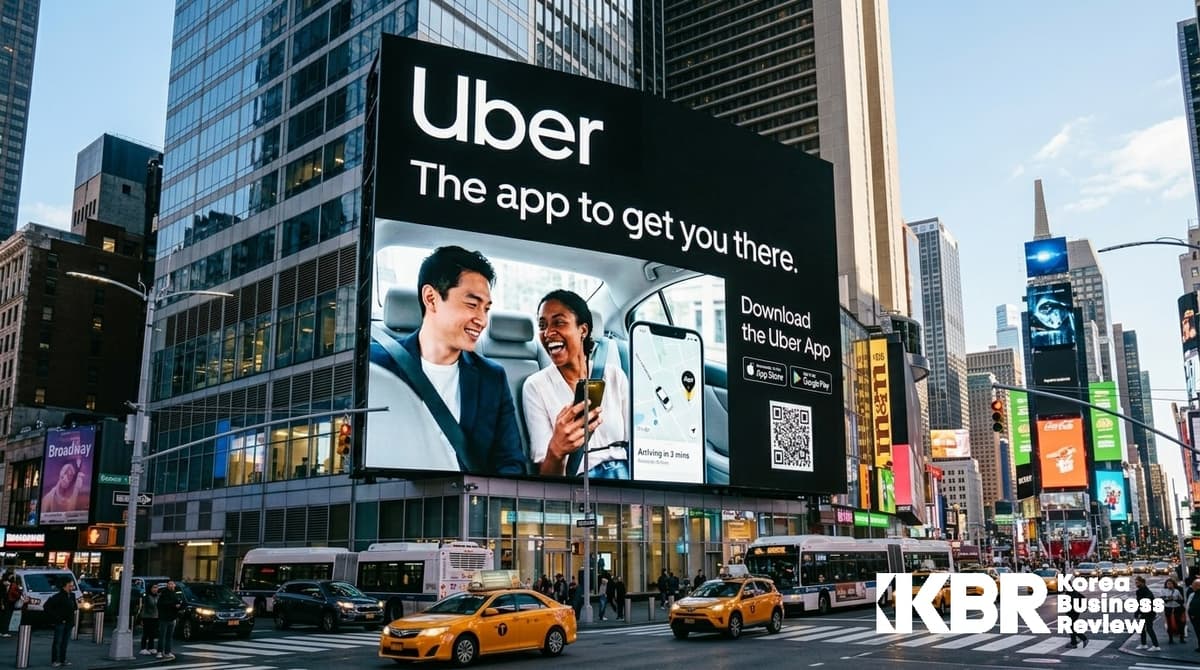
The absence of Uber and Grab cannot be explained by a single line stating they were blocked by regulations. While private car ride-sharing services like UberX are illegal under the Passenger Transport Service Act, Uber remains in a transformed state as a 'taxi-hailing app' rather than fully withdrawing, and Grab never entered South Korea in the first place. The 'Tada incident' was a critical turning point; even though the court ruled it legal, the passage of the anti-Tada law in the National Assembly in 2020 and its dismissal by the Constitutional Court solidified the reality that mobility services operating outside the traditional framework of taxis struggle to survive in South Korea. Uber's sluggish performance was also a strategic miscalculation. Its 'occupy first, negotiate later' approach clashed with the organized taxi industry and dense public transportation, whereas Kakao secured over 90% of the market with 'Kakao T,' which embraced existing taxis (recording approximately 13.58 million MAU as of February 2026). Uber's counterattack in 2026 also failed to narrow the gap; users who briefly increased through the Uber One subscription and Naver partnership dwindled back to about 650,000 as the 'Naver effect' faded, leading Uber to pivot toward niche strategies such as foreign and tourist demand and 'Uber rental.' Autonomous driving has emerged as a variable that will shake all balances anew. With robotaxis becoming commonplace in the U.S. and China, and the Bank of Korea suggesting regulatory relaxation, the full-scale realization of robotaxis will inevitably force a reexamination of the logic behind the current Passenger Transport Act, which has blocked private vehicle operations.
The Real Reasons Uber and Grab Are…
KBR Access
You've used up this month's KBR News reads
Non-members can read a limited amount of KBR News content. Sign up for free or check the membership guide to keep reading.
This month's reading: 1 / 1 used
KBR NEWSLETTER
Sign up for free and get the KBR Newsletter!
Sign up and opt in to the newsletter to receive KBR's curated business and economic insights by email.
LATEST IN TOPIC
Latest in this topic
 Why Germans Overestimated Chinese Investment by 30x, and Why Trust Doesn't Change Even When the Numbers Are Corrected
 Vietnam, Once Called the Land of Opportunity: Is It Still?
 Seoul Ranks 5th Globally in Innovation Clusters: Conditions for Collaboration and Commercialization that Businesses Must Read from WIPO Rankings
RELATED CONTENT
Related Content