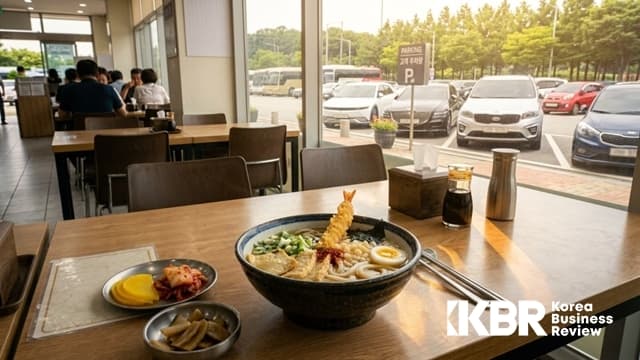
A bowl of shrimp tempura udon at a highway rest area costs 7,500 won. Forty percent of that price is not for the food, but for commissions.
The true face of a 40-year cartel revealed by an audit of the Ministry of Land, Infrastructure and Transport is contained within this single bowl. [Photo = Korea Business Review DB]
On May 7, 2026, the Ministry of Land, Infrastructure and Transport (MOLIT) officially announced the results of an audit into the operational adequacy of highway rest facilities, conducted since January of this year targeting the Korea Expressway Corporation (EX) and 'Dosunghoe,' an association of retired EX employees. The findings provided a structural and clear answer for the first time to the vague grievances that countless drivers have felt for decades—namely, the question of why rest area food is expensive and unpalatable.
The issue went beyond simply high labor costs or rents. An entrenched interest cartel solidified over 40 years has been driving up the price of every bowl of udon on the highway. The situation is even more critical because this structure has been maintained for a long time without any regulatory intervention, capitalizing on the unique characteristic of a monopoly market where consumers have virtually no alternatives.
How Much Is a Bowl of Udon Now?
The price of udon at highway rest areas has already surpassed the level of general specialty restaurants over the past several years.
According to on-site reporting in December 2025, skewered fish cake udon was sold at 7,000 won and shrimp tempura udon at 7,500 won at highway rest areas, exceeding the prices at specialized udon franchise stores. It was also confirmed that ox-head soup (somorigukbap) was sold at 13,000 won, spicy beef soup (yukgaejang) and loin pork cutlet (deungsim donkatsu) at 11,000 won each, and certain beef bone soup (gomtang) menus at 20,000 won. One rest area user stated that a family of four, including two children, ordered only three items and the bill came to 32,500 won, noting that this is higher than what they usually spend at specialized restaurants outside.
Snack prices are no exception. Walnut pastries, a representative rest area snack, rose from 2,000 won for an 8-piece package in 2020 to 3,000 won, recording a 50% increase over five years. 'Sotteok sotteok' (skewered rice cake and sausage) is being sold at 4,500 won, up about 30% over four years from 3,500 won at the time of its broadcast popularity. Consumer complaints continue that despite an increase in visitors driven by recent TV variety shows and social media trends, rest area prices continue to soar. One user vented, "Just 3 to 4 years ago, if you brought 10,000 won you could pick this and that, but now buying two items is the end."
This audit and government investigation clearly revealed that such soaring prices stem from structural causes rather than simple inflation.
The Korea Expressway Corporation began a pilot operation of the 'Rest Area Food Price Disclosure System' in November 2024, starting to publish the lowest, highest, and average prices of the top 10 revenue-generating products—including udon, pork cutlet, soup, bibimbap, ramen, and walnut pastries—by rest area and route on its official website. Ironically, this highlights how long the information-opaque structure lasted, which previously prevented consumers from comparing prices at all. For over 30 years, consumers had no way of knowing how much udon cost at any given rest area.
Core of the Pricing Structure: The Three-Stage Commission System of EX, Operating Companies, and Tenants
The core structure making highway rest area food expensive lies in a three-stage multi-layered commission system. When the Korea Expressway Corporation leases rest area operating rights to private operators, a double-leasing structure is formed wherein these operators collect commissions from tenant businesses such as restaurants, cafes, and snack shops.
According to the Korea Expressway Corporation's highway public data portal, as of June 2025, there were 207 highway rest areas nationwide. Among them, 15 are privately funded rest areas, while the remaining 192 are consignment-type operations where the Expressway Corporation owns the buildings and grants operating rights to private companies in exchange for rent.
The government itself has officially acknowledged the severity of the burden this places on consumers. In November 2025, Chief of Staff Kang Hoon-sik of the Presidential Secretariat officially pointed out at a senior secretaries' meeting that highway rest area operators were collecting high commissions averaging nearly 40%. He urged a fundamental overhaul of the overall operating structure under the principle of prioritizing public interest, such as significantly expanding directly managed rest areas operated by public institutions under the Expressway Corporation. Applying this to a 7,000-won bowl of udon, about 2,800 won of the amount paid by the consumer goes toward commissions unrelated to food ingredients or cooking.
According to industry insiders, when selling a 10,000-won pork cutlet, the Expressway Corporation takes 14% to 16% and the operator takes 3% to 4%. Consequently, some point out that the core of the discussion is not whether operators are profiteering, but rather how much rental income the Expressway Corporation is willing to give up. An operator representative protested, "People say operators are profiteering, but the operating profit margin of a rest area is only at a single-digit level."
Ultimately, in this three-stage structure of EX → operating company → tenant small business owner, a significant portion of the money paid by consumers is distributed into commissions and rent rather than food ingredients or service. Tenant businesses, forced to survive on remaining profits alone, have no choice but to cut ingredient costs or raise prices. This means that consumers' long-standing complaints about high prices paired with poor taste are by no means merely a matter of personal preference.
Furthermore, the fact that highway rest areas operate as structurally monopolistic markets with controlled entry and exit acts as a background fueling price hikes. Drivers on long trips have virtually no choice but to use a given rest area when they need to eat or use the restroom, preventing consumers from exercising choices with their feet as they would in general commercial districts.
This monopoly leads to a lack of price competition, resulting in cumulative food price hikes outpacing the inflation rate every year.
The Reality of the 40-Year Cartel: Dosunghoe and H&DE
The core issue uncovered in this MOLIT audit extended far beyond a simple commission structure.
On May 7, 2026, the Ministry of Land, Infrastructure and Transport announced the results of an audit conducted since January regarding the adequacy of highway rest facility operations by the Korea Expressway Corporation and Dosunghoe, a non-profit corporation and association of the corporation's retirees. The Ministry stated it was confirmed that Dosunghoe, since its establishment in February 1984, has spent approximately 40 years engaging exclusively in member fellowship while completely failing to carry out activities related to the public-interest project purposes stipulated in its articles of incorporation. H&DE was established in 1986 with 100% investment from Dosunghoe, and The Way Distribution was established in 2018 with 100% investment from H&DE.
The investigation showed that Dosunghoe established its subsidiary H&DE to participate in the highway rest area operating business, receiving dividends from those profits to distribute to members under the guise of birthday congratulatory money, congratulatory and condolence money, and souvenirs. MOLIT pointed out that while each member paid 550,000 won in dues, the amount received reached 2,440,000 won, creating a structure where members could receive at least four times their paid dues in congratulatory and condolence funds.
According to MOLIT's announcement, Dosunghoe secured an annual average of 880 million won in dividends from its subsidiary H&DE over the past 10 years, of which about 400 million won was paid to members as congratulatory and condolence money. As of the end of last year, Dosunghoe's accumulated savings deposits reached approximately 2.5 billion won.
This audit officially confirmed criticisms that a non-profit corporation has practically operated a for-profit business and distributed profits privately, utilizing public infrastructure like highway rest areas as a private safe for a specific group.
Tax Evasion and Preferential Bidding: The Ugly Truth of 40 Years of Malpractice
The audit results extended even to allegations of tax evasion and preferential contracts. According to MOLIT's audit, Dosunghoe distributed profits earned through its subsidiary H&DE to members while treating them as if they were used for the non-profit corporation's intrinsic purpose projects, thereby evading taxation on about 400 million won of taxable income annually. MOLIT stated that this amounted to continuous tax evasion abusing tax-exempt benefits granted to non-profit corporations.
Circumstances indicating preferential treatment by the Expressway Corporation were also uncovered. According to the audit results, in October 2015, the Expressway Corporation provided the convenience store operating rights within the Munmak Rest Area (Seochang direction) to H&DE without bidding. To eradicate practices inconsistent with the non-profit corporation system, such as Dosunghoe's profit distribution, MOLIT demanded measures including the amendment of articles of incorporation, requested a tax investigation by the National Tax Service regarding the tax evasion allegations, and decided to refer related allegations of wrongdoing to investigative agencies.
In addition, when the Expressway Corporation pursued a private-investment-style remodeling pilot project for four aging rest facilities last year, it recognized Dosunghoe-affiliated companies as separate corporate entities and granted them additional gas station operating rights. The audit confirmed circumstances in which bidding schedules and price information were leaked in advance during this process.
This audit was conducted in response to persistent pointed criticisms by the National Assembly and media outlets that a retired employees' association of the Expressway Corporation had effectively maintained rest area operating rights for a prolonged period. MOLIT decided to correct the rest area operation structure of Dosunghoe's subsidiaries and push for disciplinary actions and investigations against the Expressway Corporation and related parties.
This audit marks the first time that a structure which remained unshaken despite criticisms repeated every year during parliamentary audits since the establishment in 1984 has officially entered a dissolution procedure.
Government Initiates Structural Reform: Launch of Emergency Management Team and Establishment of Management Corporation
The Korea Expressway Corporation announced that it has launched an independent organization, the 'Emergency Management Team (TF),' directly under the acting president to formulate fundamental improvement measures for overall highway rest area operations. It plans to establish criteria for disadvantages—such as excluding retired employee associations from participating in rest area bidding—and formulate high-intensity measures to improve the fairness and transparency of operating service evaluations.
Through a rest area operation structure reform task force, MOLIT is reviewing reform measures such as operating rest areas without going through intermediary operating companies to fundamentally overhaul the multi-layered and excessive commission structure.
Furthermore, the government is pushing to establish a public enterprise dedicated to direct management as a core means of structural reform. According to industry sources, the government plans to establish a specialized management company under the Expressway Corporation to directly operate rest areas as early as the first half of 2027. Internal plans are prepared to transition to a direct management system starting with five newly opened rest areas in 2026 and expanding to dozens in 2027. A government official stated, "If profits are minimized to align with public interest, it can give consumers a considerable effect of reducing food prices."
This is effectively a form of resurrection for the Korea Expressway Management Corporation, which disappeared through privatization in the 1990s, and is interpreted as a signal that the government will drastically revise its existing policy stance, which had favored private consignment.
Once intermediary operating companies are removed, tenant small business owners will sign direct contracts with EX, creating a structure where the commission burden, which previously reached up to 40%, can be substantially lowered.
Minister of Land, Infrastructure and Transport Park Yoon-deok emphasized, "This is the first step to eradicate the cartel cemented for decades among the Expressway Corporation, retirees, and rest area operators, and to return highway rest areas to the public. We will swiftly and thoroughly carry out the reform work on the rest facility operating structure."
Now that the end of a cartel lasting over 40 years has been declared, public attention is focused on the speed of actions rather than words to see how much the reform can actually lower the price of a bowl of udon.