
Korea Business Review

issue-briefing

An Era of Labor-Robot Conflict: Can Humans and Robots Coexist?

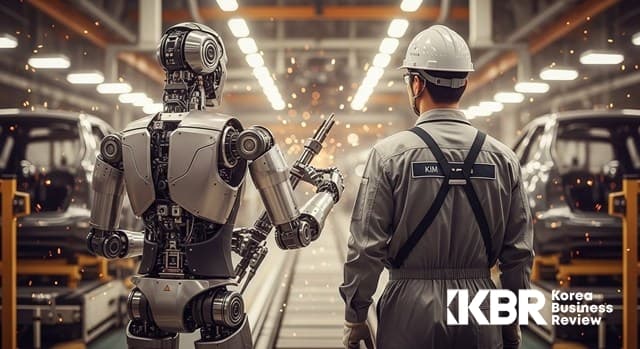
Humanoid robots and workers stand side by side at a production site, symbolically showing the expansion of manufacturing automation and the changing role of human labor. [Photo = Korea Business Review DB] Atlas Knocks on the Factory Door: At the CES 2026 media day held in Las Vegas, USA, in January 2026, Hyundai Motor Group unveiled Boston Dynamics' next-generation electric humanoid robot, 'Atlas.'
강지혜 기자Published 2026년 4월 22일Updated 2026년 8월 26일
Share
An Era of Labor-Robot Conflict: Can Humans and Robots Coexist?

Humanoid robots and workers stand side by side at a production site, symbolically showing the expansion of manufacturing automation and the changing role of human labor. [Photo = Korea Business Review DB] Atlas Knocks on the Factory Door: At the CES 2026 media day held in Las Vegas, USA, in January 2026, Hyundai Motor Group unveiled Boston Dynamics' next-generation electric humanoid robot, 'Atlas.'

Humanoid robots and workers stand side by side at a production site, symbolically showing the expansion of manufacturing automation and the changing role of human labor. [Photo = Korea Business Review DB]

Atlas Knocks on the Factory Door


At the CES 2026 media day held in Las Vegas, USA, in January 2026, Hyundai Motor Group unveiled Boston Dynamics' next-generation electric humanoid robot, 'Atlas.'

Introduced alongside a research model was 'The Atlas product,' a next-generation electric Atlas development model aimed at mass production by Hyundai Motor Group. This was received not merely as a technology demonstration, but as a scene showing Hyundai Motor Group's commercialization roadmap to apply humanoid robots to actual industrial sites.

Combining official explanations and domestic and international reports, Atlas is introduced as an electric humanoid equipped with 360-degree rotating joints and natural walking capabilities. Furthermore, domestic and international articles repeatedly cite explanations that this robot aims for a level of strength capable of handling heavy objects weighing around 50kg, and is being developed in the direction of performing repetitive tasks such as material unloading and component transport within factories. Therefore, rather than concluding on a single specific process, it is more accurate to summarize it as a robot targeting repetitive logistics and material tasks at manufacturing sites.

Hyundai Motor Group presented a roadmap to establish a mass-production system capable of producing 30,000 robots annually by 2028. According to the disclosed plan, Atlas is scheduled to be deployed to the Hyundai Motor Group Metaplant America (HMGMA), a new plant in Georgia, USA, in 2028 to be utilized for component sorting tasks, with discussions to expand its role to assembly and heavy material handling by 2030. In this way, Hyundai Motor Group views humanoids not simply as exhibition technology, but as a production means that can be phased into actual manufacturing processes.

However, this technological optimism was not immediately welcomed at the site. The Hyundai Motor union strongly protested, viewing that the deployment of humanoids could impact employment, working conditions, and the domestic production system, beyond merely improving productivity. This is because what is trying to enter the factory floor is not just a single robot, but a new production method that could shake the entire labor structure.

Union Opposition: Issues of Procedure and Employment Rather Than Technology Itself


The Hyundai Motor branch of the Korean Metal Workers' Union stated in its newsletter on January 22 that the relocation of overseas volume, introduction of new technologies, and robot automation were unilateral actions without labor-management agreement, declaring that they "can never be tolerated." It subsequently warned in the same newsletter, "Keep in mind that not a single robot can enter the site without labor-management agreement." This phrase has been repeatedly cited in various reports as an expression symbolically showing the union's aversion to the introduction of robots.

The union and the Korean Metal Workers' Union also raised the issue that "the deployment of AI robots to cut labor costs is becoming a reality," simultaneously raising concerns over employment stability and the reduction of domestic production volume. The important point here is that it is difficult to conclude that they fundamentally and totally reject the introduction of robots itself. To be more precise, it is more accurate to view them as arguing that, as the introduction of new technologies has a significant impact on employment and working conditions, it must go through labor-management agreement and consultation procedures in accordance with the collective agreement.

For this reason, interpreting the reaction of the Hyundai Motor union simply as a "21st-century Luddite movement rejecting machines" may excessively oversimplify reality. South Korea is an industrial nation that has already experienced a high level of automation and robot adoption. Therefore, the current issue is closer to the speed and method of introducing new technology and who will bear the cost, rather than whether or not to bring in robots.

The Reality of Replacement in Numbers: Between Fear and Facts


The figures surrounding the impact of AI and robots on the labor market are enormous, but most of those numbers are estimates derived under specific scenarios and premises.

In various scenario analyses, the McKinsey Global Institute has estimated that up to 400 million to 800 million workers worldwide could experience job changes due to automation by 2030.

Along with this, it is viewed that about 375 million people may need to transition from their current roles to other roles, which is more accurately read as an estimate of the need for job transitions rather than "confirmed layoffs." It is often abbreviated as "400 million to 800 million jobs replaced," but if a 99%-level expression is desired, it is safer to spell it out using terms such as "number of workers," "job changes," and "need for transition."

Goldman Sachs' perspective shares a similar context. Generative AI can affect a significant range of working hours and task contents, but at the same time, it is highly likely to create new jobs and industries, thereby increasing productivity in the long run. Therefore, Goldman Sachs' numbers should also be interpreted as a structural change outlook that the labor market can be reorganized, rather than a pessimistic sentence speaking only of "replacement."

Similar warnings are raised regarding South Korea. Professor Yong-seok Seo of the KAIST Munzile Future Strategy Graduate School presented at the Ministry of Economy and Finance Future Strategy Conference in 2025 that, in a scenario applying strong assumptions, up to 73.8% of domestic employed persons, or about 20.05 million people, could be affected by AI and automation. However, these figures are closer to upper limits where automation and AI can change task contents or job structures rather than "actual layoff numbers." In a more realistic median scenario, it was analyzed that about 24%, or 6.51 million people, could fall into the affected range, which is also appropriately understood in terms of job changes and transition needs.

On the other hand, it is difficult to explain reality with fear alone. Technological change has repeatedly tended to reduce existing jobs while creating new roles and industries. The problem lies less in "whether new jobs will be created" than in "whether workers in disappearing jobs can actually move into those new roles." Therefore, the employment shock of technology manifests more severely in transition costs, skill gaps, and the speed of education than in the numbers themselves.

U.S. labor market statistics also require caution in interpretation. For instance, according to a compilation by an HR and job-seeking analysis organization, layoffs citing "AI-related" reasons during the single year of 2025 were tallied in the tens of thousands. There are also figures reporting about 30,000-level layoffs centered on tech companies during the first two months of 2026.

However, since these numbers are based on specific industries, specific survey scopes, and specific classification criteria, generalizing them as figures representing the entire U.S. labor market is a stretch. A more accurate expression is to the extent that AI has begun to leave traces in layoff statistics, but it is not yet at the stage of discussing the collapse of the entire U.S. labor market.

White-Collar Shock: AI's Counterattack Defying Expectations


A fact repeatedly confirmed in the history of technological automation is that predictions about what will be replaced first are frequently wrong.

In the past, the outlook was dominant that blue-collar jobs such as cleaning, kitchen assisting, and simple production would disappear first. However, the reality as of 2026 is rather more complex.

While site labor still suffers from labor shortages, white-collar jobs with a heavy proportion of cognitive labor—such as document writing, summarizing, organizing, analysis, and translation—are directly impacted by generative AI.

This is also the reason why accountants, tax accountants, legal assistants, financial analysts, journalists, translators, PR specialists, and web designers are typically cited.

These jobs belong to knowledge labor rather than physical labor, but at the same time, a significant portion of them consists of patterned information processing and document production.

Generative AI rapidly absorbs precisely those points. Therefore, unlike past blue-collar-centric automation, this wave of automation shows a qualitatively different phase in that it spreads to highly educated administrative and professional positions.

PwC's and similar organizations' outlooks also align with this direction. Analyses suggest that within the next few years, a significant portion of middle management will be affected by AI-based management systems, leading to reduced or reorganized roles. However, reading this immediately as "mass layoffs of managers" is excessive. A more prudent interpretation is that managers' roles are likely to shift from a focus on control and reporting to strategic decision-making, coordination, and human relationship management.

KDI's analysis also suggests that the AI shock does not operate identically across all job positions. While demand for information and communications professionals and technology-centered professionals may increase, some simple service labor jobs and administrative service jobs may face downward pressure. Ultimately, AI is not a technology that pushes everyone in the same direction, but rather an asymmetric technology that impacts different jobs at different speeds and intensities.

The Actual Capabilities of Robots: Between Exaggeration and Reality


Humanoid robots like Atlas and Tesla Optimus are accompanied by strong symbolism and expectations, but their actual application levels must still be viewed with caution.

Various robotics researchers and industrial analysis reports point out that humanoids still face significant limitations when moving beyond controlled demo environments to respond to unpredictable variables in actual factories. Handling unfamiliar objects impromptu, moving safely in complex spaces, and sustaining tasks amid unexpected variables are natural tasks for humans, but high-difficulty challenges for robots.

Therefore, linear narratives such as "humanoids will soon replace factory labor on a large scale" are still closer to exaggeration. A more accurate evaluation is that while they may expand limitedly in repetitive and structured processes, technical hurdles still remain before large-scale replacement.

Given that Hyundai Motor Group has also presented a roadmap for phased application starting from specific processes rather than immediate total replacement, reality is far more gradual than technological promotional phrases.

Market size forecasts are also difficult to treat conclusively. Multiple market research agencies estimate the global humanoid robot market size for 2026 to be roughly between $4 billion and $8 billion.

Some China-related reports also present scenarios where Chinese manufacturers' humanoid shipments could reach approximately 28,000 units in 2026. However, these numbers vary widely depending on institutions, premises, and scopes. Therefore, rather than definitive expressions like "tens of thousands of units shipped globally," it is much safer to write that such scales are discussed under specific scenarios.

Global Response: The Triangular Debate of Robot Tax, Universal Basic Income, and Retraining


Policy discussions responding to the labor shock caused by the expansion of AI and robots converge in three main directions.

First is the robot tax.

This is an initiative to impose a certain level of social burden on companies replacing human labor with automation and use those revenues for safety nets and transition support. Following Bill Gates' raising of the issue, this concept became widely known, and academic and policy proposals suggesting the review of introducing a robot tax are emerging in South Korea as well. However, it is still closer to a conceptual-level discussion rather than a concrete legislative stage.

Second is Universal Basic Income (UBI).

Pilot programs in some countries have yielded evaluations that basic income can have positive effects on life stability and mental health. However, the financial burden remains the biggest issue. Some European case analysis studies estimate that if a UBI at about 25% of the median income is universally introduced, financial requirements equivalent to about 6% of Gross Domestic Product (GDP) could arise. However, since this is also a virtual scenario based on a specific group of countries and institutional designs, it should not be generalized as a universal conclusion.

Third is retraining and upskilling.

Many companies and policy institutions ultimately view the most realistic solution as investment in people. While reports emerge that AI-related new jobs are increasing rapidly, the real issue is not the mere increase in numbers, but whether existing workforces can move into those new jobs. Therefore, the core of labor policy during the transition period becomes how to design education, redeployment, and adaptation training alongside income preservation.

South Korea's Dilemma: Self-Portrait of a Country with World-Top Robot Density


South Korea is not on the periphery of this debate. According to International Federation of Robotics (IFR) statistics, South Korea belongs to the very top tier globally in terms of the number of industrial robots per 10,000 manufacturing workers. In other words, South Korea is a country that has already experienced a high level of factory automation and robot adoption, and today's conflict is closer to being part of an ongoing industrial structure change rather than a preview of the future.

In multiple reports, KDI has repeatedly raised the issue that if rigid labor market structures persist, companies may rely more heavily on automation equipment and robots rather than new hiring. At the same time, it has also put forth arguments that strengthening social safety nets and transforming the education system are necessary. This is closer to a warning that institutions, education, and labor market buffer devices should be redesigned to match the speed of technological change, rather than a call to slow down technology.

South Korean manufacturing has long raised productivity and automation levels, but those gains have not always translated into better job quality and more stable labor. While equipment-centric production was reinforced, the skill transmission structure and job ladder have also been weakened to some extent. Therefore, the question South Korean society must pose right now is not "whether to introduce robots" but "with whom and how to share the benefits and costs of robot introduction."

Conclusion: A Time for Calm Agreements, Neither Fear nor Optimism


The era of labor-robot conflict is now fully underway. While history shows that technological innovation has created new jobs in the long run, it also clearly tells us that the transition process has dealt deep shocks to numerous workers and communities. Therefore, technological optimism alone cannot explain reality, and dismissing labor's resistance merely as anachronistic is also inaccurate.

Humanoid robots like Atlas are highly likely to enter actual industrial sites moving forward. However, their speed, scope, and manner of replacing labor will not be determined solely by corporate promotional copy. They materialize only when actual technological levels, labor-management consultations, social safety nets, retraining systems, and policy designs interlock together.

Therefore, what is needed now is neither vague fear nor unconditional optimism. What is needed now is a calm agreement on who will bear the shocks of technological transition and in what manner.

Robots and humans can meet as enemies, or they can meet as new collaborative partners. However, the conditions for that coexistence do not create themselves. They are built one by one at the negotiating table inside the factory, through the legislative and policy processes, within corporate investment decisions, and amidst individual learning and adaptation.

The debate in front of the Hyundai Motor factory in 2026 is one of the scenes that clearly shows that fact.


KBR Access

KBR News 월 열람 가능 횟수를 모두 사용했습니다

비회원은 KBR News 콘텐츠를 제한된 범위에서 열람할 수 있습니다. 계속 읽으려면 Free가입 또는 멤버십 안내를 확인해 주세요.

이번 달 열람 현황: 3 / 3건 사용