Korea Business Review

kbr-research-notes

Samsung-SK's 800 Trillion Won Honam Bet Redraws South Korea's Industrial Map

At the Blue House National Report on June 29, 2026, it was officially announced that Samsung Electronics and SK Hynix will invest 800 trillion won to build four memory fabs in the Honam region. As Yongin and Pyeongtaek reach the limits of their power and water supply, the southwestern coast—abundant in renewable energy and water with lower land prices—was chosen as the new base. Creating a nationwide semiconductor belt spanning Honam (front-end processes), Chungcheong (packaging at 81 trillion won), and Yeongnam (materials, components, and equipment), this shifts the Seoul metropolitan area's unipolar system into a multi-core structure. However, challenges such as relocating core talent, infrastructure bottlenecks like ultrapure water facilities, and regional conflicts remain, with companies explicitly noting the possibility of investment changes in their disclosures. Because the 800 trillion won serves as a long-term guideline for the next 10 to 20 years, the success of this blueprint depends on the government's subsequent infrastructure supply, permitting, and conflict mediation capabilities.
이태민 책임기자Published 2026년 6월 30일Updated 2026년 8월 12일
Share
Samsung-SK's 800 Trillion Won Honam Bet Redraws South Korea's Industrial Map

At the Blue House National Report on June 29, 2026, it was officially announced that Samsung Electronics and SK Hynix will invest 800 trillion won to build four memory fabs in the Honam region. As Yongin and Pyeongtaek reach the limits of their power and water supply, the southwestern coast—abundant in renewable energy and water with lower land prices—was chosen as the new base. Creating a nationwide semiconductor belt spanning Honam (front-end processes), Chungcheong (packaging at 81 trillion won), and Yeongnam (materials, components, and equipment), this shifts the Seoul metropolitan area's unipolar system into a multi-core structure. However, challenges such as relocating core talent, infrastructure bottlenecks like ultrapure water facilities, and regional conflicts remain, with companies explicitly noting the possibility of investment changes in their disclosures. Because the 800 trillion won serves as a long-term guideline for the next 10 to 20 years, the success of this blueprint depends on the government's subsequent infrastructure supply, permitting, and conflict mediation capabilities.


Four memory fabs in Gwangju and Jeonnam, a nationwide semiconductor belt stretching to Chungcheong packaging and Yeongnam materials, components, and equipment... The signal for a structural transformation of the Seoul metropolitan area's unipolar system for the first time in 60 years


The Day 800 Trillion Won Headed to Honam

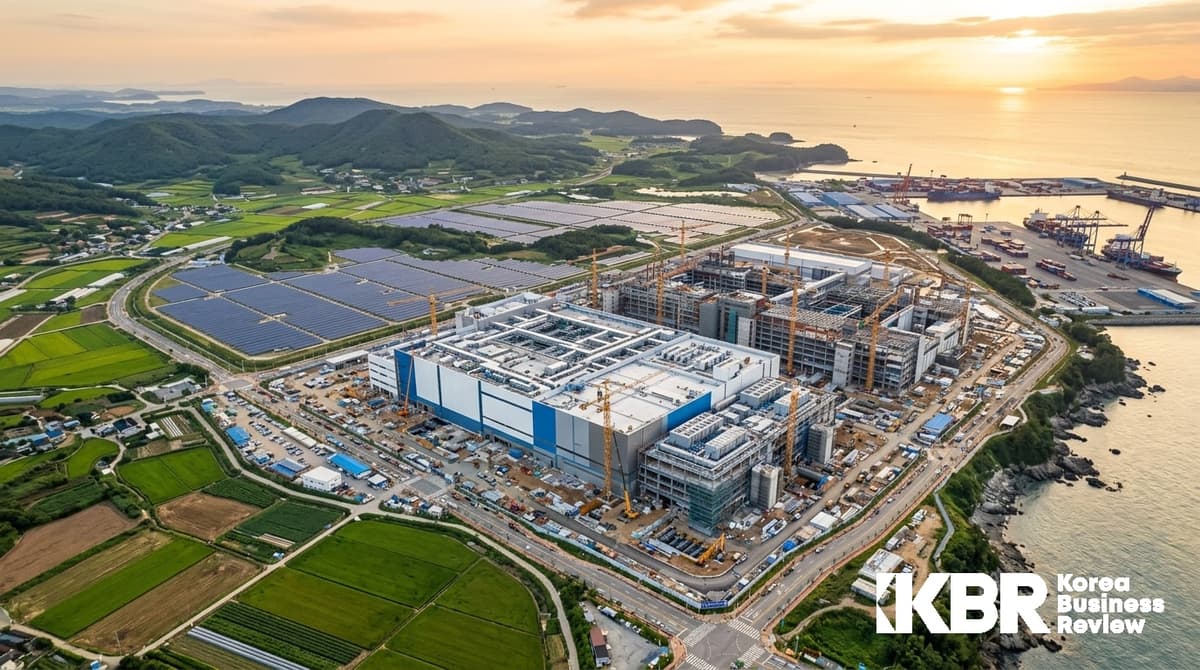
On June 29, 2026, the "National Report on the Three Major Megaprojects for South Korea's Great Leap Forward," held at the Blue House Yeongbinwan, is highly likely to be recorded as a turning point in South Korea's industrial history. Presided over by President Lee Jae-myung and attended side-by-side by Samsung Electronics Chairman Lee Jae-yong and SK Group Chairman Chey Tae-won, the government and the two major semiconductor companies formalized a blueprint to invest a total of 800 trillion won to build four memory fabs (semiconductor manufacturing plants) in Honam (the southwestern region). The structure entails Samsung Electronics building two and SK Hynix building two. For the Gwangju and Jeonnam region, ahead of the launch of the Jeonnam-Gwangju Unified Special City, this marks the region's largest private investment in history, aligning with integration 40 years after their separation in the 1980s.

The total scale of investment announced on this day is even more expansive. The total investment plan presented by the government and companies reached 4,755 trillion won, with Samsung Electronics accounting for about 2,655 trillion won and SK Group, including SK Hynix, accounting for about 2,100 trillion won. The 800 trillion won Honam semiconductor cluster is a core axis of this massive picture. However, given that these figures carry the character of a long-term guideline spanning the next 10 to 20 years, they should be understood as a blueprint containing direction rather than amounts confirmed for immediate execution.

Interestingly, market reactions were mixed. Despite the announcement of a multi-hundred-trillion-won investment, major semiconductor stocks such as Samsung Electronics and SK Hynix plunged due to a combination of massive investment burdens and global unfavorable factors. Conversely, Honam-related infrastructure and construction stocks soared to the daily upper limit. This was the simultaneous manifestation of concerns that heavy capital expenditures could weigh on corporate profitability in the short term, alongside expectations for regional development benefits. This demonstrates that investors are treating this announcement not as a "confirmed favorable factor," but as a "variable to be weighed carefully."


Why Honam: The Economics of Power, Water, and Land

Behind the companies' choice of Honam lie both justification and pragmatism. The justification is balanced national development. At the report, President Lee Jae-myung defined balanced national development as a core survival strategy, stating, "As inefficiencies due to concentration deepen, the metropolitan area is on the verge of explosion and the provinces are on the verge of extinction." However, what actually moved corporations was cold economic calculation.

Modern semiconductor fabs operate 24 hours a day without stopping, continuously drawing massive amounts of power and ultrapure-grade water. SK Hynix President Kwak Noh-jung emphasized, "In the AI era, the memory supply shortage is intensifying, and we need to secure new semiconductor clusters quickly," adding, "We need a location capable of supplying stable power and water to a large-scale site." The problem is that existing bases in Yongin and Pyeongtaek have already reached their limits. President Lee likewise diagnosed that "existing spaces centered around Yongin and Pyeongtaek are reaching their limits in power and water."

On the other hand, Honam, particularly the southwestern coastal area, is rich in renewable energy, has ample water resources, and features relatively low land prices. The government unveiled a vision to supply power to this region through renewable energy and nuclear power, while supporting water through multiple alternative water resources such as multipurpose dams and industrial water supply. Plans were also presented to prematurely achieve 100 gigawatts (GW) of renewable energy by 2030 and expand flexible resources such as nuclear power, small modular reactors (SMRs), and energy storage systems (ESS). Ultimately, the choice of Honam is closer to a case where the weakness of being an "alienated region" was paradoxically transformed into the strength of an "untapped land with vast development potential."


Front-End Processes are Key: How Are They Different from Back-End Processes?

A notable aspect of this announcement is that the plants entering Honam are "front-end process" fabs. Discussions initially centered around back-end processes (packaging) involving cutting and bundling wafers, but the weight shifted at the last minute to include building new front-end fabs that etch circuits. The arrival of a front-end plant means that the "main base" for new semiconductor production will be established in Honam. Given that core manufacturing lines for memory semiconductors—rather than simple assembly and testing bases—will be located entirely there, the ripple effect on the local industry is on a completely different scale.

Constructing and equipping a single semiconductor fab is known to cost about 30 to 40 trillion won, and considering equipment advancement as well as rising exchange rates and inflation, it can require up to 150 trillion won. The figure of 800 trillion won for four fabs in Honam is an estimate reflecting this cost structure. For reference, SK Group Chairman Chey Tae-won previously estimated that "building four fabs in the Yongin semiconductor cluster will cost 600 trillion won by 2050," giving an idea that the Honam investment scale is by no means an exaggerated figure. This starkly illustrates how capital-intensive semiconductor manufacturing is. Because front-end fabs require dozens of microscopic processes, hundreds of types of high-priced equipment, and extremely precise environmental controls, they have the characteristic of being difficult to relocate once established and thus deeply rooted in the region.


A Semiconductor Belt Stretching Across the Country

The true significance of this initiative lies in the fact that it does not stop at Honam alone. The government drew a "nationwide semiconductor ecosystem" designed to foster Honam as a front-end production base while cultivating the Chungcheong region into an advanced packaging (back-end) hub and the Southeastern and Daegyeong (Yeongnam) regions into a materials, components, and equipment (MCE) supply chain hub. This is a multi-core transition strategy that divides roles according to each region's existing strengths.

Specifically, 81 trillion won will be injected into the Chungcheong region. Centered around Samsung Electronics' packaging bases in Cheonan and Onyang, new High Bandwidth Memory (HBM) plants will be established, and plans are in place to support timely HBM packaging investments by SK Hynix in Cheongju. Chairman Lee Jae-yong stated, "We will make concentrated investments in advanced packaging such as HBM, centered around our existing back-end production bases in Cheonan and Onyang." The Southeastern and Daegyeong regions will be developed as innovation hubs responsible for stabilizing next-generation semiconductor supply chains, including power semiconductors. The government also announced a plan to invest 30 trillion won over 15 years to support the entire cycle of R&D, design, verification, and manufacturing to lead in next-generation semiconductors.

On top of this, AI data center investments will be added by region. According to the Blue House, data center investment plans are slated at 87 trillion won for Honam, 150 trillion won for Chungcheong, and 146 trillion won for Yeongnam. In particular, approximately 17 trillion won will be invested in Solasido, Haenam, Jeonnam, to build a national AI data center, presenting a picture where semiconductor production facilities and AI computing infrastructure are linked in a single region. This is a deployment targeting an industrial ecosystem of matched supply and demand, where AI infrastructure—which consumes semiconductors the most—operates right next to where semiconductors are made.


The Seoul Metropolitan Area's Unipolar System: Cracks After 60 Years

Until now, South Korea's semiconductor industry had virtually all its core capabilities concentrated in the southern Gyeonggi belt stretching from Giheung, Hwaseong, and Pyeongtaek to Yongin. This Honam investment is an attempt to create the first meaningful crack in this unipolar structure. It simultaneously targets two goals: transforming the metropolitan-centered production system into a multi-core structure to respond to skyrocketing memory demand in the AI era, while creating new growth foundations in non-metropolitan areas that were alienated during industrialization.

Minister of Trade, Industry and Energy Kim Jeong-kwan diagnosed, "The global memory market is projected to grow explosively within the next 5 years," adding, "The so-called 'memory bottleneck,' where memory is hard to obtain, will determine the speed of development in the AI era." This is the recognition that memory supply equals AI competitiveness. Under the goal of doubling DRAM production capacity within 5 years, the government is also executing a "speed race" to bring forward the completion dates of the Yongin National Industrial Complex and the SK Hynix Yongin Cluster by 7 years and 12 years, respectively. In other words, it is a dual strategy of rapidly completing existing metropolitan bases while preemptively securing future supply capacity in Honam.

The chain reaction on the regional industrial structure also commands attention. When anchor companies like Samsung Electronics and SK Hynix settle in Honam, a so-called "Southbound Train" phenomenon is expected, where numerous cooperative materials, components, and equipment companies relocate to follow them. Analysts suggest that the aggregation of partner companies can form a semiconductor-specialized industrial complex, and an advanced upgrading of the industrial structure can occur sequentially, with existing automotive and energy companies transitioning their technologies to the semiconductor ecosystem. It is a typical pattern for a single semiconductor fab to be accompanied by the simultaneous entry of numerous partner firms specializing in equipment maintenance, gas and chemical materials supply, cleanroom construction, and logistics. Considering that Gwangju and Jeonnam have traditionally maintained an industrial structure centered on automobiles and energy, the influx of a high-value-added industry like semiconductors can serve as an opportunity to transform the very constitution of the regional economy.

Expectations on the employment front are also high. Semiconductor fabs create a broad ripple effect not only through direct employment, but also through jobs during the construction phase, partner company jobs, and the settled population formed as research and design talent gathers. Politicians also evaluated that "Gwangju and Jeonnam have all the basic conditions for semiconductor fabs—power, water, and talent," adding, "By building a semiconductor ecosystem connecting design, manufacturing, packaging, and AI demonstration rather than a simple manufacturing base, we can simultaneously achieve balanced national development and industrial security." Expectations are high that it can establish itself as core infrastructure for a future industrial ecosystem gathering high-quality jobs and young talent.


Not All Rose-Colored: Challenges to Overcome

However, formidable challenges remain before this grand blueprint becomes reality. The biggest variable is talent. Competitiveness in the advanced semiconductor industry stems from PhD-level R&D talent and production technology personnel, a significant portion of whom have their living foundations in the metropolitan area. With quite a few employees settled with their families, observations indicate that relocating talent will not be easy even if new production bases are established locally. Securing core talent at the new bases is cited as a key task that will determine success or failure.

Infrastructure bottlenecks are also a concern. Although Honam is abundant in basic resources like power and water, ultrapure water facilities and substations to purify and supply them for semiconductor processes must be built from scratch. If Yongin and Honam investments proceed simultaneously, infrastructure construction demand and specialized talent demand will pour in all at once, potentially intensifying bottlenecks. Because of this, industry outlooks suggest a phased expansion may be most likely: initially allocating secured volume to Yongin first, and gradually increasing Honam plants according to additional demand.

Managing regional conflicts is another homework assignment. The Yongin cluster's 1st fab was originally scheduled to break ground in 2022, but only shoveled its first dirt in 2025 due to protests from neighboring local governments surrounding wastewater discharge and water supply. In Honam as well, conflicts could flare up between regions that benefit from the cluster and those that do not, requiring active mediation by the government.

Above all, the fact that companies themselves are showing a cautious attitude is significant. According to the Electronic Disclosure System on June 30, Samsung Electronics amended its disclosure on "Future Business and Management Plans" from the previous day, adding the phrase, "The above mid-to-long-term investment plans are subject to change depending on future market conditions and changes in our management environment." A clause to the same effect was inserted into SK Hynix's disclosure as well. Unlike the Blue House presenting a goal of completion within its term (by 2030), companies have explicitly left room for variability based on market conditions and management environments. This is interpreted as a safety device considering that semiconductors are traditionally an industry with high price volatility driven by supply and demand, and that it remains uncertain how long the current AI supercycle will last.


Implications: Between Blueprint and Execution

The Honam semiconductor investment goes beyond simply building new plants, evaluated as the establishment of a "second semiconductor axis" at the national strategy level to reorganize the metropolitan unipolar system into a multi-core structure. If a nationwide semiconductor belt organically connecting Honam front-end, Chungcheong packaging, and Yeongnam MCE is completed, South Korea's industrial map will be fundamentally redrawn for the first time in about 60 years. It is an ambitious initiative simultaneously targeting three goals: balanced regional development, industrial security, and securing supply capacity in the AI era.

However, the gap between blueprint and execution remains vast. The figure of 800 trillion won is a guideline spanning the next decades, and companies have clearly left the possibility of change open through disclosures. The success or failure of this blueprint will be decided by how it overcomes real-world barriers of talent, infrastructure, and regional conflict. Ultimately, the key lies after the announcement. Whether the government can responsibly supply power and water infrastructure as promised, swiftly process permits, and actively mediate regional conflicts is expected to be the turning point that turns the dream of Honam semiconductors into reality.

KBR Access

KBR Analysis 콘텐츠는 Premium 전용 콘텐츠입니다

이 콘텐츠는 Premium 회원에게 제공되는 프리미엄 콘텐츠입니다. Premium은 1개월 이용권 34,900원 또는 월 정기결제 29,900원이며, 결제 시 1개월 이용권(1회 결제·자동갱신 없음) 또는 월 정기결제(매월 자동결제)를 선택할 수 있습니다. ESG, KBR 아티클, KBR Analysis 등 핵심 프리미엄 콘텐츠를 열람할 수 있습니다.

이번 달 열람 현황: 0 / 0건 사용