Myths and truths surrounding the three-month adaptation period, and the legal standards that both business owners and employees must know
What Is a Probationary Period?
The first three months entering a new workplace. For some, it is a time to learn tasks amidst tension; for others, it is a time to observe new members and withhold judgment. This period, which we commonly call the 'probationary period,' refers to the timeframe set for new hires to adapt to tasks and organizational culture, while the employer (company) evaluates the employee's job skills and suitability.
However, there is one major misconception surrounding this probationary period: the idea that "during probation, you are not yet a regular employee." To cut to the chase, this is not true. A probationary worker is someone who has already signed an official employment contract and is in the stage of developing job skills and the ability to adapt to the workplace. Therefore, even during the probationary period, they are officially hired employees and are fully protected by the Labor Standards Act, including restrictions on dismissal.
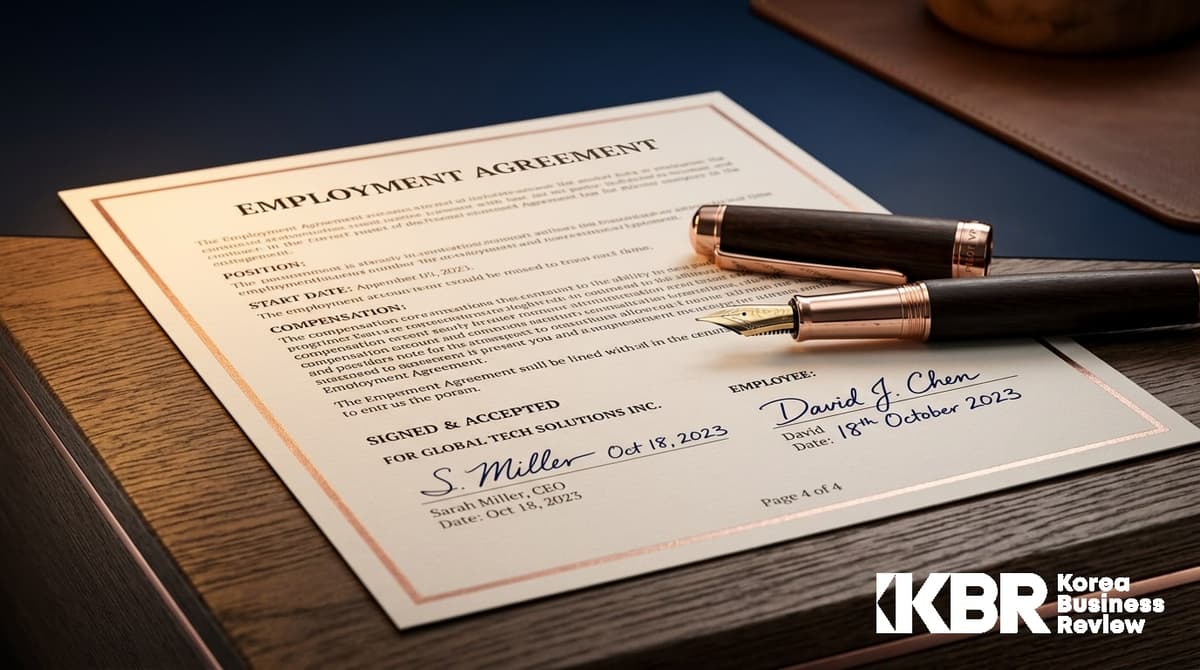
A concept frequently confused with 'probation' (수습) is 'trial employment' (시용). Trial employment is a form where the right to terminate is reserved for the employer so that, after understanding the worker's job performance and experience for a certain period before concluding an official employment contract, the employment relationship can be ended upon the expiration of the trial period if judged unsuitable. Because its legal nature differs from probation—which assumes official hiring—it is important to clearly distinguish and specify which form it is in the contract.
Core Issue: Wages During the Probationary Period
The most sensitive and frequently contested part of the probationary period is undoubtedly 'wages.' Many businesses reduce wages to some extent during probation, and the criteria determining whether this is legal or not are surprisingly strict.
First, we must look at the minimum wage standard for 2026. The Ministry of Employment and Labor decided and announced the minimum wage applicable for 2026 as 10,320 won per hour, an increase of 290 won, or about 2.9%, from 10,030 won in 2025. Converted on the basis of a 40-hour work week and 209 hours per month, this amounts to 2,156,880 won per month. This figure applies equally to all workplaces regardless of the type of business.
This is where the exception rule for the probationary period comes in. According to Article 5, Paragraph 2 of the Minimum Wage Act and Article 3 of its Enforcement Decree, for workers who have entered into an employment contract with a fixed term of one year or more and are on probation, the minimum wage can be reduced by up to 90% for up to three months from the start date of probation. Applying this to the 2026 minimum wage, the reduced hourly wage during probation becomes 9,288 won (90% of 10,320 won).
However, this 90% reduction cannot be applied at any time. There are conditions that must be met. First, the employment contract period must be one year or longer. If the contract period is less than one year, 100% of the minimum wage must be paid even if a probationary period is set. Second, the application of the reduction is possible only up to a maximum of three months from the start date of probation. Third, reductions are not applied to workers engaged in simple physical labor.
Cases Where Reductions Do Not Apply
The third condition, 'excluding simple physical labor,' is a point that is especially easy to miss in practice. Workers engaged in simple physical labor such as construction, transportation, manufacturing, cleaning, security, food service, and sales are not subject to minimum wage reductions even during their probationary period. 100% of the minimum wage must be paid to them regardless of whether they are on probation.
Simple physical labor referred to here points to occupations corresponding to major group 9 (Simple Laborers) under Statistics Korea's Korean Standard Classification of Occupations. This mainly includes tasks that are simple and routine, and can be performed with a few hours of training. Examples include preparation workers who cook and pack food at fast-food restaurants, or kitchen assistants who trim food ingredients and wash cooking equipment under the direction of a chef.
Another frequent mistake is misunderstanding the extent of the reduction. If there is an agreement in the employment contract, reducing and paying wages at the level of 80% of ordinary wages within three months of the probationary period is not inherently illegal in itself. However, if the amount calculated that way falls below 90% of the statutory minimum wage—which is 9,288 won based on 2026—that moment constitutes a violation of the Minimum Wage Act. The real standard is not 'what percentage is cut,' but 'whether the final payment is 90% or more of the minimum wage.'
Paying wages that fall short of the minimum wage may subject the employer to imprisonment for up to 3 years or a fine of up to 20 million won. It must be remembered that this is a target for criminal punishment, not merely a matter of administrative guidance.
How Long Can the Probationary Period Be Set?
The saying that "the probationary period can only be up to three months" is also a commonly heard misconception. To be precise, the three-month restriction is not a limit on the length of the probationary period itself, but a limit on the "period during which minimum wage reduction is possible."
In fact, many companies operate probationary periods of between three and six months. Setting the probationary period longer than three months is possible in itself. However, in that case, minimum wage reductions cannot be applied to the period exceeding three months, and 100% must be paid. In other words, starting from the 4th month, normal wages must be given without reduction.
In addition, the probationary period cannot be extended indefinitely. The original purpose of the probation system is to provide opportunities for learning and mastering skills during a period when job proficiency is immature. Therefore, setting an unreasonably long probationary period without rational reasons makes it difficult to be recognized as a valid probationary contract. Even when attempting to extend the probationary period, employers cannot determine it unilaterally, and must obtain the employee's consent.
Dismissal and Length of Service: Rights You Must Know
Dismissal during the probationary period also needs clarification. Compared to regular employees, reasons for rejecting employment—meaning dismissal—tend to be recognized relatively broadly for probationary workers. This is because probation itself is a period to evaluate suitability. However, 'recognized broadly' does not mean 'dismissal can be done arbitrarily at any time.' Even dismissal during the probationary period must have objective and rational reasons, and must be recognized as appropriate according to general social standards.
One distinction to make is the 'dismissal notice' regulation. Under the Labor Standards Act, employers must give at least 30 days' advance notice or pay 30 days' worth of ordinary wages when dismissing an employee, but this dismissal notice provision may not apply to workers whose continuous service period is less than three months. However, it must be made clear that this merely means the 'obligation to give advance notice' is exempted, and the requirement for justification of the dismissal itself does not disappear.
Finally, there are rights that employees must look after. Upon expiration of the probationary period, the employment relationship transitions into a regular employment contract, and the probationary period is fully incorporated into the length of service. In other words, when calculating the period of service that serves as the basis for calculating severance pay or generating annual paid leave, the probationary period is also included. The saying that "the probationary period does not count toward length of service" is likewise incorrect common knowledge.
Removing Misconceptions and Adhering to Standards
The probationary period is an important starting point for both employers and employees. Companies gauge the capabilities of new members, and employees gain time to put down roots in a new environment. However, for that starting point to lead to trust, accurately complying with legal standards must be a prerequisite.
To summarize the core points once again: probationary workers are also regular employees, and the 90% minimum wage reduction is possible only when all three conditions—a contract of one year or longer, within three months, and excluding simple physical labor—are met. The probationary period must be clearly specified in the employment contract to be recognized as valid, and the probationary period is included in the length of service. For employers, it is a way to reduce legal risk; for employees, it is the first step in protecting their rights. Making this non-short period of three months a fair opportunity for one another is perhaps the true meaning of the probationary period.