ORGANIZATION & HR
How to Design Competency Modeling Tailored to Your Organization
Competency modeling is the process of identifying required competencies based on specific behaviors observed in high performers within an organization. It is theoretically grounded in the Spencer family's iceberg model, which encompasses self-concept and motives alongside knowledge and skills. Competencies must be approached through three distinct tiers—company-wide core competencies, leadership competencies by rank, and job-specific competencies—as combining them into a single standard easily leads to a model disconnected from the field. The execution process spans six stages: setting objectives and scope, selecting target groups, data collection via behavioral event interviews or expert panels, developing a provisional model, validation, and finalization into a competency dictionary. This work should be carried out jointly by business unit leaders and management rather than the HR team alone. Rather than directly importing external frameworks, a hybrid approach that starts from and refines the actual behaviors of an organization's high performers is realistic, utilizing public standards such as the National Competency Standards (NCS) as reference frameworks. Once completed, the competency model serves as a common standard across all areas of human resource management—ranging from hiring interviews, competency evaluations, training, and succession planning to placement and compensation linkage—and risks remaining merely a document without regular reviews.
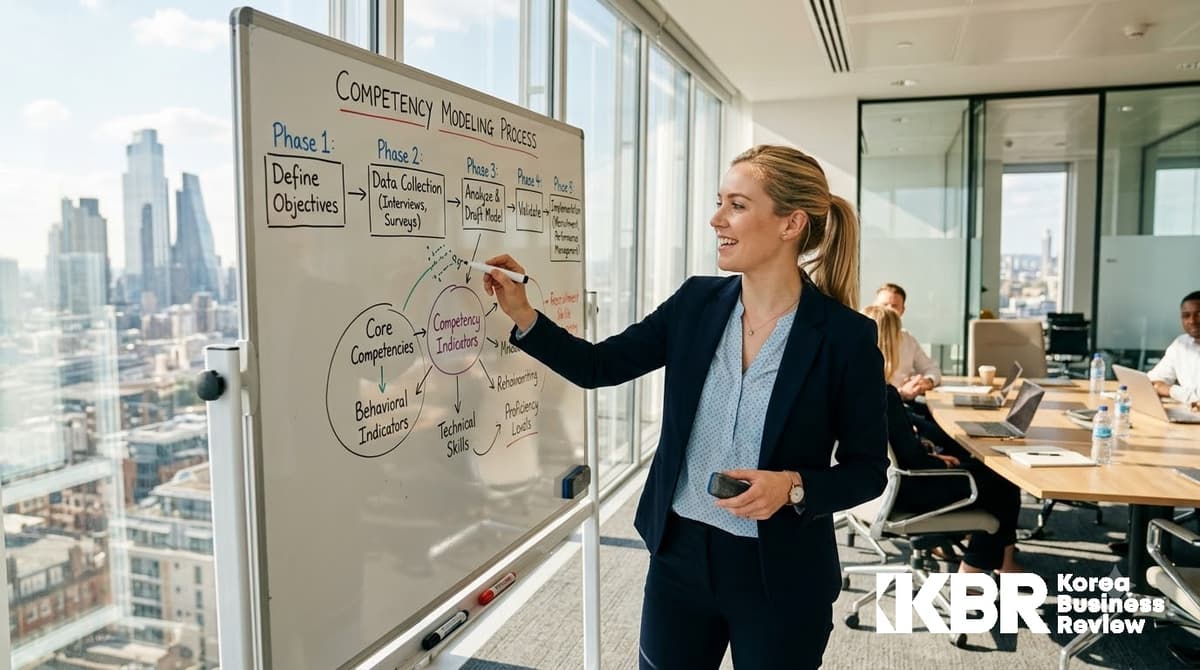
Competency modeling is the process of identifying required competencies based on specific behaviors observed in high performers within an organization. It is theoretically grounded in the Spencer family's iceberg model, which encompasses self-concept and motives alongside knowledge and skills. Competencies must be approached through three distinct tiers—company-wide core competencies, leadership competencies by rank, and job-specific competencies—as combining them into a single standard easily leads to a model disconnected from the field. The execution process spans six stages: setting objectives and scope, selecting target groups, data collection via behavioral event interviews or expert panels, developing a provisional model, validation, and finalization into a competency dictionary. This work should be carried out jointly by business unit leaders and management rather than the HR team alone. Rather than directly importing external frameworks, a hybrid approach that starts from and refines the actual behaviors of an organization's high performers is realistic, utilizing public standards such as the National Competency Standards (NCS) as reference frameworks. Once completed, the competency model serves as a common standard across all areas of human resource management—ranging from hiring interviews, competency evaluations, training, and succession planning to placement and compensation linkage—and risks remaining merely a document without regular reviews.
How to Design Competency Modeling Ta…
KBR Access
Insight 4.0 content is available to Standard members and above
This content is available to Standard members and above. Standard unlocks general membership content including Insight 4.0, Policy Insight, and Global Radar.
FREE ACCOUNT · NO CARD REQUIRED
Create a free KBR account
Creating a KBR account is free and takes about a minute — no card required. You'll come straight back to this page once you're done.
KBR NEWSLETTER
Sign up for free and get the KBR Newsletter!
Sign up and opt in to the newsletter to receive KBR's curated business and economic insights by email.
LATEST IN TOPIC
Latest in this topic
 How Far Can AI HR Innovation Go? Application Areas and Deployment Methods Through the Cases of IBM, Schneider Electric, and Unilever
 Work Redesign to Unlock Employee Capabilities: The Connection Between Inclusivity and Performance Revealed in German Enterprise Research
 Two-Day Remote Work and a 33% Drop in Turnover: Performance and Talent Retention Conditions Seen Through Trip.com's Experiment
RELATED CONTENT
Related Content
Nike's Direct Sales Shrink While Wholesale Grows: Why Owning Customer Touchpoints and Acquiring Customers Are Different
StandardWhy Those Who Want to Be Leaders Differ from Those Who Lead Teams Well
StandardDuolingo's 23% User Growth vs. 18% Revenue Increase: When Do Customer Habits Turn Into Profit?
StandardSetting Up an AX Organizational Transition: Start with Standards for Workflows, Data, Authority, and Performance