Korea Business Review

hr-insight

You See the True Face of a Company During the Interview — The Real Reasons Candidates Walk Away

The center of gravity in the hiring market has shifted toward candidates, turning it into an era where key talent chooses companies among multiple offers rather than employers selecting applicants. According to a JobKorea survey, about 87% of job seekers have experienced unpleasantness during interviews, and over 80% reported that an interviewer's attitude alone changed their decision to join—making the interviewer's attitude more powerful than an acceptance notice. Companies must give candidates trust out of practical necessity rather than mere courtesy. The cost of hiring failures has grown, top talent evaluates companies based on their interview experience, and that experience spreads by word of mouth to dictate the employer brand. Interviews must project three elements: a prepared attitude toward the candidate, an unembellished reality of the role, and consistent and fair evaluation criteria that do not waver depending on the interviewer. The feeling left with candidates is a balance of hospitality and accurate evaluation, completed by details like advance notice, punctuality, and prompt result notifications along with interviewer training—interviews serve as a mirror reflecting the company, and candidates are already looking into that mirror.
김민경 책임기자Published 2026년 6월 18일Updated 2026년 8월 12일
Share
You See the True Face of a Company During the Interview — The Real Reasons Candidates Walk Away

The center of gravity in the hiring market has shifted toward candidates, turning it into an era where key talent chooses companies among multiple offers rather than employers selecting applicants. According to a JobKorea survey, about 87% of job seekers have experienced unpleasantness during interviews, and over 80% reported that an interviewer's attitude alone changed their decision to join—making the interviewer's attitude more powerful than an acceptance notice. Companies must give candidates trust out of practical necessity rather than mere courtesy. The cost of hiring failures has grown, top talent evaluates companies based on their interview experience, and that experience spreads by word of mouth to dictate the employer brand. Interviews must project three elements: a prepared attitude toward the candidate, an unembellished reality of the role, and consistent and fair evaluation criteria that do not waver depending on the interviewer. The feeling left with candidates is a balance of hospitality and accurate evaluation, completed by details like advance notice, punctuality, and prompt result notifications along with interviewer training—interviews serve as a mirror reflecting the company, and candidates are already looking into that mirror.

You See the True Face of a Company During the Interview

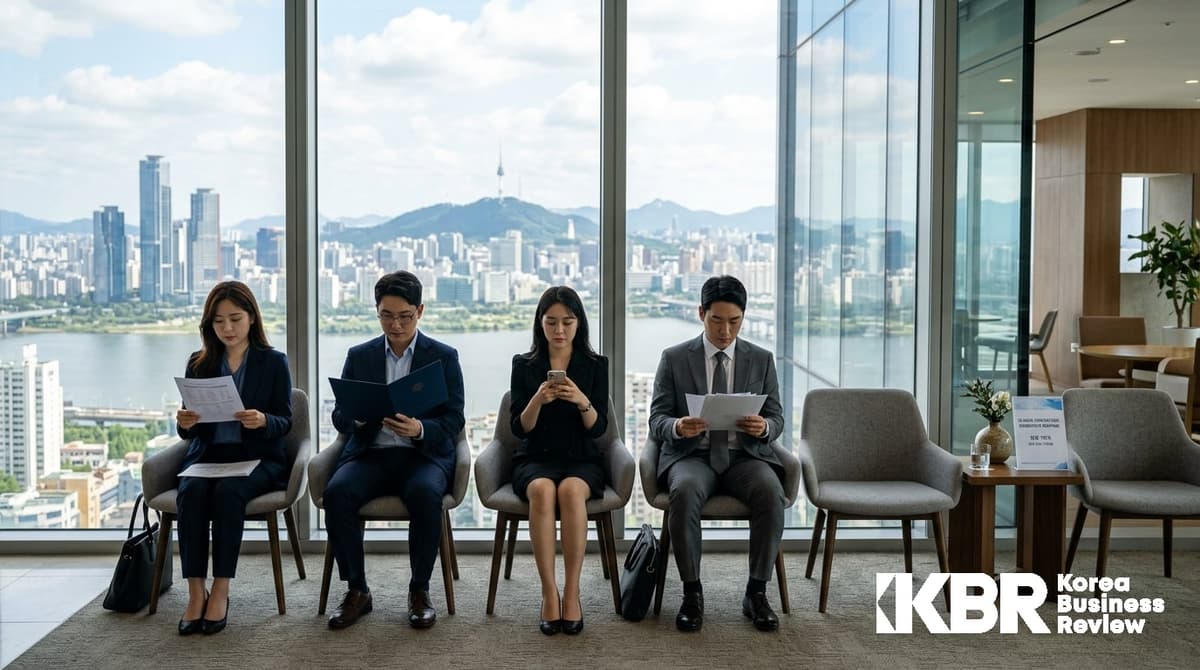
Candidates are evaluating the company while answering questions. The moment interviewers fail to build trust, the brightest talent turns away first.


The center of gravity in the job market is shifting. Once a setting where companies selected applicants, it has now become an arena where applicants select companies. According to the Korea Enterprises Federation’s 2025 survey on new hiring practices, only about 61% of companies with plans for new hiring that year marked the lowest level in recent years. With hiring scales shrinking, companies might seem to hold the upper hand, but reality is quite the opposite. In a Saramin survey, nearly half of the companies that conducted hiring in 2024 reported failing to recruit as many people as planned, with the most cited reason being the inability to find suitable applicants. It is a strange mismatch: positions are dwindling, yet finding the desired talent has become even harder.

Amidst this mismatch, the interview has taken on significance far beyond a mere evaluation step. An interview room is simultaneously a place for companies to vet candidates and for candidates to vet companies. Candidates read the interviewers' expressions, tones, questioning styles, and the organization of materials to gauge how this organization will treat them. That judgment immediately translates into the decision of whether to join. The saying that you can see a company through its interview is no longer a metaphor; it is the mechanism of actual transactions taking place every day in the hiring field.


An Interviewer's Attitude is More Powerful Than an Acceptance Notice

The impact of interviews on candidates is clearly demonstrated by data. In a JobKorea survey of 527 job seekers with interview experience, about 87% answered that they had experienced unpleasant moments during interviews. This means nearly nine out of ten felt discomfort in the interview room. What deserves more attention is what follows. When asked whether an interviewer's attitude affects their decision to join the company, combining 'very much so' and 'somewhat' responses yielded well over 80%. This signifies that more than eight out of ten job seekers change their willingness to join based solely on the interviewer's attitude.

The worst types of interviewers chosen by candidates were those who pressed them aggressively as if picking a fight over every little thing. Following closely behind were interviewers who threw private questions about dating or parents' occupations, and those who asked questions insincerely as if uninterested. Asking absurd questions unrelated to the job or showing up late for scheduled interview times also made the list of unpleasant experiences. Conversely, the traits of interviewers who left good impressions on candidates were surprisingly simple: interviewers who were kind and warm throughout the interview, those who carefully read the resume and cover letter to ask questions, and those who provided feedback on the applicant's strengths and weaknesses.

What this list tells us is clear. The element that makes candidates trust a company is not grand welfare or a flashy office building, but the sensation of being respected as a professional in the interview room. Pressure and insincerity do not merely hurt feelings; they act as a trailer previewing how one will be treated daily upon entering the organization. Interviewers think of themselves as evaluators for a little over an hour, but to candidates, that hour is a window gauging the entire company.


Why We Must Build Trust Now

The reason companies must provide trust to candidates is not a simple matter of courtesy. The cost of hiring failures has grown larger than ever. With prolonged low growth and uncertainty, companies have pivoted their strategies away from mass hiring toward the precise acquisition of a small number of suitable talents. Picking the wrong person for a position goes beyond labor costs, rippling into team morale, productivity, and re-hiring expenses. Consequently, companies focus not on how many they hire, but on whom they hire, and the core talents matching that 'whom' enter interviews holding offers from multiple companies.

Key talent is not the side receiving acceptance notices, but the side choosing acceptances. For them, an interview is not a unilateral screening but a two-way exploration. If an interviewer rattles off formal questions without properly looking into their career history, the candidate concludes that the company does not genuinely want them. Conversely, when interviewers thoroughly review resumes, trace the context of the role, and converse, candidates gain the conviction that they can work properly there. Trust is another name for this conviction, and a company that fails to provide conviction loses the best candidates to competitors during the final offer stage.

The fact that hiring experiences spread outside the company cannot be ignored either. A single interview does not end with one candidate. Applicants who feel discomfort in interviews share that experience with those around them and on online communities, which dictates the size and quality of the applicant pool for subsequent hiring. It is a structure where a single interviewer's insincere attitude undermines a company's employer brand. Conversely, a good interview experience turns candidates into the company's favorable word-of-mouth spreaders. An hour in the interview room translates into years of future hiring competitiveness.


What Needs to Be Shown

Then, what exactly should be shown to candidates during the interview? First is a prepared attitude. Reading the candidate's resume and portfolio in advance and preparing questions exclusively for that person is the starting point. Copy-and-paste common questions send a signal to candidates that the company does not view them as individuals. It is no coincidence that interviewers who carefully read resumes and cover letters to ask questions ranked high among favorable types in the JobKorea survey. Preparation is the surest expression of respect.

Second is the reality of the role. Candidates want to know the specific shape of the work they will handle, not vague visions. Honesty regarding which teams they collaborate with, what is expected during the first three months, and what criteria performance is evaluated on builds trust. Interviews that exaggerate only the positive points result in quick departures after joining. If the goal of hiring is not filling empty seats but finding people to stay with for a long time, the interview must become a place that honestly reveals the actual appearance of the company.

Third is consistent evaluation criteria. In recent hiring fields, the importance of structured interviews and behavioral-based questions is growing. Rather than subjective impressions varying by interviewer, when evaluated according to pre-determined criteria and checklists, candidates feel the process is fair. Fairness leaves trust in the company not only for successful applicants but also for unsuccessful ones. In an era where today's rejected applicant can be tomorrow's customer or a candidate for another position, fair interviews are the cheapest reputation management.


With What and What Kind of Feeling Should Be Left

Once the content to be shown is decided, the remaining question is how to deliver it and what kind of feeling to leave behind. The core sensations candidates should receive in the interview room are two: the feeling of being welcomed and the feeling of being accurately evaluated. These two seem contradictory, but they are actually a pair. Welcoming warmly while keeping questions sharp, treating comfortably while keeping evaluations strict. Candidates doubt a company's caliber through kindness alone, and doubt a company's human touch through strictness alone.

This feeling is completed through seemingly minor details. Providing sufficient advance notice of interview schedules, locations, and interviewer information; keeping promised times; and promptly and clearly communicating results after the interview are examples. In a survey by an ATS vendor, rapid result notification was cited as the biggest factor for positive hiring experiences, especially in developer roles where talent competition is fierce. Simply not keeping candidates waiting leaves the impression that the company is an organized organization with orderly operations. Conversely, companies maintaining silence for days regarding acceptance or rejection invite suspicion that their internal systems are equally loose.

Elevating individual interviewer attitudes into organizational capabilities is also important. The fact that most worst interview experiences stem from a single interviewer's lack of preparation and attitude conversely means that interviewer training is the most efficient investment. Over time, the hiring outcomes widen between organizations that train interviewers on what to ask, what not to ask, and what attitude determines the company's first impression, and those that do not. An interview is a place to evaluate candidates, but at the same time, it is a place where the company's own caliber is put to the test.

Ultimately, an interview is a mirror. Candidates look at the reflection in that mirror and imagine the company's future. They read the organization's working methods from prepared questions, the grain of future colleagues from the interviewer's attitude, and the sophistication of systems from the speed of result notifications. The brightest talent looks precisely into this mirror, and if they dislike the reflection, they knock on another door without hesitation. Providing trust in an interview is not a technique to trap a single candidate, but the most honest way to prove what kind of place that company is. You see the company through its interview. And candidates are already looking.

KBR Access

인사이트 4.0 콘텐츠는 Standard 이상 열람할 수 있습니다

이 콘텐츠는 Standard 이상 회원에게 제공됩니다. Standard는 인사이트 4.0, 정책인사이트, Global Radar 등 일반 멤버십 콘텐츠를 이용할 수 있습니다.

이번 달 열람 현황: 0 / 0건 사용