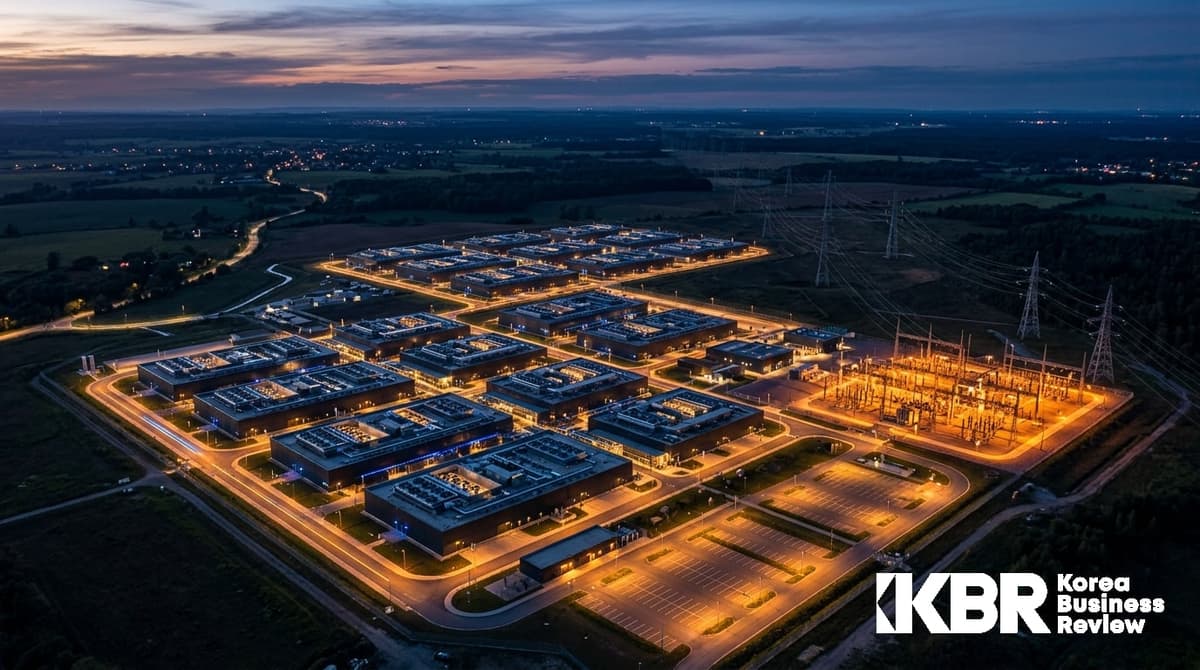
Behind the generative AI boom lie power grids and water tanks. The electricity and water consumed by data centers are rapidly shifting from mere corporate reputation issues to 'financial risks' that determine disclosure obligations and capital raising.
The 'Invisible' Resource Bill Created by AI
Asking questions to chat-bots and generating images happens smoothly on the screen, but those computations consume massive amounts of electricity and water at data centers somewhere. While AI has long been perceived as 'software,' international organizations and research institutions have recently united in emphasizing that AI is a 'physical infrastructure' spanning data centers, power generation facilities, cooling systems, transmission grids, and semiconductors. However, estimates of how much water a single AI response consumes vary up to several hundredfold depending on the measurement methodology. According to a technical report published by Google in August 2025 revealing actual operational data for the first time, the median for a single Gemini text prompt was only about 0.24 Wh of electricity and about 0.26 mL of water (equivalent to about five drops of water). In contrast, Mistral disclosed that same year that a single 400-token response from its model consumes about 45 mL of water, combining direct and indirect use. Most of this gap stems from differences in measurement scope—whether to look only at direct use for cooling or to include indirect use in the power generation process. Ultimately, while a single individual prompt is negligible, the core issue is the cumulative total when computations scale into the billions. This is why power and water—two resources—have emerged as new variables in corporate sustainability amid exploding AI usage.
Power — By 2030, Data Centers Will Swallow 'Japan's Entire Electricity'
According to the baseline scenario of the special report 'Energy and AI' published by the International Energy Agency (IEA) in April 2025, global data center electricity consumption could more than double from about 415 TWh in 2024 to about 945 TWh by 2030. This is comparable to Japan's total annual electricity consumption today. However, this is one of several scenarios; the IEA forecasts 2030 data center power demand to span a broad range from about 700 TWh (bottleneck scenario) to about 1,300 TWh (high-growth scenario), depending on the speed of AI adoption, efficiency improvements, and supply chain bottlenecks. If this trend materializes, analysis suggests data centers could account for 2 to 3 percent of global electricity demand by 2030. A follow-up report released by the IEA in April 2026, 'Key Questions on Energy and AI,' further refines the baseline outlook. It estimates that data center power consumption will increase from about 485 TWh in 2025 to about 950 TWh in 2030, with power demand for AI-specific data centers in particular surging approximately threefold over the same period. In fact, data center power demand in the single year of 2025 jumped by about 17%. Nevertheless, the IEA also points out that electricity consumption per AI task is rapidly becoming more efficient. In Google's case, energy usage per Gemini prompt has dropped to about one-third over the past year. This forms a dynamic where efficiency improvements partially offset skyrocketing usage growth.
The epicenter of growth is the United States and China. The IEA estimates that these two countries will account for about 80% of global data center electricity growth through 2030, projecting an increase of about 130% for the U.S. compared to 2024. One of the core reasons for this surge in power consumption is 'heat.' High-density AI servers emit massive amounts of heat, and the electricity used for cooling accounts for 30 to 40 percent of total data center power. Ultimately, the power issue directly connects to the cooling issue—in other words, the water issue.
Water — The Latest ESG Variable to Surface
Compared to electricity, water has long remained outside the discussion. However, data centers directly consume water to cool servers (evaporative cooling) and indirectly consume water in power plants generating electricity and in semiconductor manufacturing processes. According to IEA estimates, global data center water consumption could more than double from about 560 billion liters in 2023 to about 1.2 trillion liters by 2030. An environmental cost report involving institutions like the United Nations University (UNU) also estimated water consumed by AI data centers in the single year of 2025 at around 1 trillion liters. However, because such aggregate figures vary widely depending on measurement methodologies and scope (consumption vs. withdrawal, AI-dedicated vs. all data centers), they are best read as 'trends within a reasonable range' rather than precise, definitive values. Even so, the direction points to a single place: water usage is increasing rapidly, and furthermore, in areas already suffering from drought. This is why competition for data center locations is spilling over into a 'competition to secure water.'
Why It Is a 'Corporate Sustainability' Issue Now
The mere fact that resource consumption is increasing does not make it an ESG issue. The decisive change is that this consumption is being translated into corporate greenhouse gas emissions and water risks, and is beginning to be captured in 'disclosures' and 'finance.' A representative case is Microsoft. In its 2025 environmental sustainability report, Microsoft stated that total emissions (Scopes 1, 2, and 3) increased by 23.4% compared to the 2020 baseline, driven primarily by AI and cloud expansion. In particular, Scope 3—indirect emissions occurring in partner companies and supply chains—accounted for about 97% of its total carbon footprint. This demonstrates that even big tech companies, upon streamlining their own operations (Scopes 1 and 2), hit a larger wall: emissions across the value chain. Simultaneously, Microsoft has set a 'Water Positive' goal for 2030, aiming to reduce water use by about 125,000 cubic meters per facility annually through data center designs that use virtually no cooling water. Resource efficiency has risen to the core agenda of corporate strategy.
Korea's Dilemma — Concentration in the Capital Area and a Disclosure Vacuum
Korea is no exception to this trend. According to IDC Korea, domestic data center power demand is projected to grow from about 4,461 MW in 2025 to about 6,175 MW in 2028, at an average annual rate of about 11%. The Korea Data Center Council expects the domestic private data center market size to expand from about 6.2 trillion won in 2024 to about 10.2 trillion won in 2028. The problem is infrastructure absorption capacity. According to power grid impact assessment data from the Ministry of Trade, Industry and Energy and KEPCO, 290 applications for data center electricity use were submitted nationwide over an approximately 11-month period from August 2024 to June 2025, with 195 of them (about 67%) concentrated in the Seoul metropolitan area. Requested capacity in the metropolitan area alone reaches about 20 GW, equivalent to twenty 1 GW-class nuclear reactors. The National Assembly Research Service estimated that AI data centers could consume up to six times more power than existing data centers, pointing out that urgent countermeasures are needed.
Institutional vacuums are also a challenge. Although the maximum additional power demand for data centers is set at about 4.4 GW as of 2038 under the 11th Basic Plan for Electricity Supply and Demand, critics note that major projects currently pursued in the field alone exceed this figure. Permitting procedures have become more complex due to the Distributed Energy Activation Special Act implemented in 2024, and integrated national-level analyses on actual input and required quantities of water and power are still insufficient. Another limitation frequently cited is that as ESG disclosures were previously left to voluntary compliance, the consistency of information disclosure among companies was poor.
The Era of Mandatory Disclosure: Data Centers Become a 'Financial Risk'
At this exact juncture, the power and water issues of data centers become direct disclosure agenda items for Korean companies. On February 26, 2026, the Sustainability Standards Board (KSSB) under the Korea Accounting Standards Board finalized Sustainability Disclosure Standards Nos. 1 and 2, based on the international standards IFRS S1 and S2 set by the ISSB. The greatest uncertainty—the 'absence of standards'—has thus been resolved. On the other hand, what the Financial Services Commission unveiled the day before, on February 25, is the 'Draft Roadmap for Sustainability Disclosures' designed to reflect these standards step-by-step into domestic regulations; it is currently at the 'draft' stage slated for finalization around April to May 2026 following a public comment period. Therefore, it should be noted that the schedule below is based on the currently disclosed draft rather than being finalized. Based on the draft, mandatory disclosure is proposed to begin in 2028 (for the 2027 fiscal year) for KOSPI-listed companies with total connected assets of 30 trillion won or more (approx. 58 companies), expanding sequentially to those with 10 trillion won or more in 2029. Scope 3 disclosures, which cover emissions across the supply chain, are under discussion to be applied starting in 2031 (for the 2030 fiscal year) for the first tier of targets after an approximate 3-year grace period, and specific schedules may be adjusted during the finalization process.
KSSB Standard No. 2, identically to the TCFD recommendations, requires disclosures across four pillars: governance, strategy, risk management, and metrics and targets. For companies operating data centers or deeply reliant on cloud and AI services, heavy power consumption and water usage will become items that must be identified, evaluated, and disclosed as climate-related risks and opportunities. Resource usage figures that were once written as a single line in voluntary reports are now beginning to be captured on the 'second financial statements' scrutinized by investors.
KBR Insight — Resource Efficiency Is No Longer a Matter of Reputation, but Capital
The era of treating data center power and water issues as an 'environmental campaign' has passed. First, power and water are matters of business continuity that dictate location, permits, and operating expenses. Without securing them, a data center cannot operate even after completion. Second, once Scope 3 disclosures get underway, every company utilizing AI and cloud will shoulder the resource efficiency of its partners as part of its own emissions. Third, water use is highly likely to expand into another disclosure axis aligned with upcoming discussions on natural capital and biodiversity (TNFD). While the rapid improvement in resource efficiency is a clear positive, it is still too early to conclude whether that rate of improvement will outpace overall usage growth. Consequently, companies need to begin right now by: (1) collecting data on the power usage effectiveness (PUE) and water usage effectiveness (WUE) of the data centers and clouds they use; (2) reflecting renewable energy procurement (PPA) and the adoption of high-efficiency cooling in supply chain contract terms; and (3) clearly separating resource-related figures into 'actuals, estimates, and targets' to organize them into disclosure language. The resource bill created by AI has already arrived, and who bears that cost and how will become the parting point of the next competition.