
Korea Business Review

deep-analysis

The Reality of the 'Gift' Jensen Huang Brought to South Korea: Strategic Implications of HBM Demand, AI Infrastructure, and Robot Cooperation

Jensen Huang, who visited South Korea again after 7 months, unveiled a three-way cooperation card involving HBM, AI infrastructure, and robotics. Ranging from the supply of 260,000 GPUs to recruitment for an R&D center, South Korea is put to the test of moving beyond a 'parts supplier' to become an 'AI co-designer.'
류현진 선임기자Published 2026년 6월 5일Updated 2026년 9월 3일
Share
The Reality of the 'Gift' Jensen Huang Brought to South Korea: Strategic Implications of HBM Demand, AI Infrastructure, and Robot Cooperation
Why Jensen Huang Is Back in South Korea Now

Why Jensen Huang Is Back in South Korea Now

HBM, AI infrastructure, and robotics... South Korea emerges as the heart of NVIDIA's supply chain.

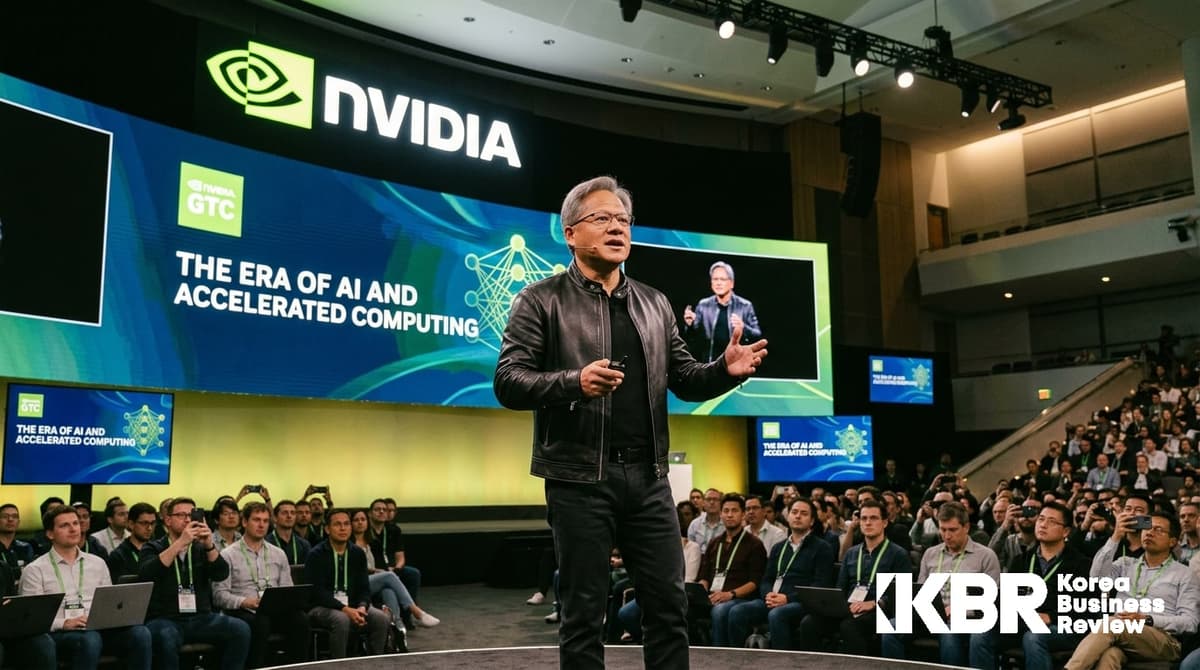
On June 5, 2026, NVIDIA CEO Jensen Huang set foot in South Korea once again, roughly seven months after his previous visit. This return comes about half a year after he announced plans to strengthen the 'AI alliance' and supply 260,000 next-generation graphics processing units (GPUs), which was timed with the Asia-Pacific Economic Cooperation (APEC) summit held in Gyeongju in late October of last year.

While officially framed around client and partner visits and investment discussions, this schedule is interpreted by many as a signal of how NVIDIA is positioning South Korea right at the center of its global strategy realignment. Analysts note that it is no coincidence the chief of the world's top AI accelerator company boarded a flight directly to Seoul right after wrapping up his schedule at Taiwan's 'Computex 2026.'

The keywords running through this visit can be condensed into three areas: the realignment of the memory supply chain centered on High Bandwidth Memory (HBM), the establishment of AI infrastructure and research and development (R&D) hubs within South Korea, and the expansion of cooperation in the robotics and physical AI sectors.


1. HBM: The 'Blood Vessel' Connecting NVIDIA and South Korea

NVIDIA's AI GPUs essentially require HBM for high-performance computing, and South Korean companies practically dominate the supply of this core component. According to market researcher Counterpoint Research, global HBM market share by bit shipments in the second quarter of 2025 stood at 62% for SK hynix, 21% for Micron, and 17% for Samsung Electronics, meaning South Korean companies supply approximately 79% of the total HBM market.

From the perspective of NVIDIA's supply chain, the status of 'K-HBM' is distinct. SK hynix and Samsung Electronics have secured positions as major suppliers of HBM3E and HBM4 going into NVIDIA's next-generation GPU platforms, with ongoing analyses showing that performance and market share heavily depend on who can supply HBM more quickly and stably.

For this reason, meetings with the management of domestic memory companies and discussions regarding the quality, yield, and capacity expansion plans for next-generation HBM were cited as core agenda items during this visit. In fact, upon his arrival on June 5, CEO Huang reportedly met with reporters and indicated that all three companies, including Samsung Electronics and SK hynix, have completed quality certification for HBM4 suppliers and have entered mass production, and that the three firms are competing to supply the next-generation 'Vera Rubin' architecture. This suggests that competition has entered full swing to see who can secure a larger share of the memory supply rights destined for next-generation GPUs, going beyond simply passing tests.

As AI models grow larger, the memory capacity and bandwidth required per GPU increase exponentially, a trend confirmed by market indicators. According to Counterpoint Research, the global HBM market in the second quarter of 2025 grew by approximately 178% year-over-year in terms of bit shipments, clearly demonstrating how AI demand is driving the entire memory market.

The securities industry presents this competitive dynamic in more specific figures. Daishin Securities projected that while SK hynix's share of NVIDIA's internal volume might decline slightly from 72% in 2025 to 63% in 2026, it will still maintain the strongest partnership. For the HBM4 stage, it suggested a configuration of SK hynix at 55%, Samsung Electronics at 28%, and Micron at 17%. The interpretation is that up until HBM3E, SK hynix enjoyed a clear solo run, but starting with HBM4, Samsung Electronics is mounting a full-scale pursuit. The market forecasts the global HBM market size for 2026 at about $58.1 billion and the entire memory semiconductor market at around $56.32 billion, reinforcing the analysis that HBM has established itself as a core axis dictating the growth and profitability of the memory industry.

Ultimately, it is difficult to separate NVIDIA's next-generation GPU roadmap from the development and mass production speeds of South Korean HBM companies. With a structure solidified where HBM yields and supply capacity directly impact the launch schedules and earnings of NVIDIA products, observations suggest this visit will serve as an occasion to recalibrate the level of supply chain partnership beyond a simple purchasing and sales relationship.


2. AI Infrastructure and R&D: "South Korea Is a Great Place to Invest"

The relationship between NVIDIA and South Korea has entered a stage where it can no longer be viewed merely as simple parts and chip transactions. Taking advantage of the Gyeongju APEC on October 31, 2025, NVIDIA formalized the strengthening of its 'AI alliance' by agreeing with the Ministry of Science and ICT, Samsung Electronics, SK Group, Hyundai Motor Group, and Naver Cloud to supply a total of 260,000 GPUs, including its latest 'Blackwell' chips, to South Korea.

According to the announcement at the time, the supply volume totals 260,000 units, comprising 50,000 units for the South Korean government, up to 50,000 units each for Samsung Electronics, SK Group, and Hyundai Motor Group, and 60,000 units for Naver Cloud. Part of the government's 50,000 allocation was decided to be deployed for sovereign AI model development linked with the Korea Institute of Science and Technology Information (KISTI). Allocating this scale preferentially to a single country was evaluated as unusual, and it was simultaneously projected that South Korea's holding of AI GPUs would increase nearly fivefold to over 300,000 units.

During his June 2026 visit, CEO Huang delivered a message that went a step further. Right after arriving at the Gimpo Business Aviation Center in Gangseo-gu, Seoul, he stated that hiring has already begun to establish a South Korean R&D center, evaluating that South Korea is an optimal location to house an R&D hub given its outstanding expertise in AI and robotics and its status as a world-class manufacturing center. Regarding the hiring scale, however, he only mentioned that while the exact number is hard to pin down, it will continue to increase moving forward, adding that once sufficient personnel are secured, a site will be arranged to build research facilities—hinting at a phased investment intent transitioning from workforce hiring to securing dedicated space and building an R&D hub.

CEO Huang also dropped hints suggesting the expansion of GPU supply or the announcement of new cooperation projects, making remarks to the effect that he has brought many business opportunities for South Korea and prepared 'surprise gifts.' With the South Korean government also elevating AI infrastructure investment to a national strategic task and discussing measures to improve the data center environment—such as power, site selection, and regulatory streamlining—attention is focused on whether South Korea can leap beyond semiconductor exports to become an AI infrastructure hub if NVIDIA supports the construction of ultra-large AI computing infrastructure, the so-called 'AI Factory,' alongside GPU supplies.

However, specific details such as the exact location, scale, and total investment amount of the R&D center, as well as the power and cooling infrastructure design of the AI data center, remain in the early stages of discussion. A prudent stance coexists, noting that what has been disclosed so far is merely at the level of a directional intent to initiate hiring in South Korea and secure a site afterward, and that the specific outlines of the project need to be observed through future official announcements.

Such discussions are expected to continue not only in formal presentation settings but also in unofficial gatherings. On the first evening of his visit, CEO Huang was scheduled to hold a dinner in the Hongdae area of Seoul with major domestic business leaders including SK Group Chairman Chey Tae-won, LG Group Chairman Koo Kwang-mo, and Naver Global Investment Officer (GIO) Lee Hae-jin. This gathering is projected to widely discuss future core industry cooperation measures—including robotics, physical AI, and AI data center infrastructure—alongside the stabilization of the AI semiconductor supply chain. Right after entry, he reportedly remarked that the scale of business in the second half of this year will be much larger than the first half, and will expand further next year, meaning there is much to align directions and check preparedness with partners.


3. Robotics and Physical AI: A New Stage for 'Manufacturing Powerhouse South Korea'

NVIDIA is expanding its business scope beyond GPUs and data center chips into robot operating systems and physical AI platforms. At developer events like GTC, the company has successively unveiled 'robot digital twins' integrating AI into factory, logistics, and service robots, alongside simulation and control platforms, presenting robot systems operating in the real world as its next growth axis.

In this strategy, South Korea is evaluated as possessing the conditions to become a testbed and co-design partner. In South Korea, where the manufacturing weight is high, large manufacturers in sectors such as automobiles, electronics, and batteries have already widely adopted automation and robot facilities. Hyundai Motor Group is expanding its humanoid robot business centered on Boston Dynamics, and LG Electronics is also strengthening its service robots and smart factory businesses. CEO Huang diagnosed during this visit that while South Korea has many fields to invest in, robotics will be the next major industry, noting that South Korea holds strengths in manufacturing, mechatronics, and AI, creating a favorable environment to invest in robotics where these technologies converge.

South Korean manufacturing sites, dense with smart factories and advanced plants, are cited as advantageous environments to produce large-scale empirical data capable of learning and verifying robot AI algorithms. Because the 'AI alliance' package announced at the 2025 APEC summit included cooperation across all fields of robotics, communications, and data centers in addition to GPU supplies, discussions on joint projects related to physical AI and robots are expected to continue through successive meetings with key corporate executives from Hyundai, LG, SK, and Samsung during this visit. Projections suggest that if actual cooperative models materialize, South Korea could emerge as a major hub for NVIDIA's robot ecosystem.

Because physical AI requires massive learning data and real-world environmental verification, the fact that various South Korean sites such as factories, logistics centers, and hospitals can serve as 'actual training grounds' for robot AI is also evaluated as an attractive factor from NVIDIA's perspective.


4. The Reality of the 'Gift' Received by South Korea and Remaining Tasks

The opportunities this visit brings to South Korea are already being visualized in certain figures. First, the agreement to supply 260,000 GPUs is a scale capable of generating mid- to long-term demand across domestic ultra-large AI research, the cloud and data center industries, and the system integration and AI service ecosystems overall. Furthermore, expanding HBM demand empowers the mid- to long-term investment and capacity expansion plans of Samsung Electronics and SK hynix, laying the foundation to restructure earnings structures around high-value-added memory.

Given that K-HBM's share within NVIDIA's supply chain has already reached approximately 79%, South Korean memory companies are highly likely to receive direct and indirect benefits from the global AI cycle if they maintain technological competitiveness. When AI infrastructure and R&D investments get underway, ripple effects are anticipated not only for telecommunications companies, cloud providers, and research institutes adopting GPUs, but also for related industries such as power, site selection, cooling infrastructure, construction, operation, and security. Moreover, robotics and physical AI cooperation can lead to a new growth axis encompassing the advancement of manufacturing alongside the export of AI robot solutions, components, and software.

However, prudent voices are equally strong, warning that this 'gift' will not automatically translate into performance. Variables remain: competitors like Micron are pursuing rapidly in the HBM market, and supply chain strategies can be readjusted at any time depending on semiconductor regulatory trends between the United States and China. AI infrastructure investments can likewise only materialize when complex conditions are satisfied, such as massive power supplies, data center site acquisition, and regulations concerning transmission lines, cooling, and the environment. In the robotics and physical AI domains, significant time required for software, telecommunications, safety regulations, international standard competition, and ecosystem formation is cited as a risk factor.

Ultimately, what Jensen Huang brought to South Korea is closer to a massive gateway of opportunity centered on HBM, AI infrastructure, and robotics, rather than a finished 'deliverable.' Whether that gate can be truly opened and stepped through, allowing South Korea to leap beyond a 'parts supplier' to become a 'co-designer of the AI era,' depends entirely on the speed and direction with which South Korean corporations and the government execute their plans over the coming years.

경영연구 및 사례분석 연구 : KBR경영연구소

저작권자 ⓒ 코리아비즈니스리뷰(Korea Business Review). 무단 전재 및 재배포 금지