

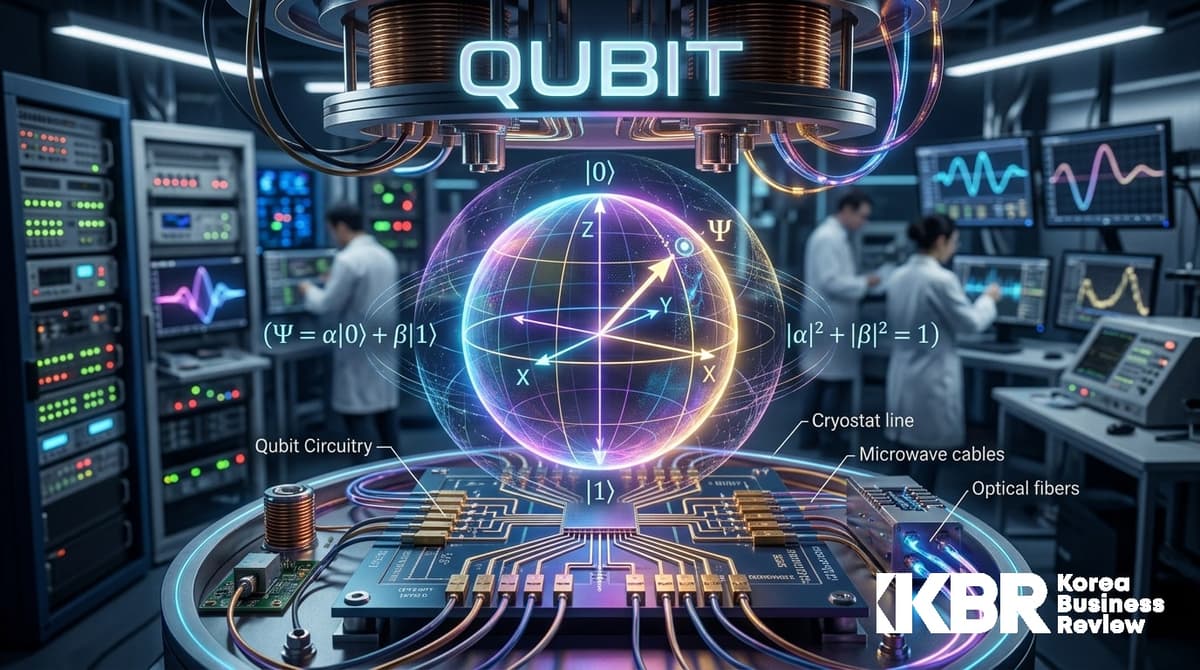
Bits vs. Qubits: What Makes Them Different
Every computer we use today operates on a basic unit of information called a 'bit.' A bit can only take one of two states: 0 or 1. If an electrical signal flows, it is 1; if it does not, it is 0. The entire modern digital civilization is built upon this simple binary system. Smartphones, servers, and even artificial intelligence computations are all the result of billions of bits rapidly switching between 0 and 1 to process information.
A qubit (Quantum Bit) is the fundamental unit of information in quantum computing that corresponds to this bit. As the name suggests, it is a concept that applies the principles of quantum mechanics to information processing. Unlike bits, which hold only a value of either 0 or 1, qubits can probabilistically represent the states of 0 and 1 at the same time. This difference is the starting point where quantum computing fundamentally diverges from classical computing.
Superposition: Being 0 and 1 at the Same Time
The most core characteristic of a qubit is 'superposition.' In quantum mechanics, a particle can possess multiple states simultaneously until it is observed. Qubits are no different. Before being measured, a qubit simultaneously holds a probability of being 0 and a probability of being 1, and the moment it is measured, it finally settles into a single value. This is often compared to a coin. When a coin lies on a table, it is either heads or tails, but while it is spinning in the air, it simultaneously holds the possibilities of both heads and tails. Qubits utilize the state of this 'spinning coin' for information processing.
The reason this characteristic is important lies in the expansion of computational capability. Two bits can express only one of four states: 00, 01, 10, or 11. Conversely, two qubits can express all four of these states simultaneously. As the number of qubits increases, the number of simultaneously expressible states grows exponentially. Theoretically, $n$ qubits can process $2^n$ states simultaneously. This is the basis on which quantum computers can approach certain types of problems differently from classical computers. However, this does not mean they are faster than classical computers in all calculations. There are specific types of problems where quantum computers excel, while classical computers remain more efficient for general operations.
Entanglement: How Qubits Connect
Another core characteristic of a qubit is 'entanglement.' When two or more qubits are placed in an entangled state, the moment the state of one qubit is determined, the state of the other qubit is also determined instantaneously. This correlation is maintained no matter how far apart the two qubits are physically. This is precisely the phenomenon that Einstein described as 'spooky action at a distance.'
Entanglement allows a quantum computer to handle multiple qubits as a single interconnected system. Rather than processing individual qubits independently, entangled qubits perform complex operations while influencing each other's states. This characteristic is known to be particularly useful for tackling computational structures that are difficult for classical computers to process, such as cryptography, molecular simulation, and optimization problems.
How Qubits Are Physically Implemented
Qubits cannot remain merely a concept; they must be implemented as actual physical systems. Major implementation methods currently under research and development include superconducting circuits, ion traps, photons, and semiconductor spin methods. IBM and Google primarily utilize superconducting circuits, a method that operates in cryogenic environments close to absolute zero. The ion trap method traps ions using electric fields to use as qubits, while the photon method uses light particles as information units. The semiconductor spin method is drawing attention due to its compatibility with existing semiconductor manufacturing processes.
Each method has its own pros and cons. The superconducting approach offers fast computation speeds but requires cryogenic cooling equipment, while the ion trap method provides high stability but is difficult to scale. It has not yet been concluded which method is most suitable for commercialization, and multiple methods are being researched in parallel. It is a matter of public record that major tech companies such as IBM, Google, Microsoft, and Amazon are developing quantum computing platforms using their respective approaches.
Limitations of Qubits and Current Challenges
While qubits hold powerful potential, several practical limitations exist at the current technological level. The biggest problem is the 'error rate.' Qubit states are easily disturbed by minor vibrations from the external environment, temperature changes, and electromagnetic interference. This is called 'decoherence.' The time a qubit maintains its superposition state is very short, and if computations are not completed within this timeframe, errors occur. Because of this, quantum error correction technology is treated as one of the core tasks in quantum computing research.
Scalability is also a critical challenge. It is known that practical quantum computing requires thousands to millions of stable qubits, but currently unveiled systems have not yet reached this level. The fact that additional qubits are required for error correction is also a factor that reduces the effective number of qubits. Due to these technological challenges, the general consensus among researchers is that considerable time will be required before quantum computers can establish themselves as general-purpose systems replacing classical computers.
Why You Need to Understand Qubits
A qubit is not merely a technical term. It is the starting point of a new paradigm that fundamentally changes the very way information is processed. While classical computers have advanced for decades by sequentially processing 0s and 1s, quantum computers utilize the quantum mechanical properties of superposition and entanglement to approach certain types of problems in an entirely different way. Encryption, drug discovery, financial optimization, and climate modeling are cited as potential application areas of quantum computing for problems that are difficult for classical computers to solve within a realistic timeframe.
Of course, current quantum computers are still close to the experimental stage, and practical use will require solving error correction and scalability issues. However, understanding the principles of qubits has become essential foundational knowledge for reading the direction of future technological changes. To discuss the impact that quantum computing will have on industry and economy, accurately understanding what a qubit is—its core unit—and how it differs from classical bits is the starting point.