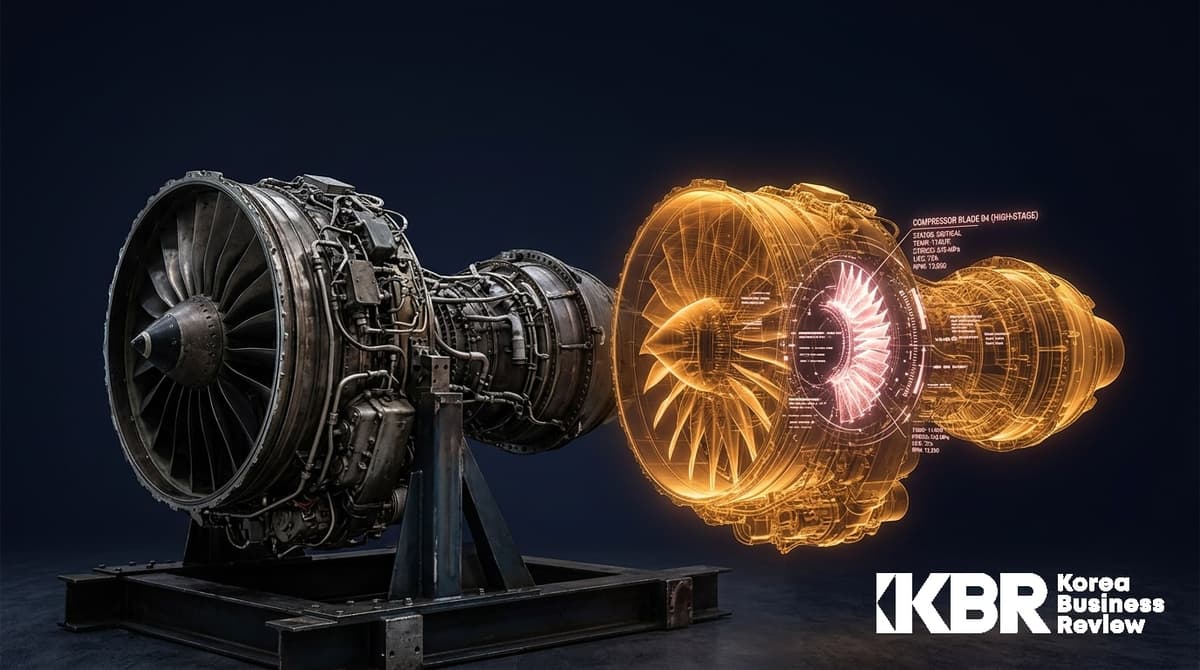
Virtual twins break down before physical factories do — The operating principle of digital twins
What if you could know an airplane engine will fail before it actually breaks down? What if you could check how much production output would change before actually modifying factory equipment? Industry's answer to this age-old question is the digital twin. A digital twin is a technology that creates a 'digital twin'—an exact replica of real-world factories, facilities, cities, and even human organs in a virtual space—and streams data collected from reality in real time so that the virtual twin moves identically to the real world. What makes it decisively different from simple 3D modeling is this 'real-time synchronization.' While a 3D model is a static photograph, a digital twin is closer to a living video that breathes alongside reality.
An old idea that began with Apollo 13
The roots of the digital twin concept run surprisingly deep. During the Apollo 13 accident in 1970, NASA used identical simulators built on the ground to replicate the spacecraft's condition and find rescue solutions, which is frequently cited as the prototype of the digital twin mindset. Later, in 2002, Professor Michael Grieves of the University of Michigan presented a conceptual model in a Product Lifecycle Management (PLM) lecture consisting of physical products, virtual products, and the data flow connecting them, establishing an academic framework. The name 'digital twin' itself is known to have been formalized by NASA's John Vickers in the early 2010s. Although the concept appeared early, it took time for technology to catch up. Only in the late 2010s—when Internet of Things (IoT) sensors became affordable, 5G enabled real-time transmission of large volumes of data, and cloud computing and artificial intelligence could analyze that data instantly—did the digital twin step down from theory into industrial tools.
Three layers breathing together with reality
The operating structure can be understood broadly through three layers. The first is the data collection layer. Thousands or tens of thousands of sensors attached to real-world facilities and spaces continuously measure physical data such as temperature, vibration, pressure, and location. The second is the modeling and synchronization layer. Collected data is reflected in real time on the 3D model in virtual space, so that if a real machine vibrates, the virtual machine vibrates identically. The third is the simulation and prediction layer, where the true value of the digital twin is manifested. On top of the virtual twin, assumptions such as 'what happens if this part is replaced' or 'where will bottlenecks occur if production line speed is increased by 10%' can be endlessly experimented with without real-world risk, and artificial intelligence learns data patterns to yield predictions such as 'this bearing has a high probability of failing within three weeks.' This enables predictive maintenance—tackling issues before they break down—rather than corrective maintenance, where equipment is fixed after breaking. Because unplanned downtime in manufacturing directly leads to revenue loss, many evaluate that this prediction capability alone provides sufficient economic justification for adopting digital twins.
From factories to cities, an expanding stage
Looking at actual application cases makes the weight of the technology even clearer. In the manufacturing sector, Siemens built a model early on at its Amberg plant in Germany to manage the entire process from design to production using digital twins, while GE has operated services that create individual digital twins for each aircraft engine to analyze flight data and predict maintenance timings. Domestic momentum is also active. Samsung Heavy Industries operates 'SVessel CBM,' which monitors ship components virtually to diagnose failures, and digital twins were selected as one of the 10 representative tasks of the Korean New Deal promoted by the government. Broadening the perspective to the city unit, smart cities are the most ambitious stage for digital twins. Singapore is cited as a representative case for simulating urban planning and disaster response with its 'Virtual Singapore' project, which replicated the entire country in a 3D virtual space. In addition, Incheon City has promoted a transition to 'digital twin administration,' utilizing a GIS platform-based three-dimensional digital virtual city to precede mock experiments and predictions across general administration. The ability to verify the massive time and cost required when applying new policies or infrastructure to a city through virtual experiments beforehand is why digital twins are rapidly permeating urban administration.
At least severalfold within 10 years, the future told by the market
Market outlook figures also support the growth trajectory of this technology. While absolute figures differ because collection standards vary by research institution, the directions are consistent. Fortune Business Insights forecasted that the global digital twin market will grow from approximately $17.7 billion in 2024 through a compound annual growth rate of around 40% to exceed $200 billion by 2032. Spherical Insights estimates that it will grow from about $13.8 billion in 2023 to over $140 billion in 2033, recording an annual average growth rate of around 27%. Although there are institutional discrepancies over whether the compound annual growth rate is 27% or 40%, there is almost no disagreement on the outlook that the market will expand by at least several times to over 10 times in the next 10 years. The engines of growth are clear: improvements in simulation precision combined with AI, lowered entry barriers for small and medium-sized enterprises due to the spread of cloud-based solutions, and converging demands to optimize energy efficiency through virtual experiments under carbon-neutrality pressures.
Remaining challenges and a clear direction
Challenges certainly remain. The first is the issue of cost and data. Creating a precise digital twin requires significant initial investment in sensor infrastructure and data integration, and a clumsy twin that fails to faithfully reflect reality can actually induce faulty decision-making. The second is security. As operating data from factories and cities moves entirely into virtual space, the scope of damage in the event of hacking expands correspondingly. The third is standardization. The fragmentation problem—where data formats differ by company and solution, preventing twins from connecting with one another—is cited as a common industry concern. Nevertheless, the overarching trend appears clear. Just as every company came to have a website in the past, the outlook that major factories, cities, and core facilities will sooner or later possess their own digital twins is gradually establishing itself as common sense in the industry. Technology that replicates reality is ultimately technology for operating reality better.