Looking Beyond a Single GPU Firm's Earnings to the Chain Reaction of Server, Memory, Power, and Data Center Demand: Assessing the Sustainability of the AI Infrastructure Investment Cycle
Record-Breaking Quarterly Performance and an Unusual 'Annual Outlook'
Nvidia reported revenue of $96.221 billion for the second quarter of fiscal 2027 (May–July 2026) after the market close on August 26, 2026 (local time), marking a 106% increase compared to the same period last year. This surpassed the market consensus of around $92 billion by over 4%, continuing the company's trend of exceeding its own guidance. Net income surged 126% to $59.688 billion, and adjusted diluted earnings per share (EPS) came in at $2.22, beating the market expectation of $2.09. Data center revenue jumped 117% to $89.0 billion, accounting for approximately 92% of total revenue.
However, what actually moved the market was not the earnings scorecard, but the conference call. Chief Financial Officer (CFO) Colette Kress provided Q3 revenue guidance of $108.0 billion (±2%). This figure is nearly $40 billion higher than the market expectation of about $104.2 billion, marking the first time quarterly revenue has crossed the $100 billion threshold. The company explained that this outlook did not factor in China data center computing revenue, meaning the calculation excludes a market virtually closed off by export controls.
The decisive remark came next. During the call, CFO Kress projected that revenue for the next fiscal year, fiscal 2028, will grow by approximately 70% year-over-year. It is worth noting that this was a preliminary outlook revealed during the conference call rather than official formal quarterly earnings guidance. It is unusual for Nvidia, which typically provides visibility only one quarter ahead, to mention specific growth rate figures for the following fiscal year alongside its official earnings guidance. This should be viewed as management's long-term supply and demand outlook, differing in nature from quarterly revenue guidance. Existing analyst consensus estimates hovered around the 44-45% level. Immediately following the announcement, the stock, which had been quiet, rose more than 4% in after-hours trading and surged around 8% during the regular session on the 27th, climbing into the upper $220 range. The previous trading session's close was $209.66.
70% is a Number Determined by Supply, Not Demand
The most crucial clue when interpreting this outlook is the caveat added by CFO Kress. She explicitly stated that the 70% projection is 'adjusted for supply constraints.' Nvidia management explained that if customer demand forecasts submitted to the company were applied as-is, next year's growth rate would point to roughly double that level. However, these are not confirmed orders or contract values, but rather the company's demand estimates based on customer projections. CEO Jensen Huang also responded to analyst questions by implying that customer demand is far larger than the 70% growth outlook, but production capacity is at a level where they can confidently project about 70% growth. When asked where the supply bottleneck lies, he pointed to constraints across the entire supply chain rather than naming a single specific component.
The company presented three figures as evidence on the demand side. First, CFO Kress mentioned in her opening remarks on the conference call that order backlogs (backlogs) from major cloud and hyperscaler customer groups have exceeded $2 trillion. However, the target companies, contract scopes, and calculation periods were not specifically disclosed. Second, CFO Kress mentioned in the same remarks that capital expenditures by the top five hyperscalers are expected to reach approximately $800 billion in 2026 and about $1.3 trillion in 2027. Third is the expansion of cooperation with Amazon Web Services (AWS). AWS announced plans to additionally deploy 2 million Nvidia GPUs based on Blackwell Ultra, Rubin, and Rubin Ultra architectures into its global infrastructure from 2027 to 2028. Nvidia described the same contract on a fiscal year basis as spanning from the current quarter through the second quarter of fiscal 2029. Both companies agreed to jointly expand Vera CPU-based infrastructure for agentic AI workloads, though Vera is a CPU, not a GPU, and is distinct from the aforementioned 2 million units. The customer mix has also broadened. Revenue from neo-cloud, industrial, enterprise, and sovereign AI customer groups—grouped and presented by Nvidia as ACIE on the conference call—rose 138% year-over-year to $40.31 billion, demonstrating that the demand base is expanding beyond hyperscalers. However, ACIE is closer to a customer grouping classified by the company for explanatory purposes rather than an independent business segment under statutory disclosures.
Evidence on the supply side lies in the financial statements. The scale of supply chain commitments to secure components and manufacturing capacity in advance reached $279 billion, more than doubling from $119 billion in the previous quarter. Production shipments of the next-generation platform, Vera Rubin, began in early August, and the company expects it to be the fastest ramp-up in history. In summary, Nvidia's argument is that the bottleneck for the 2027 AI infrastructure cycle is supply, not demand. If this argument holds true, the entities capturing profits in this cycle are not the companies selling the volume, but the companies capable of building it.
Memory Costs, Rather Than Intensified Competition, Pulled Down Margin Guidance
In the same announcement, Nvidia lowered its profitability outlook. While actual gross margin for the second quarter reached 75.0%, slightly higher than the previous quarter's 74.9%, the company projected a decline to 74% (±50 bps) in Q3 and 71–72% in Q4, before recovering to 72–73% in fiscal 2028. Although this guidance has not yet materialized, it signals margin pressure spanning the next two quarters. The direct reason cited by the company was component costs rather than intensifying competition. CFO Kress stated that memory prices are in an extreme situation, with price increases exceeding the company's previous expectations and expected to rise further next year. However, she explained that the current tightness in memory supply and demand is largely intertwined with AI infrastructure deployment demand.
This section serves as the most direct signal for South Korean companies. The fact that Nvidia, one of the largest buyers in the AI accelerator market, publicly acknowledged memory cost pressures means that memory suppliers' pricing power has structurally strengthened. Market research firm TrendForce projected that contract prices for server DRAM in the third quarter will rise by 13 to 18% compared to the previous quarter, as production capacity is preferentially allocated to high-value-added products such as HBM. However, TrendForce also added a caveat that the extent of price hikes for customers bound by Long-Term Agreements (LTAs) will be relatively limited, while non-contract incremental volumes or non-contract customers may experience price increases more acutely. During Samsung Electronics' Q2 earnings conference call, Kim Jae-jun, Executive Vice President of the Memory Business Division, stated, "HBM4 revenue in the second half will comfortably exceed 60% of total HBM sales." Similarly, SK Hynix's Kim Ki-tae, head of HBM Sales & Marketing, explained that "the expansion of HBM4 volume and increased shipments of 1c DRAM in the second half are positively contributing to ASP."
The domestic stock market reacted immediately. Based on Korea Exchange ticker prices on the 27th, Samsung Electronics opened higher at 270,000 won (+3.25%), and SK Hynix at 1,776,000 won (+5.21%) (based on opening prices). On the same day, the Bank of Korea's Monetary Policy Board announced a 25-basis-point hike in the base rate from 2.75% to 3.00% per annum. As volatility in the domestic stock market subsequently widened, both stocks trimmed their intraday gains, with Samsung Electronics closing at 266,000 won (+1.72%) and SK Hynix at 1,730,000 won (+2.49%) (based on closing prices). While multiple factors—including foreign supply and demand dynamics, exchange rates, and profit-taking—jointly influence individual stock movements during trading hours and it is difficult to attribute the moves solely to the rate decision, it is clear that the AI infrastructure tailwind and domestic monetary tightening coincided on the same day.
There is also a noteworthy paradox. Rising memory prices presented a burden for Nvidia itself as well. Gaming and workstation-related revenue, presented by the company as edge computing on the conference call, reached $7.2 billion, up about 27% year-over-year. The company cited the impact of rising component prices, including memory, on product costs and market supply and demand as a major variable. This implies that AI infrastructure investments are rippling down even to the cost structures of the consumer IT market.
The Chain Reaction Extends Beyond Servers to Power
Viewing the AI infrastructure cycle solely through GPU sales is seeing only half the picture. Moody's projected that capital expenditures by the top six U.S. hyperscalers will reach approximately $700 billion this year and about $820 billion in 2027. Although direct comparison is difficult due to differing calculation scopes and target company criteria compared to Nvidia's (CFO Kress) estimate of $1.3 trillion for 2027 based on the top five hyperscalers, the direction is the same. Moody's analyzed that these investments are driving growth across the entire supply chain, extending beyond semiconductors and IT hardware to power generation, construction, and cooling equipment. The Dell'Oro Group estimated that global data center capital expenditures will exceed $3 trillion by 2030, representing an upward revision of nearly double compared to its forecast from earlier this year. However, Dell'Oro also attached conditions that investment persistence, power availability, and supply chain conditions will dictate the actual growth pace.
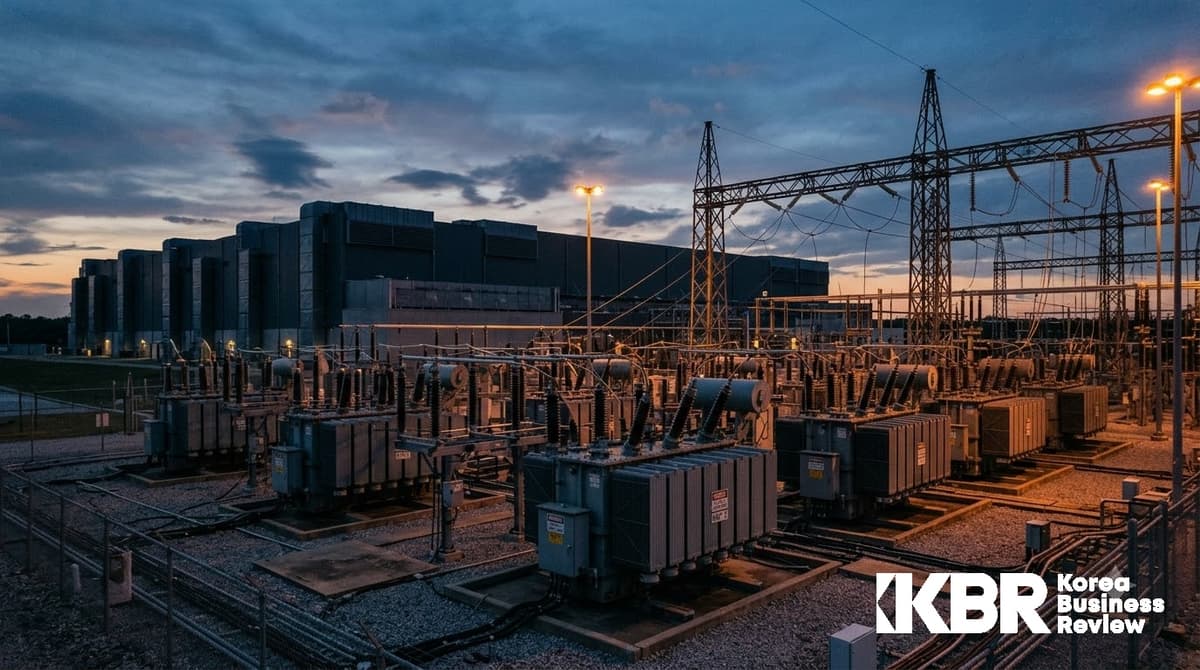
At the same time, Moody's projected that AI capacity will not keep pace with demand through 2027 because power for data centers is difficult to secure immediately and construction takes time. Securing power and grid interconnections are cited as core bottleneck factors in expanding AI data centers. At this juncture, the benefits for South Korean companies are not limited to memory. Simple aggregation of each company's Q2 2026 disclosures and earnings presentation materials shows that the order backlogs of Hyosung Heavy Industries, HD Hyundai Electric, and LS ELECTRIC exceed 36 trillion won, with operating profits standing at around 730 billion won. However, there are limitations to direct comparison as business segment scopes, consolidated versus separate accounting standards, and exchange rate application timings vary by company. Hyosung Heavy Industries saw its order backlog jump 63% year-over-year to 17.5 trillion won, prompting it to raise its annual new order target from 8.4 trillion won to 12 trillion won. HD Hyundai Electric's Q2 new orders rose 44.6% to $1.44 billion, and its order backlog increased 29.6% to $8.49 billion.
A notable shift is in the customer mix. KB Securities analyzed in a recent report that the customer base for ultra-high-voltage transformers—previously centered on North American utilities—has begun expanding to global Big Tech companies operating AI data centers. Industry estimates suggest that the lead times for certain ultra-high-voltage transformer products have lengthened from historical levels of 1 to 1.5 years to currently around 3 to 5 years. This signifies that competition is underway to secure delivery volumes for 2028 to 2030 right now. For Nvidia's 70% growth outlook to materialize, an equivalent amount of power infrastructure must be deployed at the same pace, suggesting that earnings visibility for domestic power equipment companies could be sustained even longer than the GPU cycle.
The Most Vulnerable Link: The 'Circular Financing' Debate
When assessing the sustainability of this cycle, capital flows must be examined in tandem. Nvidia has steadily expanded its investments, long-term supply agreements, and financial support for frontier AI companies. Recently, it announced a strategic partnership with Apollo, BlackRock, Blackstone, Brookfield, Goldman Sachs, and KKR to establish an independent AI computing infrastructure financing platform that will mobilize over $500 billion in third-party capital over time. This is in a promotion stage premised on final contract execution rather than a structure where capital raising is already complete.
Some market observers raise concerns that financial structures where Nvidia supports infrastructure procurement for its customer ecosystem could ultimately underpin demand for its own hardware. Conversely, Nvidia maintains that it is a third-party capital structure where financial institutions independently review and invest in infrastructure. CFO Kress addressed this debate head-on. She stated that while she knows some call this circular financing, the company sees it differently, explaining that those companies' technological leadership has been verified, customer influx and usage are surging, and they are poised to become the largest technology companies in history. CEO Huang similarly cited the point that AI has passed an inflection point and is performing genuinely useful work.
However, this debate is not a matter of optimism or pessimism, but of verification. A structure where capital builds infrastructure, infrastructure gives rise to larger models and startups, and they in turn consume infrastructure can act as a powerful flywheel—or spin in reverse if final demand is not confirmed. This is why items such as inventories, accounts receivable collection periods, and advance supply chain commitments are more crucial going forward than earnings themselves. In fact, cash outflows from working capital due to inventory increases on this quarter's cash flow statement expanded by $2.162 billion compared to the same period last year.
Five Checkpoints for Assessing 2027
From the perspective of South Korean companies and investors, this announcement is not an event that ends with the conclusion that 'Nvidia did well.' It leaves behind five observation points to gauge whether the AI infrastructure investment cycle will extend through 2027.
First is whether Q3 earnings actually achieve the $108 billion guidance. This is the first verification stretch for the 70% growth trajectory. Second is whether gross margins actually confirm a bottom at 71–72% in Q4. This serves as an indicator showing whether Nvidia has succeeded in passing on rising memory costs to customers, while inversely signaling how well memory suppliers' pricing power is maintained. Third is the 2027 capital expenditure guidance from hyperscalers. Typically disclosed during January-February earnings releases, the key is where figures land between Nvidia's estimate of $1.3 trillion and Moody's projection of $820 billion.
Fourth is power delivery schedules. If transformer lead times, grid connection backlogs, and the pace of securing power generation facilities are delayed, GPUs cannot be operated even if they are in hand. Fifth is the scale and recovery structure of circular financing exposures. It must be verified quarter by quarter whether the actual revenue growth of frontier AI companies and the scale of Nvidia's investments and guarantees grow in tandem, or if only one side expands.
In summary, this earnings report is closer to a signal that AI infrastructure demand has secured visibility of at least one year or more. However, the upper limit of that growth is now dictated not by demand, but by memory, power, and capital financing structures. For South Korean companies, all three of these are participable arenas rather than threats. Memory and power equipment have already entered supplier-favored zones, and downstream sectors such as cooling, substrates, and power semiconductors follow the same curve. The crux is not guessing how long this cycle will last, but establishing a system to read the signals of a cycle downturn earlier than anyone else.
}